Tile Roof Underlayment Replacement Cost in Florida: Warning Signs and Lift-and-Relay vs Full Replacement
Tile roof underlayment replacement cost in Florida, the warning signs from the ground and the attic, and when a lift-and-relay beats a full tear-off.
- The tile is the weather shield. The underlayment is the waterproofing. Concrete tile is rated for 50 to 75 years and clay for 75 to 100+, so the underlayment, not the tile, is what most tile roof replacements in Tampa Bay are really about.
- A lift-and-relay that salvages most of your tile usually lands below a full replacement, which runs $10 to $16 per square foot installed for concrete tile and $12 to $22 for clay in our price ranges.
- Replacing the underlayment is a reroof under the Florida Building Code. A permit, the FRSA-TRI tile manual and the 25% rule all apply, and the Ninth Edition code lands December 31, 2026.
- For insurance, roof age counts from the date 100 percent of the roof surface was built or replaced, and Citizens caps tile at 50 years before it wants documented remaining useful life.
Tile roof underlayment replacement cost in Florida comes down to how much of your existing tile survives the lift. A lift-and-relay that reuses most of the tile usually lands below a full replacement, which runs $10 to $16 per square foot installed for concrete tile and $12 to $22 for clay in our Tampa Bay price ranges.
It is landing on a lot of Tampa Bay doorsteps. Westchase, Tampa Palms in New Tampa, the lake lots off Collier Parkway in Land O’ Lakes, Countryside in Clearwater, the Mediterranean revivals off Bayshore in South Tampa: whole neighborhoods of tile went on in the 1990s and early 2000s, and the quotes are arriving now.
The Tile Is Not Your Roof. The Underlayment Is.
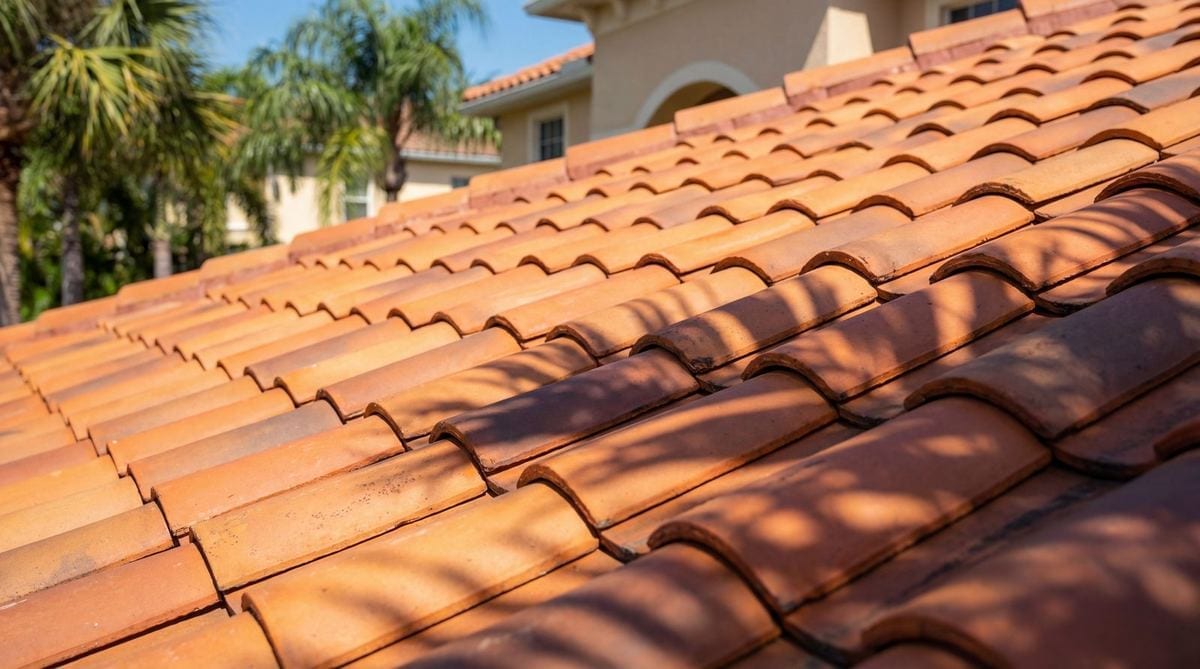
Every tile roof is two roofs. The tile you see from the street is a weather shield. The underlayment you never see, the membrane between the tile and the plywood deck, is the actual waterproofing. Wind-driven rain gets under tile by design, and the underlayment carries it to the eave.
The two layers age on different clocks. The concrete tile we install is rated for 50 to 75 years and clay for 75 to 100+, the same figures we publish alongside our installed price ranges. A barrel tile roof in Florida can outlive the people who bought it.
The underlayment does not get anywhere near that. We will not put a number on it; the honest answer depends on what was installed and how, and anyone who quotes you one lifespan is guessing. What we find when we lift tile on 20-plus-year-old roofs across Tampa Bay:
- Felt so brittle it snaps like a cracker when you fold it.
- Laps that have opened, so water rides the felt into a seam instead of over it.
- Nail holes from the original tin tags and battens, wallowed out and rust-ringed.
- Rot in the deck at the valleys, around plumbing stacks and along the eave. Everywhere water concentrates.
On the tile roofs we open up across Tampa Bay, the tile is almost never the reason we are there. The underlayment is.
A tile roof rarely dies. The waterproofing under it does, and the tile hides it until a ceiling stains. For how each material ages here, read how long a roof lasts in Florida; our tile roof repair and replacement guide covers clay versus concrete.
The Tile Looks Perfect While the Ceiling Stains
You cannot see underlayment from the ground. You can see what it does when it fails.
From the driveway:
- Slipped tiles, especially several in a row along a hip or valley. Tiles do not slide on their own.
- Debris lines. A dirt-and-leaf tide line along the eave or up a valley means water is pooling on the underlayment instead of running off.
- Cracked ridge or hip mortar with tiles rocking under it.
- A wavy drip edge or a sag at the eave. That is soft decking, which only happens after the underlayment has been leaking for a while.
From the attic:
- Stains on the ceiling or the deck directly under a valley. Valleys carry the most water and are the first place old underlayment quits.
- Daylight at the eave, where the underlayment and eave closure have rotted away.
- Soft decking, rusty nail tips or damp insulation under a plumbing stack or skylight curb.
One stain is a repair. Stains under two different valleys plus a soft eave is an underlayment conversation. The tile looks perfect through all of it, which is why owners in Tampa Palms get blindsided twenty-some years in.

Lift-and-Relay vs Full Replacement: The Salvage Talk
There are two ways to replace the underlayment on a tile roof. The difference is whether your tile goes back on.
Lift-and-relay. We lift and stack every tile, strip the underlayment to the deck, replace bad decking, install a new tested underlayment system with new flashings and drip edge, and relay your own tile with new fasteners or foam.
Full replacement. Same tear-off, same deck work, but the old tile leaves in the dumpster and new tile arrives on a truck. More expensive whenever the old tile was salvageable.
The deciding factor is breakage, and we do not know it until we lift the first few squares. Clay that has baked on a South Tampa roof since 1998 usually comes up clean. Older concrete goes chalky and brittle, and a roof that loses a tile every few feet on the lift is not worth relaying.
Then there is the matching problem. Blends get dropped, and the flat concrete profile that went on a Westchase street in 1999 may not be made by anyone anymore. Three options, walked through before anything comes off the roof:
- Salvage. A tile reclaimer or salvage yard that still has the discontinued pallets.
- Rob from the back. Pull sound tile from a slope nobody sees to relay the street-facing slopes, and finish the hidden slope with the closest current match.
- Replace. If the profile is gone and breakage is high, a full replacement stops being the expensive option and starts being the honest one.
The right answer is the one we can still defend after the first pallet comes off the roof, not the one that sounded good on the estimate.
Can a Florida roofing company do tile roof repairs without a full replacement? Constantly. A few slipped tiles, a cracked hip, a chimney that was never counter-flashed: those are roof repairs, not reroofs. Where that line falls is the subject of roof repair vs replacement in Florida.
The Code Already Chose Your Underlayment for You
A lift-and-relay is a reroof in the eyes of the code. Not a repair. Permit, inspections, and the current standard, which for tile in Florida means the FRSA-TRI manual.
Under the 8th Edition (2023) Florida Building Code, the referenced standard for tile is the 7th Edition FRSA-TRI Florida High Wind Concrete and Clay Tile Installation Manual, which moved tile underlayment to a tested, performance-based approach and removed the prescriptive two-ply hot-mop references from the design flowchart. The tin-tagged 30-pound felt and hot-mopped cap sheet we find under so many 1990s tile roofs is no longer the default.
The next code is already written. The 2026 Florida Building Code, Ninth Edition, takes effect December 31, 2026. Its steep-slope changes put the drip edge over the underlayment and allow a self-adhering underlayment complying with ASTM D1970 over a primed drip edge flange; tile still references the FRSA-TRI manual. The eave is where we find the first leak, and the code is tightening exactly there.
For the quote in your hand, that means:
- No permit line is a red flag. Reroof permits run $150 to $350 in Hillsborough, $175 to $400 in Pinellas and $125 to $300 in Pasco in our county breakdown.
- The underlayment line should name a product and a system.
- New flashings, valley metal and drip edge are part of the job, not an upsell.
A relay is a reroof. Permit, code, inspections. Anyone telling you otherwise is planning to skip something.
Not sure what is under your tile?
We lift a few tiles at the valleys and the eave, photograph the underlayment, put everything back and hand you a written repair-or-relay recommendation. Free, same-week, across Tampa Bay.
Tile Roof Underlayment Replacement Cost: Our Price Basis
How we price the options, in the ranges on our estimate page:
| Option | What is replaced | When it makes sense | Our price basis |
|---|---|---|---|
| Spot repair | A few tiles, a hip or ridge section, a flashing | Underlayment is sound and the leak is local | Small repairs $300 to $800; medium (valley, chimney flashing) $800 to $2,500 |
| Lift-and-relay | Underlayment, flashings, drip edge, bad decking; your tile goes back on | Tile is sound, breakage is low, profile is available or salvageable | Per roof, usually below a full replacement; depends on how much tile survives |
| Full replacement, concrete | Everything to the deck plus new concrete tile | Tile is brittle or discontinued with no salvage | $10 to $16 per square foot installed |
| Full replacement, clay | Everything to the deck plus new clay tile | Same triggers on a clay roof | $12 to $22 per square foot installed |
Why does a relay land below a full replacement? Because the tile is the biggest material line, and a relay does not buy it. You pay for underlayment, flashing, fasteners, deck repairs, replacement tiles and the labor to handle every tile twice. That labor is more than a straight tear-off, but where most of the tile survives, the tile you did not buy usually outweighs it. We do not put a percentage on the gap; it moves with breakage and profile availability.
For scale, Angi’s 2026 national data puts an installed tile roof at $8,500 to $26,400. Run our concrete range across our rule of thumb, a 2,000 square foot home carrying about 2,400 square feet of roof, and a full concrete tile replacement here is $24,000 to $38,400 before the permit. Florida’s wind zone and tested underlayment systems are why our ranges sit above the national middle.

How the 25% Rule and Insurance Roof Age Treat a Relay
Two rules written with shingle roofs in mind land hard on tile owners.
The 25% rule. The Florida Building Code says “not more than 25 percent of the total roof area or roof section of any existing building or structure shall be repaired, replaced or recovered in any 12-month period unless the roof covering on the entire existing roof system or roof section is replaced or recovered to conform to the requirements of this code.” SB 4-D, effective May 27, 2022, added an exception for roofs built or replaced under the 2007 FBC or later: only the repaired, replaced or recovered portion has to meet the code in effect. The 2007 FBC was not effective until March 1, 2009, so a 2005 build in Land O’ Lakes does not get the exception.
So you cannot “just do the leaking slope” on an older tile roof and call it a repair if that slope is more than a quarter of the section. The mechanics are in the Florida 25% roof rule explained.
Roof age for insurance. Florida’s s. 627.7011 says an insurer “may not refuse to issue or refuse to renew a homeowner’s policy insuring a residential structure with a roof that is less than 15 years old solely because of the age of the roof.” At 15 years and older, the insurer must allow a roof inspection by an authorized inspector at your expense before requiring replacement, and it may not refuse solely because of roof age if the inspection indicates 5 years or more of useful life remaining. Roof age is calculated from “the last date on which 100 percent of the roof’s surface area was built or replaced.”
Read that last line twice. A relay strips the whole roof to the deck and re-covers it under a permit, with your old tile going back on top. Whether a carrier treats that as a replacement for roof-age purposes is the carrier’s call, and we will never tell you what your insurer will decide. What we do is make the question easy to answer: permit, final inspection, dated photos of the bare deck and new underlayment, and an invoice that reads “reroof,” not “repair.”
Citizens. Citizens sets a maximum roof age of 50 years for tile, slate, concrete or metal roofs, against 25 years for shingle. Roofs past the maximum can qualify with documentation of remaining useful life, a minimum Citizens moved from three years to five, and coverage on that basis is extended for up to five years at most. And from the same bulletin: where a roof was not replaced all at once, “the roof age will be based on the oldest part of the roof.”
the maximum roof age Citizens allows for tile, slate, concrete and metal roofs before it requires documented remaining useful life
Source: Citizens Property Insurance Corporation, roof rule changes bulletin (March 2023)Fifty years is Citizens’ ceiling for a tile roof, not a promise that yours will get there.
Put those together and the “do one slope” plan gets expensive twice: it can trigger the 25% rule, and it pins your roof age to the oldest section. If you are inside the 15-year window, we wrote the Florida 15-year roof rule for that. Our role is documentation. We do not adjust or handle claims, and we never promise what an insurer will do with the paperwork.
Three to Five Days on the Roof, and What We Photograph
On a tile job our crews typically schedule three to five working days on the roof, plus material lead time. A big two-story with a dozen hips and valleys runs longer, and rain days do not count. The permit-to-final calendar is longer than the on-roof time, so plan in weeks.
Day two, the underlayment day, decides whether the roof lasts, and it is the day we photograph the most. Once the tile is back down, nobody sees the waterproofing again for decades. The photos are the only proof.
What leaves our office on every relay, insurance or not:
- Before photos of every slope and the attic.
- The bare deck after tear-off and every sheet we replaced.
- The underlayment laps, drip edge sequence, valleys and penetrations before a single tile goes back on.
- The permit number, inspection results and final, plus an itemized estimate and invoice with measurements.
- If a storm claim is in play, we meet the adjuster on site with the same file. That is insurance documentation support. The claim is yours and the decision is the carrier’s.

Your Tile Roof Is Past 20. Do These Three Things.
If your tile went on in the 1990s or early 2000s and nobody has ever lifted it:
- Walk the attic with a flashlight after the next hard rain. Under the valleys, along the eaves. Stains, daylight, damp insulation.
- Get the roof lifted, not just looked at. An inspection that never pulls a tile is a driveway inspection. We pull a few, photograph the underlayment, put them back and give you a written recommendation. Free.
- Get the salvage conversation in writing before you sign. Expected breakage, where replacement tile comes from, what happens if your profile is discontinued.
Tile is what we do. Our tile roofing crews relay and replace clay and concrete across all six Tampa Bay counties; our Tampa tile roof page covers the neighborhoods we work most. Integrity Roofing of Florida is a Florida-licensed contractor, license CCC1334243, TAMKO Pro Gold and GAF-certified, BBB A+ rated. If the answer is a full roof replacement, we will show you the photos that made the case, not just the number.
Get a straight answer on your tile roof.
Free inspection across Tampa Bay. We photograph the tile and the underlayment under it, price the relay and the replacement side by side, and put the recommendation in writing.
Frequently Asked Questions
How much does tile roof underlayment replacement cost in Florida?+
It depends on whether your tile goes back on. A lift-and-relay that salvages most of the existing tile usually costs less than a full replacement, because the tile, the biggest material line on the roof, is not bought again. Our installed ranges for a full replacement are $10 to $16 per square foot for concrete tile and $12 to $22 for clay. Breakage, profile availability and roof complexity decide where a relay lands, so we price it per roof after lifting a few tiles.
How long does tile roof underlayment last in Florida?+
There is no honest single number. It depends on the product, the installation, and how much heat and water the roof has taken. What we can say is what we find on 20-plus-year-old tile roofs across Tampa Bay: brittle felt, open laps, rusted nail holes and rot at the valleys and penetrations, under tile that still looks new. Concrete tile is rated for 50 to 75 years and clay for 75 to 100 or more, so the underlayment, not the tile, sets the life of the roof.
Can you replace the underlayment without replacing the tile?+
Yes. That is a lift-and-relay. We lift and stack your tile, strip the old underlayment to the deck, replace any soft decking, install a new tested underlayment system with new flashings and drip edge, then relay your own tile with new fasteners. Broken tiles are replaced from salvage stock or a matching order. It works when the tile is sound and the profile is still available or salvageable. Brittle or discontinued tile can push the job to a full replacement.
Does a lift-and-relay reset my roof age for insurance?+
Florida law calculates roof age from the last date on which 100 percent of the roof's surface area was built or replaced. A relay strips the whole roof to the deck and re-covers it under a permit, but your tile goes back on, and how a particular carrier treats that is the carrier's decision. We never promise an insurance outcome. What we do is document the job with a permit, a final inspection, dated photos of the deck and new underlayment, and an itemized reroof invoice.
What underlayment does the Florida Building Code require under tile?+
Tile installations in Florida follow the FRSA-TRI Florida High Wind Concrete and Clay Tile Installation Manual, which the 8th Edition code references and which moved underlayment to tested, performance-based systems instead of a prescriptive two-ply hot mop. The 2026 Ninth Edition, effective December 31, 2026, requires the drip edge over the underlayment and allows an ASTM D1970 self-adhering underlayment over a primed drip edge flange. Your quote should name the underlayment system, and a relay always needs a permit.
How long does tile roof underlayment replacement take?+
Our crews typically schedule three to five working days on the roof for a tile job, plus material lead time. The permit-to-final calendar is longer than the on-roof time, so plan in weeks once the permit application, the tile or salvage order and the inspections are counted. Large two-story roofs with many hips and valleys, discontinued profiles that need salvage, and rain days all stretch the schedule, which is why we quote the on-roof days and the calendar separately.
What happens if my tile profile has been discontinued?+
We tell you before anything comes off the roof. The options are salvage from a tile reclaimer, moving sound tile from a hidden rear slope to the street-facing slopes and finishing the hidden slope with the closest current match, or a full replacement when breakage is high and no match exists. The right choice depends on how much tile survives the lift, so we confirm the plan with you after the first section comes up.
Want a real estimate on your Tampa Bay roof?
Enter your address and we'll pull satellite measurements instantly.
Mike Shepherd · Co-Owner, Integrity Roofing of Florida
Mike Shepherd co-owns Integrity Roofing of Florida with Bettina Savorelli. The company is a Florida-licensed roofing contractor (license CCC1334243), a TAMKO Pro Gold and GAF-certified installer, and a BBB A+ rated business serving Hillsborough, Pinellas, Pasco, Polk, Manatee and Sarasota counties. His crews install and repair tile, metal and shingle roofs across Tampa Bay and document storm damage for homeowners' insurance claims. Every article is written from the field, not from a content desk.
Ready to talk to a real human?
No phone tree, no pressure. Owner-level attention on every call.