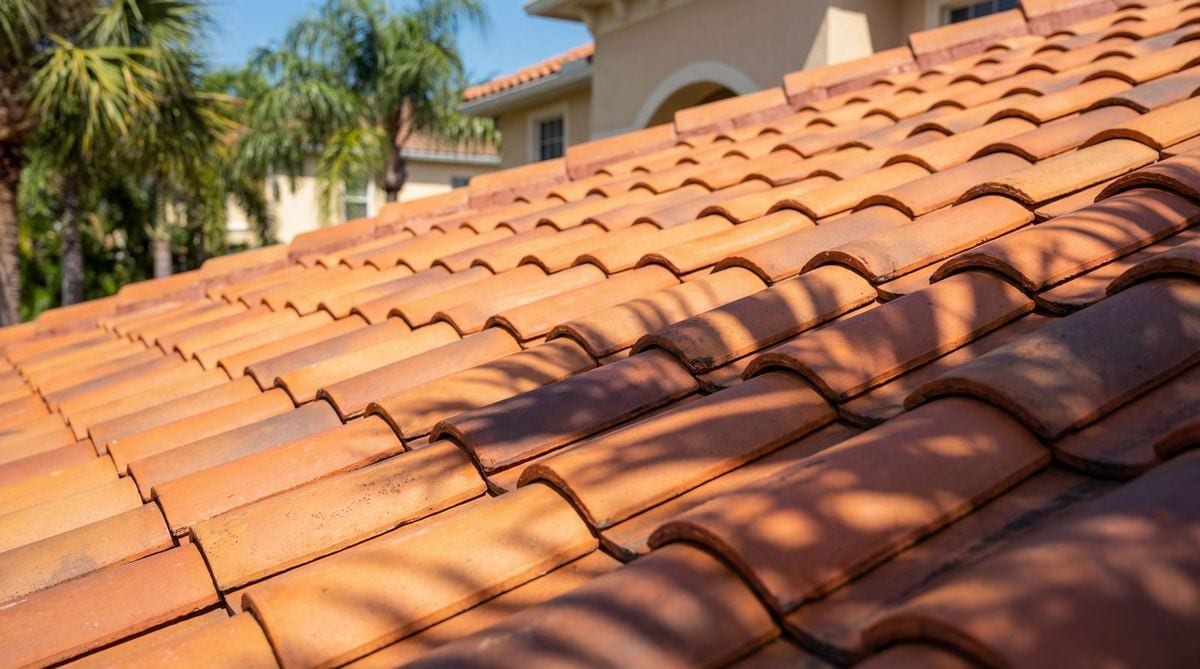
Tile Roof Repair & Replacement in Florida: Costs, Lifespan & What to Expect
Clay vs. concrete, lifespan vs. underlayment life, and how to tell if your Florida tile roof actually needs replacing. Or just a careful repair. From real Tampa Bay roofers who've done both.
- Tile roofs are a two-layer system. Tiles last 50-100 years, but underlayment lasts only 20-25 years in Florida. Most tile roofs are replaced because of underlayment failure, not tile failure.
- Clay tile runs $15-$25/sq ft installed and lasts 75-100+ years; concrete tile is $10-$18/sq ft and lasts 40-50 years before the tile body itself gets brittle.
- Properly installed tile can survive 150+ mph wind uplift. But only with modern fastening (screws, clips, or foam adhesive) and a premium two-layer underlayment system.
- If your tile roof is 15+ years old and the underlayment has never been replaced, get it inspected. You're one bad storm away from your first leak.
Drive through any Florida neighborhood built after 1985 and look up. Odds are, more than half the roofs you see are tile. Barrel-shaped clay in the older Mediterranean-style homes, flat or low-profile concrete in the newer builds. Tile is, without exaggeration, the defining roof of the state. And yet most homeowners who own one don’t really understand what they have, how long it’s actually supposed to last, or why the quote they just got for a “tile roof replacement” is $38,000 instead of the $12,000 their neighbor paid for shingles.
This is the guide we wish every Florida tile homeowner read before the first hailstorm, the first leak, or the first insurance adjuster knocked on the door. It covers what tile actually is (clay vs. concrete. They are very different products), how long it really lasts in our climate (hint: the tile lives far longer than the roof system underneath it), when repair makes more sense than replacement, and what a proper Florida tile install is supposed to look like under the hood.
1. Why Tile Dominates Florida Roofs
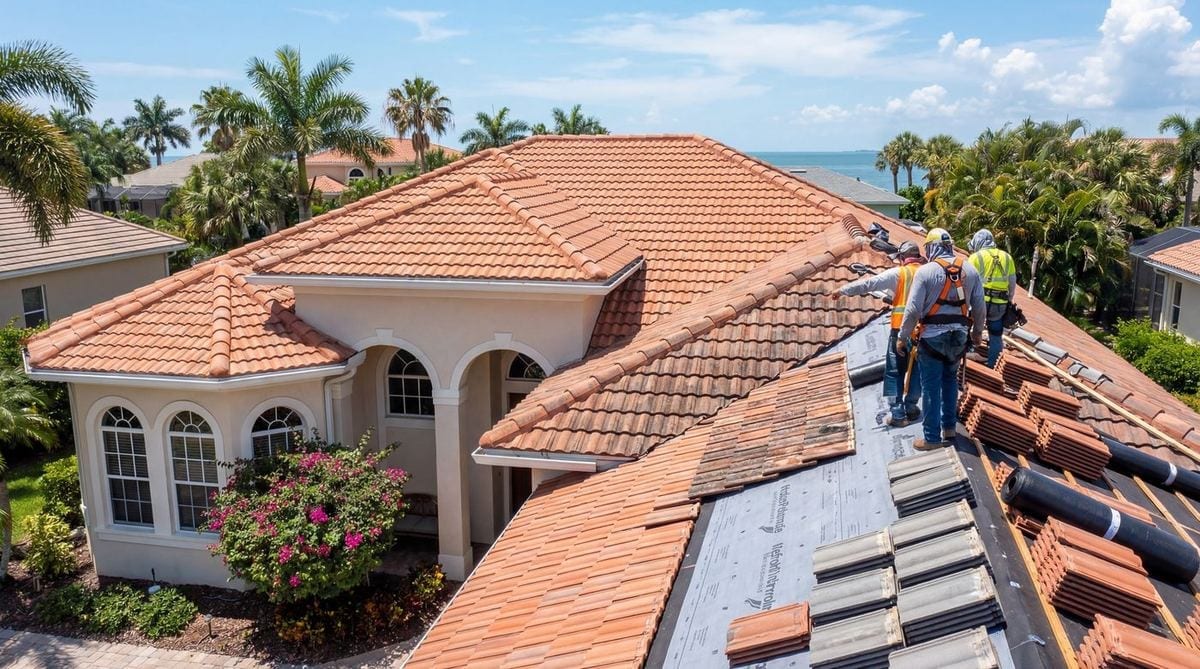
Tile became the default Florida roof for four reasons, and they all still hold up in 2026.
Hurricane performance. When installed to current Florida Building Code standards, tile roofs have some of the highest uplift ratings of any residential roof covering. The Florida Building Code requires tile to be mechanically fastened (screws, clips, or foam adhesive. No more mortar-set-only tiles on new builds in High-Velocity Hurricane Zones), and properly installed tile has survived Category 4 and 5 storms that stripped asphalt shingles off adjacent houses. The Insurance Institute for Business & Home Safety (IBHS) has repeatedly documented tile’s strong post-storm performance when the underlayment and fastening are done right.
Heat reflection. Clay and concrete tile both have high thermal mass and, critically, a ventilated air gap under the tile itself. That gap acts as a radiant barrier. According to the Tile Roofing Industry Alliance (formerly TRI, now TRIA), tile roofs can reduce attic heat transfer by up to 70% compared to direct-deck shingles. In a Tampa summer, that’s a real number on the power bill.
Longevity. The tile itself. Not the roof system, the tile. Is rated for 50+ years on concrete and 75-100+ years on clay. Most other roof coverings are replaced twice in the life of one tile roof.
Aesthetics and resale. Mediterranean, Spanish Colonial, and Florida Contemporary architecture are all built around a tile roofline. Replacing tile with shingles on a home designed for tile almost always hurts resale value in Florida’s premium neighborhoods.
2. Clay Tile vs. Concrete Tile: The Real Differences (Zone 1)
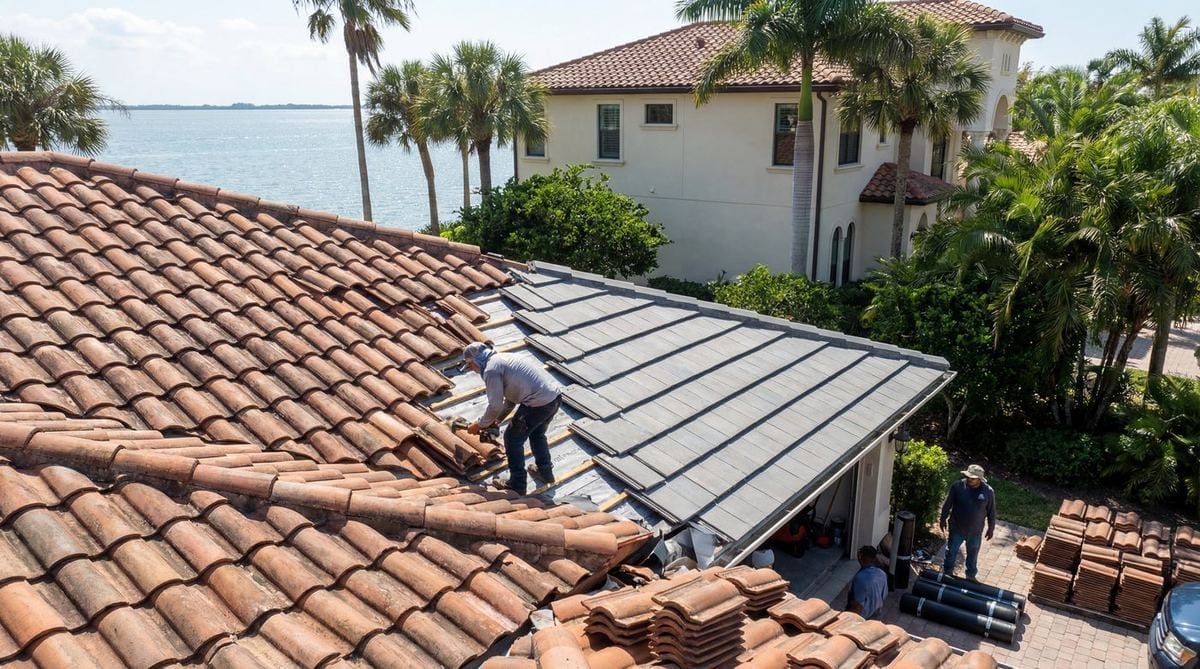
Here is where most homeowners get confused. “Tile is tile,” they assume. It is not. Clay and concrete tile are two fundamentally different products with different costs, weights, lifespans, and failure modes.
Clay tile is kiln-fired natural clay. Essentially a ceramic. The color is baked into the material itself and does not fade. Eagle Roofing Products and other manufacturers rate quality clay tile for 75+ years, and there are clay roofs in Europe still in service after 150 years. Clay is heavier per square foot of raw material but is typically formed in barrel (Mission, Spanish S) profiles that use less coverage material, so the installed weight is roughly comparable to concrete.
Concrete tile is cement, sand, and iron oxide pigment pressed in molds. Color is applied to the surface. Not through the body. Which means concrete tile can fade noticeably after 20-25 years of Florida UV. Concrete is less expensive upfront, typically heavier per installed square (about 900-1,100 lbs per 100 sq ft vs. 600-900 for clay barrel), and has a shorter realistic service life of 40-50 years before the tile body itself becomes brittle and porous.
- Cost: $10-$18/sq ft installed
- Weight: 600-650 lbs per square (100 sq ft)
- Lifespan: 50-100+ years
- Color: natural terracotta tones, limited palette
- Weather: excellent in heat; can crack in freeze
- Traditional Mediterranean aesthetic
- Cost: $8-$14/sq ft installed
- Weight: 900-1,200 lbs per square (structural check needed)
- Lifespan: 40-50 years
- Color: wide palette including colors that mimic clay, wood, or slate
- Weather: strong in heat and wind; color may fade over time
- Works with any Florida architectural style
Clay vs. Concrete Tile Comparison
| Factor | Clay Tile | Concrete Tile |
|---|---|---|
| Material cost (installed) | $15-$25 per sq ft | $10-$18 per sq ft |
| Weight (per sq ft) | 6-10 lbs | 9-12 lbs |
| Realistic lifespan | 75-100+ years | 40-50 years |
| Color permanence | Permanent (fired-through) | Surface pigment fades in 20-25 years |
| Hurricane rating (installed to FBC) | Up to 150+ mph uplift | Up to 150+ mph uplift |
| Aesthetics | Warmer, richer patina over time | Uniform initially, fades unevenly |
| Water absorption | ~6% | ~13% (heavier when saturated) |
| Maintenance | Low | Low to moderate |
| Best for | Mediterranean, Spanish Colonial, premium resale | Budget-conscious, modern/contemporary |
The weight difference matters more than it sounds. Florida homes designed for tile have trusses engineered for tile loads. A home originally built for shingles usually cannot take concrete tile without a structural engineer’s sign-off. This is one of the first things any honest Florida roofer will check before quoting a “switch to tile.”
3. How Long a Tile Roof Actually Lasts in Florida (Zone 1. Underlayment is the real lifespan)
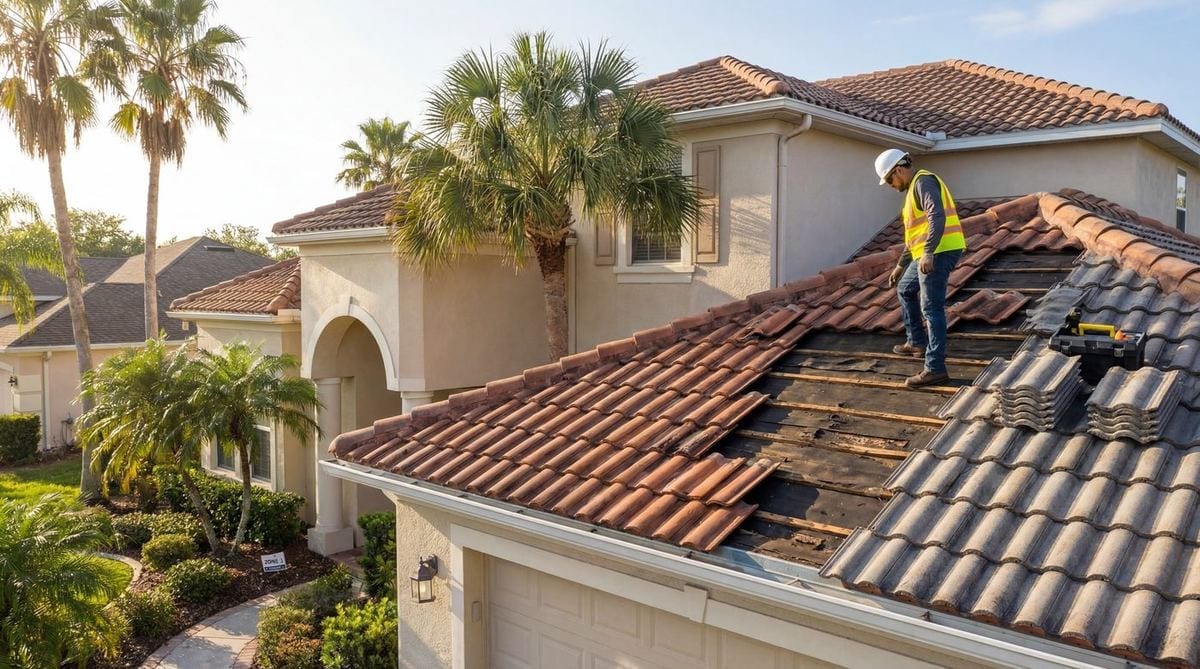
This is the single most important concept in this entire guide, and it’s the thing homeowners almost never hear from manufacturers’ marketing: the tile is not the roof.
A tile roof is a two-layer system. The tiles are the weather-facing armor. They shed the bulk of the water, they take the UV beating, they take the impact. But what actually waterproofs the house is the underlayment. The layer of synthetic membrane or tin-tag felt installed on top of the plywood deck, underneath the tile. In a properly installed tile roof, water that gets past the tile (and some always does. Wind-driven rain, capillary action, cracked tiles, valley overflow) is caught by the underlayment and drained off before it reaches the wood.
Here’s the problem: the tile lasts 50-100 years. The underlayment lasts 20-25 years in Florida, maximum.
The National Roofing Contractors Association (NRCA) and the Tile Roofing Industry Alliance both publish guidance confirming that standard 30-lb asphalt-saturated felt underlayment in a Florida climate has a service life of roughly 20 years. Premium synthetic underlayments (self-adhered modified bitumen, high-temp peel-and-stick) can push that to 30-40 years, but even the best synthetics eventually break down from the heat trapped between the plywood and the tile, which can exceed 170°F on a July afternoon.
What this means in practice:
- If your tile roof is 15-20 years old and you’ve never had the underlayment replaced, you are approaching the end of the waterproofing system’s life regardless of how the tiles look from the driveway.
- If your tile roof is 25+ years old, you are on borrowed time. You may not be actively leaking, but you are one bad storm away from it.
- If a roofer tells you your 20-year-old tile roof is “good for another 30 years because the tiles look great,” they are either uninformed or not being straight with you.
This is also why salt air matters in Florida more than people realize. Coastal homes. Clearwater Beach, St. Pete Beach, Tierra Verde, Apollo Beach. Get accelerated underlayment degradation from salt exposure entering through the natural ventilation gap under the tile. The tile itself shrugs off salt. The felt underneath does not.
4. When to Repair Individual Tiles vs. Redo the Whole Roof (Zone 2)
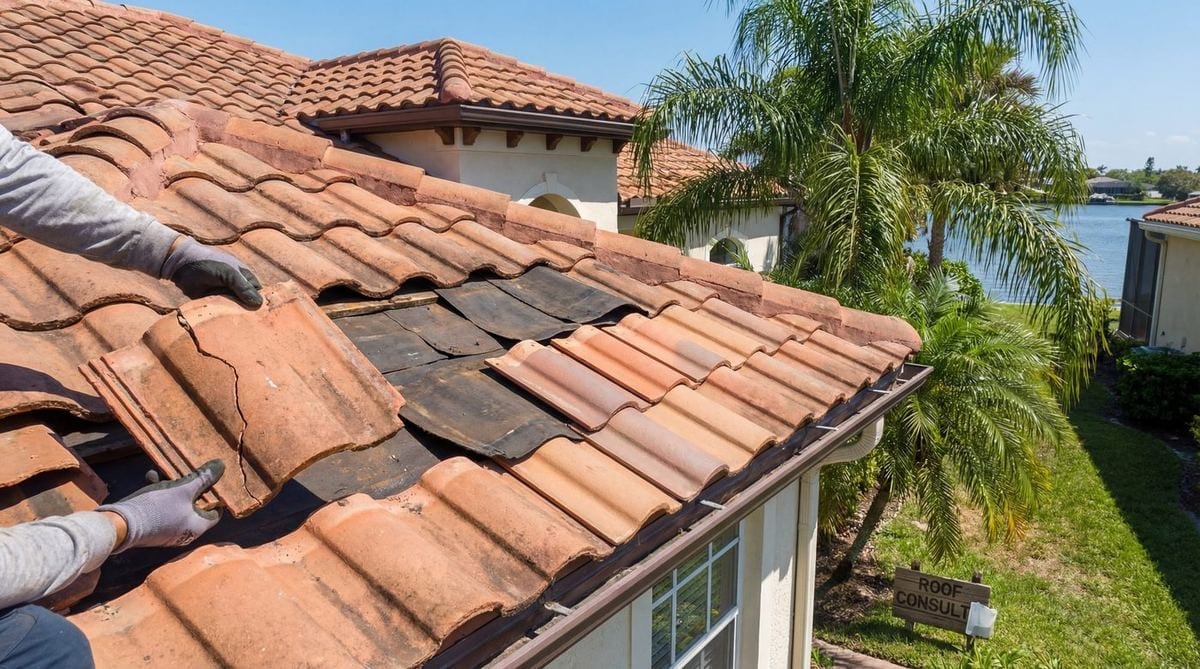
I’ve walked roofs in this state for long enough to develop a rough rule of thumb, and here it is: if the underlayment is sound, repair. If the underlayment is failing, replace. The tiles are almost never the deciding factor.
A handful of broken or slipped tiles from foot traffic, a fallen palm frond, or a hailstorm is a tile roof repair job. Usually a few hundred to a couple thousand dollars depending on access and tile availability. Replacement tiles can be sourced for most profiles, and a good tile roofer keeps a “boneyard” of salvaged tiles from tear-offs for exactly this reason. If you search “tile roof repair near me” and someone quotes you $15,000 to fix six broken tiles, walk away.
Here are the signs I look for that push the call from “repair” to “replace the underlayment”:
- Active leaks in multiple, unrelated areas of the house. One leak is a localized failure. Three leaks in three different rooms almost always means the underlayment is generally shot.
- Visible staining, drip lines, or daylight when you look up at the plywood from inside the attic.
- Underlayment age of 20+ years with standard 30-lb felt, or 30+ years with synthetic.
- Deck deterioration. If plywood is soft, stained, or sagging, the water has been getting through for a while.
- Widespread tile damage after a major storm. Not individual tiles, but ridges, hips, and field tiles displaced across large sections.
And here’s the part that surprises homeowners: most “tile roof replacements” in Florida are not actually replacing the tile. They are tile-off, underlayment-replacement, tiles-back-on jobs. A careful contractor will remove your existing tiles, stack them on pallets on the ground, tear off the old underlayment, install new decking where needed, install new premium underlayment (ideally a two-layer self-adhered system), and reinstall your original tiles with new fasteners. You lose maybe 5-10% of tiles to breakage during removal, and those get filled in from salvage stock or new matching tiles.
The result is a “new” roof with a 25-30 year waterproofing life and tiles that still have 30-60 years left in them. This is the right way to handle a tile roof replacement and extend a tile roof’s life, and it’s usually 30-40% cheaper than buying all-new tile.
Is your tile roof due for repair or replacement?
Free inspection. We photo-document the tile surface AND the underlayment beneath. So you know what you're actually paying for.
5. What a Proper Florida Tile Install Looks Like (Zone 2)
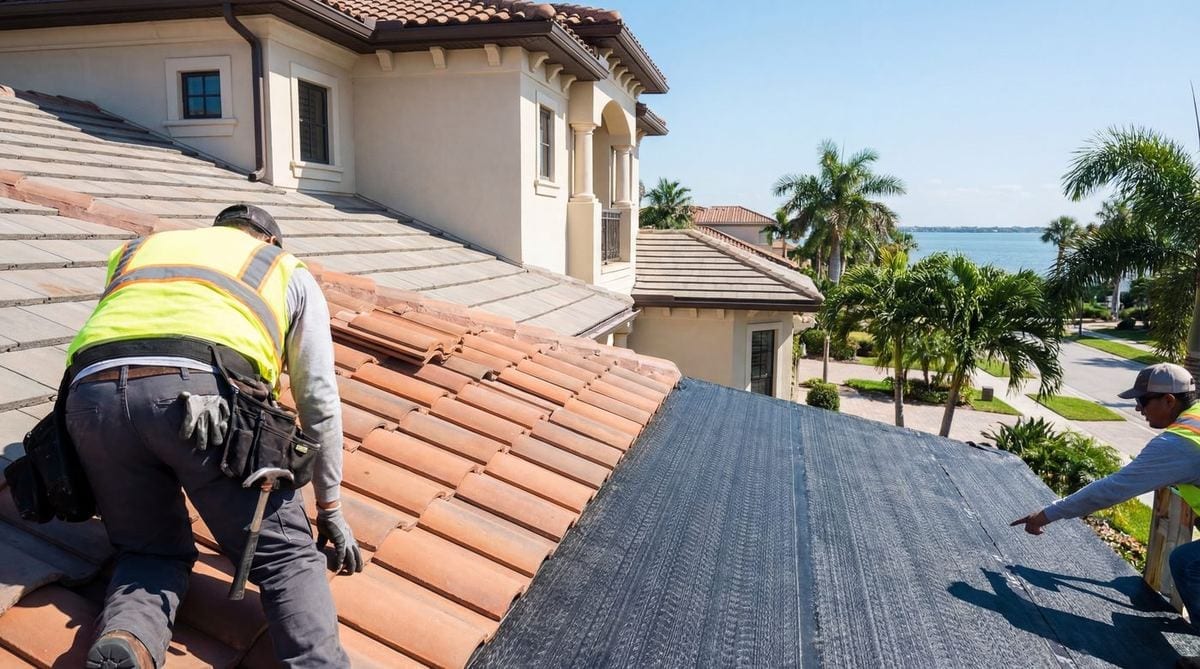
The difference between a tile roof that lasts 30 years and one that fails in 12 is almost entirely in the install. Here is what we look for. And what we do. On every tile job:
Deck prep. Every sheet of plywood gets inspected. Any soft, delaminated, or water-stained decking gets replaced, not painted over. Re-nail the deck to current Florida Building Code fastening schedules (8d ring-shank, 6-inch edge / 6-inch field in High-Velocity Hurricane Zones).
Underlayment. The most important decision on the whole roof. For Florida, we specify a two-layer system: a self-adhered modified-bitumen base sheet (peel-and-stick) directly on the deck, covered by a high-temperature synthetic cap. This is more expensive than standard 30-lb felt, and it is the reason our underlayment warranties go 30 years instead of 20. Skipping this is the single most common corner-cut in the Florida tile industry.
Flashing. Valleys, chimneys, skylights, wall intersections, and plumbing penetrations all get new metal flashing. Typically 26-gauge galvanized or, in coastal zones, aluminum or copper. Reusing old flashing is a warranty-void move, and it’s the source of more tile roof leaks than the tile itself.
Tile fastening. Per Florida Building Code, every field tile in a High-Velocity Hurricane Zone must be mechanically fastened. Two screws and a foam adhesive pad, or clip systems depending on the profile. Ridge and hip tiles get fastened with stainless-steel screws through pre-drilled holes into a nailer board, set in mortar or with a ridge-attachment system. The old mortar-only installs from the 1980s do not meet current code and are a primary failure point in older roofs.
Birdstop and eave closures. The open ends of barrel tiles at the eaves need to be closed off with birdstop. Otherwise pests, wasps, and wind-driven rain get into the underlayment cavity. Every tile roof we do gets proper birdstop. You’d be surprised how many don’t.
6. Tile Roof Repair & Replacement Cost in 2026 (Zone 2)
Florida pricing ranges, based on what we’re seeing in Tampa Bay in Q1-Q2 2026 and consistent with national cost data from HomeAdvisor and Angi:
| Job Type | Typical Cost Range (2026) |
|---|---|
| Individual tile repair (1-10 tiles) | $350 - $1,500 |
| Slipped tile reset / ridge repair | $500 - $2,500 |
| Section underlayment repair (under 100 sq ft) | $1,500 - $4,500 |
| Full tile-off / underlayment replace / tiles reset (2,000 sq ft concrete) | $22,000 - $32,000 |
| Full tear-off and all-new concrete tile (2,000 sq ft) | $28,000 - $42,000 |
| Full tear-off and all-new clay tile (2,000 sq ft) | $38,000 - $58,000 |
| Shingle-to-tile conversion (including structural) | $45,000 - $70,000+ |
Insurance claims: if hurricane or hail damage is involved, the insurance company pays actual cash value or replacement cost depending on your policy. Florida’s insurance climate is brutal in 2026, and adjusters have gotten aggressive about declaring tile roofs “repairable” when homeowners believe they need replacement. This is exactly where the underlayment-age conversation matters most. A 22-year-old tile roof with spot damage is usually a full-replacement claim, not a patch, because the underlayment is at end of life. A good public adjuster or a roofer who knows how to write a proper scope can make a five-figure difference on that claim.
7. Common Tile Problems We See in Tampa Bay (Zone 3)
After years of climbing Tampa Bay tile roofs, these are the five issues we find on nearly every inspection:
- End-of-life underlayment on roofs built in the late 1990s and early 2000s. The homeowners see no leaks and assume they’re fine. They’re usually 2-3 years from their first leak.
- Cracked ridge and hip tiles from old mortar-set installs. Mortar shrinks and cracks over 20 years. Water gets in, rusts the nails, and the ridge line starts walking.
- Missing or degraded birdstop at the eaves, usually with wasp nests and a thick layer of debris on top of the underlayment at the drip edge.
- Foot-traffic damage from prior contractors. Cable guys, solar installers, AC techs. Who walked the roof without knowing how to step on a tile roof. (Step on the lower third of the tile where it’s supported by the one below. Never the unsupported center.)
- Substandard flashing at chimneys and skylights, reused from previous installs or never properly counter-flashed to begin with.
The good news: every one of these is either a repair or a planned-out tile-off underlayment job. Tile roofs almost never need to be thrown away. They need to be maintained correctly, and the underlayment needs to be refreshed once per generation.
8. Get Your Free Tile Roof Inspection (Zone 3 CTA)
If your Tampa Bay tile roof is 15+ years old, if you’ve had a leak, if you’re buying or selling a home with tile, or if an insurance adjuster just handed you a repair scope that feels too small for the damage. Get a second set of eyes on it.
At Integrity Roofing of Florida, tile is what we do. Our inspections include:
- A full walk of the roof (when safely accessible) plus drone imaging of every slope
- Underlayment age and condition assessment, not just a tile count
- Attic inspection for moisture, staining, and deck condition from the underside
- Honest repair-vs-replace recommendation, in writing, with photos
- Free estimate. No obligation, no hard sell, and if repair is the right call we’ll tell you
We’ve been installing and repairing tile across Tampa, St. Pete, Clearwater, Brandon, and the surrounding Bay area for years. We’re licensed, insured, and every job is supervised by an owner who still walks roofs. If you want a straight answer about your tile roof, call us or request an estimate online. We’ll show up, give you the real story, and leave you with enough information to make the right decision. Whether you hire us or not.
Ready to get started? Request your free tile roof inspection or call us directly. We answer the phone. We show up when we say we will. And we only recommend the work your roof actually needs.
Get a straight answer about your tile roof.
Free, no-obligation inspection across Tampa, St. Pete, Clearwater, and Brandon. We'll photo-document tiles and underlayment, and tell you whether it's a repair or a replacement. In writing.
Want a real estimate on your Tampa Bay roof?
Enter your address and we'll pull satellite measurements instantly.
The Integrity Roofing Team · Florida Roofing Experts · Licensed & Insured
The Integrity Roofing of Florida team installs and repairs tile, metal, and shingle roofs across Tampa Bay. With decades of combined field experience, we've helped more than a thousand homeowners navigate hurricane-damage claims, material choices, and the gap between what's marketed and what actually holds up in Florida conditions. Every post is written by working Florida roofers. Not content writers.
Ready to talk to a real human?
No phone tree, no pressure. Owner-level attention on every call.