Florida's 15-Year Roof Rule: How Old Can Your Roof Be for Insurance? (2026)
How old can a roof be for insurance in Florida? What s. 627.7011 says at 15 years, Citizens' 25 and 50 year caps, and how to pass the roof inspection.
- Florida law says a carrier cannot refuse to write or renew solely because a roof is under 15 years old. At 15 or older, an inspection showing 5 or more years of useful life takes age off the table as the sole reason.
- Roof age counts from the date 100 percent of the surface was replaced. A partial re-roof, however recent, does not reset it.
- Citizens uses harder numbers: 25 years for shingle, 50 years for tile and metal, a 5-year minimum of remaining life past those caps, and coverage extended for up to five years.
- Between years 15 and 20 you have two plays: repair to pass the inspection, or replace and collect wind mitigation credits on the new roof.
How old can a roof be for insurance in Florida? An insurer cannot refuse to write or renew a policy solely because a roof is under 15 years old. At 15 or older, you can hire an authorized inspector, and if the report shows 5 or more years of useful life, age alone cannot be the reason for refusal.
That is s. 627.7011(5), and it matters more in Tampa Bay than almost anywhere, because the roofs that went on during the 2004 to 2007 building boom are now 19 to 22 years old and the 2007 to 2011 re-roofs are crossing the 15-year line right now. If you are not sure how many years your roof has left, read our guide to how long a roof lasts in Florida, then come back here for the insurance side.
How old can a roof be for insurance in Florida? The statute
Most of what gets repeated about the 15-year rule on Nextdoor is half right. Here is the actual statute, s. 627.7011(5), in its own words.
An insurer “may not refuse to issue or refuse to renew a homeowner’s policy insuring a residential structure with a roof that is less than 15 years old solely because of the age of the roof.”
For a roof that is “at least 15 years old, an insurer must allow a homeowner to have a roof inspection performed by an authorized inspector at the homeowner’s expense before requiring the replacement of the roof.”
And the line that matters most. The insurer “may not refuse to issue or refuse to renew a homeowner’s insurance policy solely because of roof age if an inspection … indicates that the roof has 5 years or more of useful life remaining.”
Three things people miss.
The clock. Roof age is calculated from “the last date on which 100 percent of the roof’s surface area was built or replaced.” A 2019 patch on the back slope of a 2006 roof does not make it a 2019 roof. It is a 2006 roof with a patch.
The word “solely.” The statute stops a carrier from refusing you on age alone. It does not stop a refusal for a roof in bad condition, a claims history, or a dozen other underwriting reasons. Age is one door, and the inspection closes it.
The date. The Legislature enacted the rule in 2022 as part of SB 2-D. It applies to policies issued or renewed on or after July 1, 2022. A letter from before that may have been legal at the time. The next one has to follow the current law.
The statute says 5 years of useful life. Not “looks fine from the driveway.” Not “no leaks yet.” Five documented years.
of remaining useful life is the threshold an inspection must show before an insurer can be stopped from refusing a policy on roof age alone
Source: Florida Statutes s. 627.7011(5), Online SunshineWhat a roof condition inspection actually checks

This is the part almost nobody writes about, because the people writing about the 15-year rule are insurance agents, not the ones on the ladder.
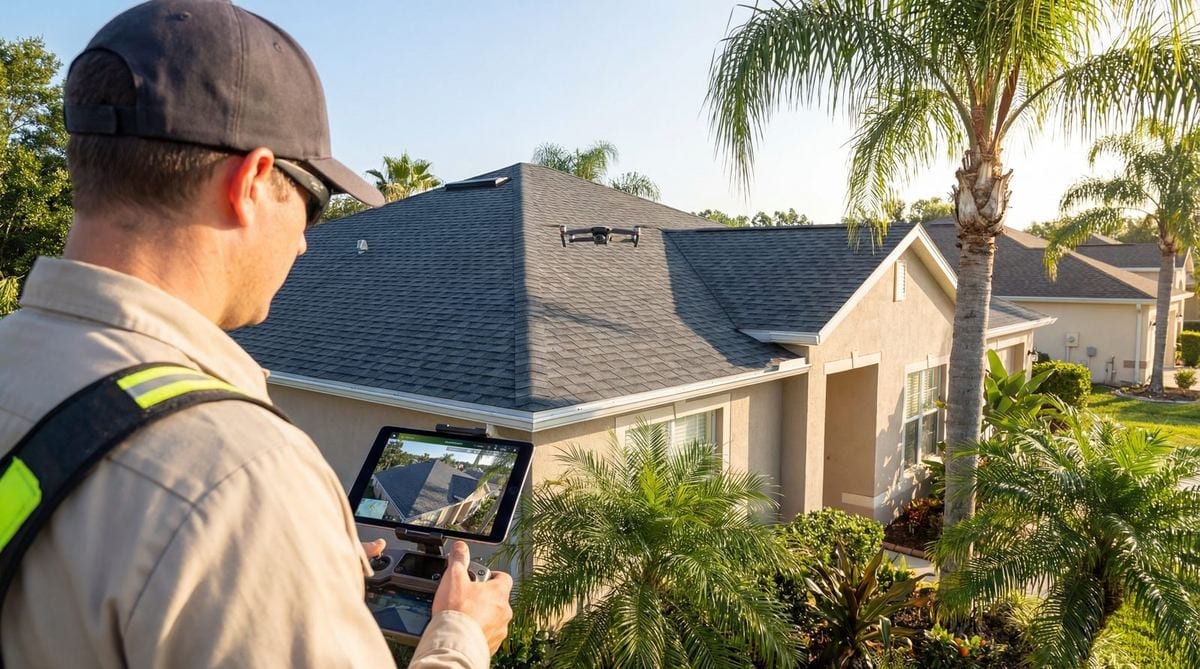
When our crews inspect a roof for a useful-life report, we are not guessing at a number. We are looking for specific failure modes.
On a shingle roof we start with the granule surface. Granule loss shows up in the gutters and at the downspout splash blocks long before the roof looks bald from the street. Then we lift a few tabs on the south and west slopes to test the seal strip. If they lift with no resistance, wind will lift them too.
Then brittleness. A 16-year-old shingle in Brandon that cracks when we bend a corner in the afternoon heat does not have five years in it, whatever it looks like from the driveway.
Then flashing at every wall, chimney and pipe boot, then the deck, walked slowly for soft spots, then the attic for stained sheathing and daylight.
Tile is a different exam. The tile itself is almost never the problem. On the tile roofs we open up in Westchase and Carrollwood, the failure is the underlayment: a single layer of 30-pound felt from the early 2000s that has baked into something that flakes when you touch it. We look for slipped and cracked tiles, exposed underlayment at the eaves and hips, and ridge mortar or foam that has let go.
Metal gets checked at the fasteners. On an exposed-fastener 5V crimp roof, the neoprene washers under the screws are the weak point, and after 15 to 20 years of Florida sun a good share have split, backed out or rusted. Standing seam hides its fasteners, so the exam moves to the seams, end laps and penetrations.
| Roof type | Typical Tampa Bay failure signs at 15+ years | What usually passes |
|---|---|---|
| Architectural shingle | Granules in the gutters, seal strips that lift freely, brittle tabs on the west slope, cracked pipe boots | Full granule coverage, tabs that resist a lift, intact flashing, no soft decking, no attic staining |
| 3-tab shingle | Curled and cupped tabs, bald spots at the ridge, tabs lost in ordinary summer storms | Rarely passes past 15; a flat, sealed, fully granulated 3-tab roof is the exception |
| Concrete or clay tile | Slipped or cracked tiles, crumbling underlayment at eaves and hips, failed ridge mortar or foam, stained ceilings under valleys | Sound tile, pliable and fully covered underlayment, a tight ridge, dry valleys |
| Exposed-fastener metal (5V, R-panel) | Split or missing washers, backed-out screws, rust streaks at fasteners and laps, loose panels at the eave | Tight fasteners with intact washers, no red rust, panels seated at every lap |
| Standing seam metal | Corrosion at dissimilar-metal contact, open end laps, failed sealant at penetrations | Clean panels, closed seams, sealed penetrations; usually the easiest pass on this list |
A roof either has the years or it does not. We would rather tell a homeowner in Seminole Heights that her roof has two years, not five, than sign a report the next storm makes a liar out of.
Citizens plays by different numbers: 25 years and 50 years
If your policy is with Citizens, the state-created insurer that ends up with a lot of Tampa Bay homes when private carriers walk away, the statute is the floor and Citizens has published its own ceiling in its March 2023 roof rule bulletin.
- Maximum roof age for replacement eligibility: “older than 25 years for shingle and other types of roofs (soft)” and “50 years for tile, slate, concrete or metal roofs (hard).”
- A roof past those maximums can still qualify with documentation of remaining useful life, and the minimum moved “from three years remaining useful life to five years.”
- Coverage on an over-age roof is extended “for a period of up to five years” no matter how much longer the inspector says it will last. “Five years is the maximum allowed.”
- Where a roof was not replaced all at once, “the roof age will be based on the oldest part of the roof.”
- Effective for new business in 2023 and for renewals from September 1, 2023.
Read that fourth bullet twice if you own a 1970s block home in Gulfport or Pinellas Park where the front slope was redone after a storm and the back never was. Citizens counts the back.
Citizens gives a shingle roof 25 years and a tile or metal roof 50. Past that it wants five years of documented life, and five years is the most it will extend.
The practical read: a 26-year-old shingle roof at Citizens is on a five-year clock at best, and only if it passes. A 30-year-old concrete tile roof in Lakewood Ranch is not even at the cap yet, which is one reason we push tile roofing and metal so hard for people who plan to stay put.

Years 15 to 20: repair to pass, or replace and stack credits
This is the window where the decision gets made, usually under a deadline printed on a letter.
Option one: repair to pass. If the inspection finds sound decking, decent granule coverage and a few specific defects, fix the defects. New pipe boots, re-sealed flashing, a handful of replaced tabs, a re-bedded ridge on a tile roof. Then re-inspect and document. It is the wrong call when the shingles crack on a bend or the tile underlayment is gone; no amount of patching turns that into five years. Our post on roof repair versus replacement in Florida walks through where that line sits.
One caution on big repairs. Florida’s separate 25 percent rule, as FRSA lays it out, can turn a large repair on an older roof into a code-mandated re-roof of the whole section; it is a building code rule, not an insurance one, and our Florida 25% roof rule explainer covers how it works.
Option two: replace and stack the credits. A full replacement resets the age clock to today and puts wind mitigation discounts on top. Florida requires residential rate filings to include “actuarially reasonable discounts, credits, or other rate differentials” for features shown to reduce windstorm loss, and s. 627.0629 names “wind uplift prevention, roof strength, roof covering performance, roof-to-wall strength” and opening protection among them. Since October 1, 2023, every insurer has had to describe its hurricane mitigation discounts on its website, so read your carrier’s list before you sign a contract.
Those credits get recorded on the OIR-B1-1802, the Uniform Mitigation Verification Inspection Form, which “is valid for up to five (5) years provided no material changes are made to the structure or inaccuracies are found on the form.” An updated form took effect April 1, 2026, so a new roof is the moment to redo an old one. Our guide to wind mitigation and 4-point inspections in Florida explains what the inspector looks at.
Run the numbers. On our installed price ranges, an architectural shingle re-roof is $4.50 to $5.50 per square foot, and a 2,000 square foot home usually carries about 2,400 square feet of roof after pitch, overhangs and waste, so the roof is roughly $10,800 to $13,200. The trade is this: keep the old roof and you buy a useful-life report at every renewal, with a non-renewal risk each time and shingles that get harder to pass every year; replace it and the age clock resets to zero for 15 years while the wind mitigation credits come off the premium. Florida already carries the highest average homeowners premium in the country, $2,437 in 2021 against a national average of $1,411, which is the number those credits work against. Our post on whether a new roof lowers homeowners insurance in Florida goes deeper on the discounts.
A 17-year-old roof that barely passes takes age off the table for now. A new roof takes it off the table for 15 years, plus the credits.
Got the letter? Get the inspection first.
We inspect roofs across Hillsborough, Pinellas, Pasco, Polk, Manatee and Sarasota at no charge, tell you honestly whether it has five years in it, and document what we find so you can send it to your carrier.
My Safe Florida Home, wind credits and paying for the roof

If the answer is replace, three things soften the check.
The free inspection and the grant. You will see “the 2026 Florida roof replacement program” in search results. There is no statewide program by that name. What exists at the state level is My Safe Florida Home, run by the Department of Financial Services: free wind mitigation inspections and grant assistance for approved upgrades, with grants of up to $10,000 available. The inspection comes first and produces a report of recommended improvements; roof improvements, impact windows and doors, garage door reinforcement and secondary water barrier installation are on the approved list.
We will not pretend to know the program’s funding status on the day you read this, and neither should any roofer on your doorstep. Our My Safe Florida Home roof grant guide covers the process, and our roundup of Florida roof replacement assistance programs lists the county programs that also pay for roofs.
The credits. A new roof built to current code, documented on a fresh OIR-B1-1802, is where the discounts under s. 627.0629 land. Send the form to your agent the day the final inspection passes and ask exactly when the credit applies.
The financing. Plenty of the roofs we replace in this window are financed, and a roof with a deadline on it should not wait for cash. Our roof financing options page lays out what we offer, and our Roof Financing Options guide compares the routes.
How we document your roof for the carrier
This is insurance documentation support, and we want to be precise about that, because the line between documenting a roof and adjusting a claim is a legal one and plenty of roofers blur it.
When a homeowner in Apollo Beach or Land O’ Lakes calls with a non-renewal letter, here is what we produce:
- Photos of every slope, every penetration and every problem, plus attic photos where we can get in: overviews from the ground and close-ups of the seal strip, flashing, fasteners and eave underlayment.
- Measurements. Roof area, pitch, number of layers, and the roof’s age as far as the permit record supports it. If you have the permit or final inspection card from the last full replacement, dig it out. That document proves the date.
- A written condition statement on Integrity Roofing of Florida letterhead, signed, with our license number, CCC1334243. It states what we found, what we repaired if anything, and our estimate of remaining useful life, whether that is five years or two.
- An itemized estimate for any repair or replacement we recommend, so you and the carrier are looking at the same scope.
What we do not do: adjust claims, talk numbers with your carrier, or promise an outcome. The underwriting decision belongs to the insurer. And if your carrier will not tell you who counts as an “authorized inspector” for its purposes, ask before you pay anyone for a report; the statute uses that phrase, and in our experience carriers do not all read it the same way.
Our report does not guarantee a renewal. It documents the years the roof has left, and the inspection itself is what s. 627.7011 says you are entitled to.
Selling or buying a house with a roof over 15 years old

Can you sell a Florida home if the roof is older than 15? Yes. The statute governs insurers, not closings, and there is no roof age cutoff for selling a house. The roof still decides the calendar.
Here is the timeline. The buyer applies for insurance during the inspection period, the carrier asks the roof’s age, and at 15 or older it wants an inspection before it binds. The lender needs the policy bound before closing. So a 17-year-old roof either clears the buyer’s carrier inside that inspection window or the contract starts to wobble.
Two documents keep it from wobbling. First, the permit final from the last full replacement, because that date is the roof’s legal age and the buyer’s agent will ask for it. Second, a current useful-life report from a roofer the carrier will accept. Put both in the listing folder before the sign goes up.
A typical case: a 2007 architectural shingle roof on a Land O’ Lakes two-story, 19 years old at listing. The seller has it inspected in June, the report finds sound decking and tight seal strips and writes it at six years, and that report rides along with every offer. The buyer’s carrier accepts it and binds. Without it, the same house becomes a price negotiation over a $10,800 to $13,200 roof three days before closing.
If you are the buyer, get the roof inspected by a roofer and get the useful-life number in writing. The 4-point inspection your carrier orders reports the roof’s condition and age for underwriting; it is not the same thing as a roofer’s remaining-life estimate, and it is not written to tell you how many years you are buying.
What to do this week if the letter is already in your hand
- Pull the permit for your last full roof replacement from your county’s permit portal. The final inspection date is the roof’s legal birthday.
- Read the letter for the word “solely.” If age is the only reason given and the roof is under 15, point your agent to the statute. If the roof is 15 or older, you are owed the inspection before any replacement demand.
- Book a free roof inspection and ask for a useful-life number in writing. Not a vibe.
- If the roof passes, send the report and photos to your agent and keep copies. If it does not, price the roof replacement and the wind mitigation credits together, and apply for the My Safe Florida Home inspection while you wait on quotes.
- Do not let anyone on your doorstep tell you the letter means you must replace. The law says you are owed an inspection first.
Find out whether your roof has five years in it.
Free inspection, straight answer, and a documented report with our license number on it. If it needs replacing, we price the roof and the wind mitigation credits together.
Frequently Asked Questions
Can you insure a 15 year old roof in Florida?+
Yes. Under s. 627.7011(5), once a roof is at least 15 years old the insurer must allow you to have it inspected by an authorized inspector at your expense before requiring replacement. If the inspection shows 5 years or more of useful life remaining, the carrier cannot refuse to issue or renew solely because of roof age. Carriers can still decline for other underwriting reasons, and Citizens applies its own age caps, so the inspection report is what keeps the conversation open.
What is the 25 rule for roof replacement in Florida?+
It is a building code rule, not an insurance rule. When more than a quarter of a roof section is repaired or replaced within a 12-month window, the code can require the whole section to be brought up to current standards, with an exception for roofs built or replaced under the 2007 Florida Building Code or later. The 15-year rule is about whether a carrier can refuse you. The 25 percent rule is about how big a repair can get before it becomes a re-roof.
What is the 2026 roof replacement program in Florida?+
There is no statewide program by that name. County repair programs and My Safe Florida Home grants exist, and what people usually mean is My Safe Florida Home, run by the Florida Department of Financial Services. It offers a free wind mitigation inspection and, for approved upgrades, grant assistance of up to $10,000. Roof improvements, impact windows and doors, garage door reinforcement and secondary water barrier installation are on the approved list. You apply by creating an account on the program's website, and the inspection is always the first step.
Can you sell a home in Florida if the roof is older than 15 years?+
Yes. The 15-year rule governs insurers, not closings, and there is no roof age cutoff for selling a house. The friction shows up on the buyer's side: their carrier applies the same rule plus its own underwriting guidelines, and a lender will not close without insurance in place. In practice a seller with an older roof either gets a current inspection report showing remaining useful life, prices the roof into the deal, or replaces it before listing.
How does Florida calculate roof age for insurance?+
The statute counts from the last date on which 100 percent of the roof's surface area was built or replaced. A partial re-roof does not reset the clock. Citizens applies the same idea and states it bluntly: where a roof was not replaced all at once, the roof age is based on the oldest part of the roof. Keep the permit record and the final inspection date from your last full replacement, because that document is what proves the age.
How long is a roof certification or inspection report good for?+
The statute does not put an expiration date on the roof condition inspection itself, and in our experience each carrier sets its own rule on how recent the report must be. The wind mitigation form is different: the OIR-B1-1802 is valid for up to five years provided no material changes are made to the structure and no inaccuracies are found on the form. Citizens, for its part, extends coverage on an over-age roof for a maximum of five years no matter how much life the inspector found.
Does a roofer's letter guarantee my policy will be renewed?+
No, and be wary of anyone who says otherwise. A licensed roofer can document the roof's condition with photos, measurements and a written statement, and the statute lists a roofing contractor among possible authorized inspectors, but only one the insurer approves, so confirm with your carrier before you pay for a report. The underwriting decision belongs to the carrier. The documentation removes roof age as the sole reason for a refusal, which is what the law allows. It does not force any insurer to write a policy.
Want a real estimate on your Tampa Bay roof?
Enter your address and we'll pull satellite measurements instantly.
Mike Shepherd · Co-Owner, Integrity Roofing of Florida
Mike Shepherd co-owns Integrity Roofing of Florida with Bettina Savorelli. The company is a Florida-licensed roofing contractor (license CCC1334243), a TAMKO Pro Gold and GAF-certified installer, and a BBB A+ rated business serving Hillsborough, Pinellas, Pasco, Polk, Manatee and Sarasota counties. His crews install and repair tile, metal and shingle roofs across Tampa Bay and document storm damage for homeowners' insurance claims. Every article is written from the field, not from a content desk.
Ready to talk to a real human?
No phone tree, no pressure. Owner-level attention on every call.