Roof Financing Options: How to Pay for a New Roof in 2026
Every way a Florida homeowner can finance a new roof in 2026. Personal loans, HELOCs, insurance, PACE, FHA 203(k), and contractor-backed programs. With real APRs, pros/cons, and who actually qualifies for what.
- Personal loan APRs run 8–14% for prime credit; HELOCs come in at 8–10% but put your home up as collateral.
- A HELOC typically beats a personal loan when you have 20%+ home equity and a timeline that tolerates 2–6 weeks of underwriting.
- Florida insurance usually covers a replacement only when the roof is under 25 years old, has documented storm damage, and the loss exceeds your 2–5% hurricane deductible.
- Florida PACE qualifies on home equity and tax history. Not credit. And can fund $30,000+ efficiency-rated roofs even for 550-score homeowners.
In This Article
- What a New Roof Actually Costs in 2026 (and Why Paying Cash Is Rare)
- Personal Loans for Roofing: How They Work
- HELOCs and Home Equity Loans: The Lowest APRs
- Credit Cards: When They Make Sense (and When They Don’t)
- Insurance-Paid Roofing: Who Qualifies in Florida
- FHA 203(k) and Government-Backed Roofing Loans
- Florida PACE Loans: The Hidden Option for Energy-Efficient Roofs
- Roofing-Company Financing. What to Look For
- Get a Real Quote and Financing Offer Today
Replacing a roof is the single largest maintenance bill most Florida homeowners will ever face. It is also one of the few home expenses that is almost impossible to defer. A compromised roof leaks, triggers mold, and voids your homeowner’s insurance faster than any other building component. If you are reading this, you have probably already been told your roof is near end-of-life, or you have a claim in process and you are trying to figure out how to cover the gap between what insurance pays and what the contractor is asking for.
This guide walks through every legitimate roof financing option available in Florida in 2026. No sales pitch, no “best for everyone” answers. Each product has different APRs, different qualification rules, and a different homeowner profile it actually works for. By the end, you will know which paths to pursue and which to avoid.
What a New Roof Actually Costs in 2026 (and Why Paying Cash Is Rare)
Let’s start with the number most people underestimate. A full roof replacement in Florida in 2026 ranges from roughly $9,500 for a small asphalt-shingle home to well over $45,000 for a tile or standing-seam metal roof on a larger footprint. The national median for asphalt shingle replacement sits near $11,500, but Florida pricing skews higher because of hurricane-rated underlayment, Miami-Dade code requirements, and the peninsula’s ongoing insurance-driven labor shortage.
According to the Consumer Financial Protection Bureau, most households do not keep enough liquid savings to absorb an unplanned five-figure home repair in cash. Federal Reserve data has repeatedly shown that roughly 37% of American adults would struggle to cover a $400 emergency expense without borrowing. And a new roof is thirty to one hundred times that number. That is why financing, not cash, is the default way Americans pay for this work.
Here is the rough landscape of what you can expect to pay in interest, depending on which product you use. These are 2026 market averages from Bankrate, NerdWallet, and CFPB lender surveys.
| Product | Typical APR Range (2026) | Term Length | Credit Score Needed | Collateralized? |
|---|---|---|---|---|
| Personal loan (prime credit) | 8% – 14% | 2 – 7 years | 680+ | No |
| Personal loan (fair credit) | 15% – 29% | 2 – 5 years | 600 – 679 | No |
| HELOC (variable) | 8% – 10% | 10-yr draw + 20-yr repay | 680+ | Yes (your home) |
| Home equity loan (fixed) | 8.5% – 10.5% | 5 – 30 years | 680+ | Yes (your home) |
| Cash-out refinance | 7% – 8.5% | 15 – 30 years | 620+ | Yes (your home) |
| Credit card (standard) | 21% – 28% | Revolving | 650+ | No |
| 0% APR promotional card | 0% for 12 – 21 mo | Then 20%+ | 700+ | No |
| FHA 203(k) | 7% – 8% | 15 – 30 years | 580+ | Yes (your home) |
| FHA Title I (property improvement) | Fixed, lender-set | Up to 20 years | Flexible (≈500+) | Loans over $7,500 (your home) |
| PACE (Florida) | 6% – 9.5% | 5 – 30 years | Not primary factor | Yes (property lien) |
| Roofing-company financing (prime) | 7.99% – 14.99% | 2 – 15 years | 650+ | Usually no |
Two things to notice before you pick a lane. First, APR is not the only cost that matters. Origination fees, prepayment penalties, and the length of the term all change the total dollars you actually pay. Second, collateralized products (HELOC, home equity loan, PACE, 203(k)) offer lower rates precisely because your home is on the line if you default. That risk trade-off is the single biggest decision you will make.
One more data point worth knowing. The Internal Revenue Service permits mortgage interest deduction on home equity debt only when the funds are used to “buy, build, or substantially improve” the home securing the loan. A new roof almost always qualifies as a substantial improvement, which means HELOC and home equity loan interest is usually tax-deductible for itemizing households. A detail that tilts the math meaningfully toward secured products for higher-income homeowners. Confirm with your CPA before filing.
Personal Loans for Roofing: How They Work
A personal loan is an unsecured installment loan. Fixed rate, fixed term, fixed monthly payment, no collateral. You borrow a lump sum (typically $1,000 to $100,000), receive the cash in 1 – 5 business days, and pay it back in equal monthly installments over 2 to 7 years. The Consumer Financial Protection Bureau categorizes these as one of the most flexible consumer credit products available.
For a roof replacement, personal loans make sense when you have strong credit (680+) but limited home equity, when speed matters (a hurricane left a tarp on your house and you need the roof replaced in two weeks), or when you do not want a lien on your property. The upside is simplicity. No appraisal, no title work, no second mortgage. The downside is rate. Even with a 780 credit score, you will pay 3 – 5 percentage points more than you would on a HELOC.
NerdWallet reports that the median APR for a 720-credit-score borrower on a $25,000 home-improvement personal loan in early 2026 is approximately 11.8%. On a 5-year term, that is about $556/month and $8,360 in total interest. Compare that to a HELOC at 8.5% on the same amount and term: about $513/month and $5,780 in interest. Roughly $2,580 less. The trade-off is that the HELOC puts your home up as collateral.
- APR: 8-25% typical in 2026
- Term: 2-7 years
- Approval: 1-5 days, credit-score driven
- Collateral: unsecured. No equity requirement
- Best for: quick turnaround, limited home equity, smaller projects
- Payment: fixed monthly installments
- APR: 7-12% typical in 2026 (variable)
- Term: up to 30 years (10-year draw + 20-year repay)
- Approval: 2-6 weeks, requires home appraisal
- Collateral: your home equity. Risk of foreclosure if unpaid
- Best for: homeowners with 20%+ equity, larger projects, flexible draw
- Payment: variable; interest-only during draw period possible
Watch for origination fees. Many personal lenders charge 1% – 8% off the top, which is deducted from the amount you actually receive. A $25,000 loan with a 6% origination fee nets you $23,500 in hand while you still owe $25,000 plus interest. Always compare APR, not interest rate. APR includes fees.
HELOCs and Home Equity Loans: The Lowest APRs
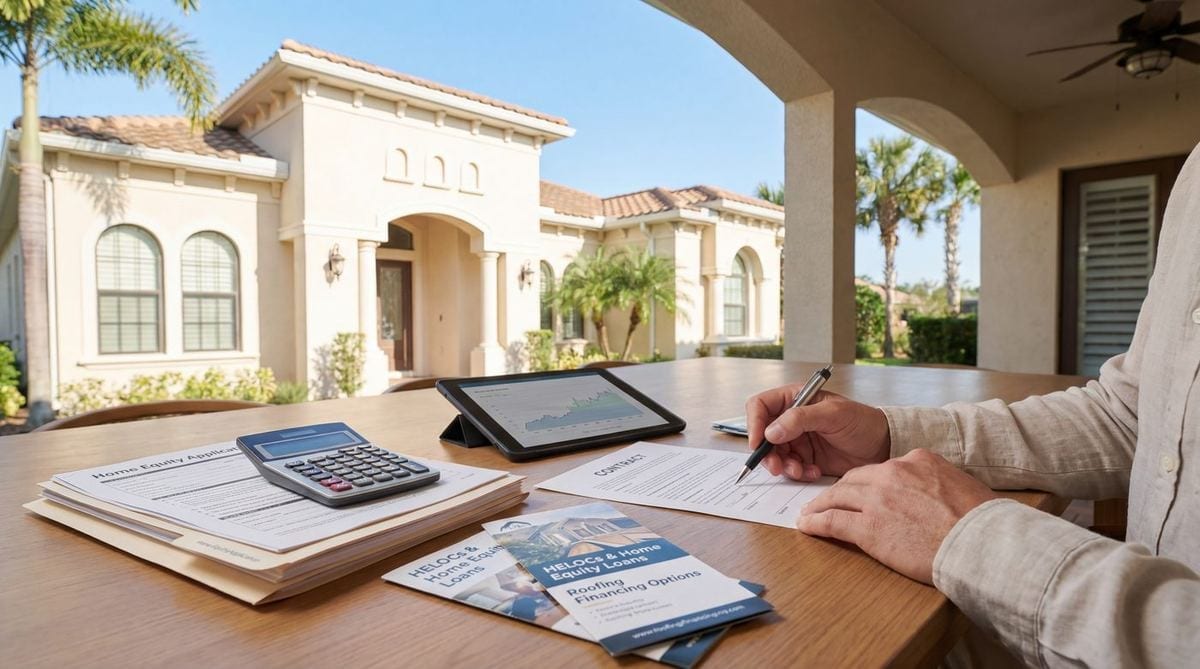
If you have owned your Florida home for more than three or four years and have at least 15% – 20% equity, a home equity line of credit (HELOC) or home equity loan is almost always the cheapest way to finance a roof. Both products use your home as collateral, which is why the APRs are 3 – 8 points lower than unsecured alternatives.
A HELOC works like a credit card secured by your home. You are approved for a credit line. Say $60,000. And you draw against it only as needed, paying interest only on what you use. Most HELOCs have a 10-year “draw period” followed by a 20-year “repayment period.” Rates are usually variable, tied to the prime rate, which currently sits at 6.75%. Your actual rate is that prime rate plus a lender margin, so Bankrate tracked average HELOC rates in early 2026 in the 8% – 10% range for prime borrowers.
A home equity loan is a single lump-sum second mortgage at a fixed rate over a fixed term (typically 5 – 30 years). It is simpler to budget for because your payment never changes, but you lose the flexibility of drawing money only when you need it.
Both products require a home appraisal, title search, and 2 – 6 weeks of underwriting. Closing costs run $500 – $3,000, though many lenders waive them if you keep the account open for 3+ years. CFPB rules require lenders to disclose all fees in a standardized format. Read the Loan Estimate carefully.
These products are the right answer when you have equity, good credit, and are not in an emergency timeline. They are the wrong answer when you cannot tolerate the risk of foreclosure on a missed payment, or when your home value has already been maximized by a cash-out refinance.
Credit Cards: When They Make Sense (and When They Don’t)
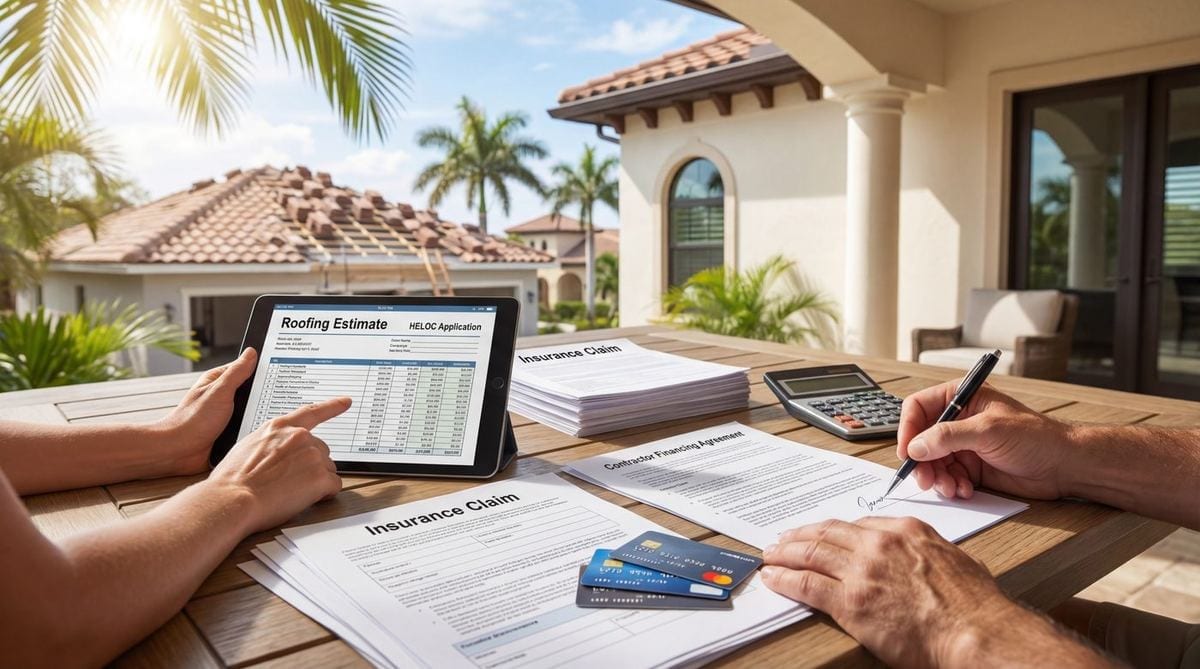
Putting a $20,000 roof on a standard-APR credit card is how people get destroyed. The Federal Reserve reported the average credit card APR at roughly 23% entering 2026. At that rate, making minimum payments only would stretch a $20,000 balance into a 30+ year payoff and more than $40,000 in interest. Don’t do it.
That said, there is exactly one scenario where credit cards are a smart play: a 0% APR promotional card that you can realistically pay off in the promotional window. NerdWallet tracks cards currently offering 0% APR for 18 – 21 months on purchases. If your roof is $15,000, you have strong credit (700+), and you can commit to $715/month payments for 21 months, you can finance the entire job at zero interest. The moment the promo ends, any remaining balance starts accruing at 20% – 28%. So the discipline is non-negotiable.
Watch two traps. First, most 0% cards have balance transfer fees of 3% – 5% if you move existing balances onto the card, but purchases are usually clean. Second, some contractors add a “processing fee” of 2% – 3.5% when you pay by credit card, which can erase the benefit of a 0% offer. Ask up front.
Insurance-Paid Roofing: Who Qualifies in Florida
This is the section most Florida homeowners read first, and the one we want to be the most blunt about. In our own field experience across Tampa Bay since 2011, roughly one in three calls we take after a named storm involves an insurance-eligible roof. And roughly half of those homeowners were about to pay out of pocket because they had never filed a claim or had been told informally that their roof “wouldn’t qualify.”
Florida’s homeowner insurance market is the most complicated in the country. After the 2022 – 2024 insurer exodus, the state passed SB 2-A and related reforms (Florida Office of Insurance Regulation) that tightened claim timelines, capped attorney fees, and changed how Assignment of Benefits agreements work. The short version: if your roof is less than 25 years old and sustained hurricane, hail, or windstorm damage, your policy almost certainly covers the repair or replacement minus your hurricane deductible (typically 2% – 5% of your dwelling coverage).
The Federal Trade Commission warns homeowners about storm-chasing contractors who pressure you into signing an Assignment of Benefits before they have even inspected the damage. In Florida in 2026, AOB forms are restricted but not banned. Read anything you sign, and never hand over claim rights to a contractor you have not vetted. A reputable roofer will work directly with your adjuster without requiring you to sign over your policy benefits.
Insurance-paid roofing works when (1) your roof is under 25 years old, (2) there is a documented storm event, (3) you file within the state’s claim window (currently one year from date of loss for hurricane claims), and (4) the damage exceeds your deductible. It does not work for wear-and-tear, improper installation, or deferred maintenance. If your 27-year-old roof is leaking because it has reached end-of-life, no insurer in Florida is going to cover it.
Know what your roof will cost before you apply.
Get a free, no-obligation instant estimate. Pair it with the right financing option for your situation.
FHA 203(k) and Government-Backed Roofing Loans
The FHA 203(k) Rehabilitation Mortgage is a government-insured loan program run by the Department of Housing and Urban Development that rolls a home purchase or refinance together with renovation costs. Including roof replacement. Into a single mortgage. There are two flavors: the “Limited 203(k)” (up to $35,000 in repairs, no structural work) and the “Standard 203(k)” (no cap, structural work allowed). Both require a HUD-approved 203(k) Consultant on standard projects.
203(k) loans are underrated by most roofers and most homeowners. The APR is usually within 0.25 – 0.5 points of a standard FHA mortgage. Call it 7% – 8% in early 2026. And the credit score minimum is 580 with 3.5% down, or 500 – 579 with 10% down. Compared to a personal loan at 15% or a home equity loan at 10%, you can save $5,000 – $15,000 in interest over the life of the project.
The trade-off is paperwork and timeline. A 203(k) closing takes 45 – 90 days, requires a HUD-approved consultant on Standard projects, and imposes stricter contractor vetting and draw schedules. It works best when you are already refinancing or purchasing a home that needs a new roof anyway. It is a poor fit for emergency storm-damage scenarios where you need the roof in 2 – 3 weeks.
There is also the VA Renovation Loan for eligible veterans and the USDA 504 Home Repair Program for very-low-income rural homeowners, which offers 1% loans up to $40,000 and grants up to $10,000 for those 62 and older.
Florida PACE Loans: The Hidden Option for Energy-Efficient Roofs
Property Assessed Clean Energy (PACE) financing is Florida’s best-kept secret for homeowners who cannot qualify for traditional credit. PACE is not a loan in the traditional sense. It is a special assessment added to your property tax bill, repaid over 5 – 30 years. DSIRE (the Database of State Incentives for Renewables & Efficiency, maintained by NC State) tracks every active PACE program in Florida, including Ygrene, Renew Financial, and Florida PACE Funding Agency.
PACE qualifies you based on home equity and property-tax payment history, not credit score. That means homeowners with 550 credit who have been rejected by every conventional lender can still finance a $30,000 roof. As long as the new roof meets efficiency standards. Most reflective tile, standing-seam metal, and cool-roof shingle roof installations qualify. The ENERGY STAR Roof Products database lists certified options.
The trade-off is real. PACE assessments are senior to your mortgage in most cases, which means if you sell or refinance, the PACE obligation typically must be paid off or assumed by the buyer at closing. Some mortgage lenders (including Fannie Mae and Freddie Mac) will not refinance a property with an active PACE lien. Before signing, read the full disclosure and model what happens if you sell in year 3, year 7, and year 15.
PACE works well for homeowners who plan to stay in the property long-term, cannot qualify for conventional credit, and are installing an efficiency-rated roof. It works poorly for homeowners who expect to sell within 5 – 7 years or who will need to refinance their primary mortgage.
Roofing-Company Financing. What to Look For
This is where Integrity Roofing of Florida fits into the picture. We offer financing through two partners. GreenSky provides credit-based home improvement loans through a network of participating lenders, with quick approval decisions and monthly payment options, subject to credit approval. Ygrene is a PACE program that finances eligible Florida home improvements and is repaid through your property tax bill rather than a conventional loan, subject to program and property eligibility. Between a credit-based loan and a property-based PACE option, most Tampa Bay homeowners can find a path that fits.
The honest case for contractor-backed financing: it is fast, it is flexible, and it lets homeowners who do not have home equity or cash savings get the roof they need without a 45-day FHA 203(k) underwriting cycle. Most of our customers close on financing and schedule installation in the same week. For storm-damage, insurance-gap, and wear-and-tear scenarios where timing matters, it is often the cleanest option.
The honest limits: roofing-company financing is almost never the lowest APR available. If you have 20% home equity and a 760 credit score, a HELOC will beat any contractor financing by 2 – 4 points. What roofing-company financing does well is speed, approval breadth, and zero friction with the install schedule.
Here is how we help homeowners work the decision:
- We give you the real cash price first. Our quote does not change based on whether you finance. Some roofers pad the price 10% – 15% to cover finance commissions. Ours does not.
- We walk you through GreenSky and Ygrene. We help you compare a credit-based GreenSky loan against Ygrene PACE, and if neither is the best fit, we point you toward a HELOC or a 203(k) instead. The goal is the right financing, not a commission.
- We coordinate directly with your insurance adjuster if the job is storm-related, so you are not fighting on two fronts.
- We itemize the quote so if you have a partial insurance payout, you know exactly what the financing needs to cover.
Across Tampa Bay, we have helped homeowners finance roofs through a mix of GreenSky, Ygrene PACE, home equity, and insurance-paid pathways. The one pattern we see over and over: the homeowners who get the best outcomes are the ones who get two or three financing quotes in parallel with the roofing estimate, not after.
Get a Real Quote and Financing Offer Today
If you are within our service area in Tampa, St. Petersburg, Clearwater, or the broader Tampa Bay region, we will send a licensed roofer to your property, give you a written estimate with no sales pressure, and walk you through your GreenSky and Ygrene financing options at the same time. You will walk away knowing (1) the real price of the job, (2) the financing terms you actually qualify for, and (3) whether your insurance is likely to cover any part of it.
No obligation. No pressure. Just the numbers you need to make a smart decision.
Book a free roof inspection and financing review →
Prefer to talk it through first? Call us at (813) 388-9190 or request a callback from our team. We will pick up the same day.
Know what your roof will cost before you apply.
Get a free, no-obligation instant estimate. Pair it with the right financing option for your situation.
Want a real estimate on your Tampa Bay roof?
Enter your address and we'll pull satellite measurements instantly.
The Integrity Roofing Team · Florida Roofing Experts · Licensed & Insured
The Integrity Roofing of Florida team installs and repairs tile, metal, and shingle roofs across Tampa Bay. With decades of combined field experience, we've helped more than a thousand homeowners navigate hurricane-damage claims, material choices, and the gap between what's marketed and what actually holds up in Florida conditions. Every post is written by working Florida roofers. Not content writers.
Ready to talk to a real human?
No phone tree, no pressure. Owner-level attention on every call.