Roof Replacement Cost in Florida (2026): Complete Tampa Bay Guide
Real 2026 pricing for tile, metal, and shingle roof replacements across Tampa Bay. Plus how Florida's 25% rule, insurance carriers, and county variance actually affect what you'll pay.
- Florida's 25% rule can turn a partial repair into a full replacement. But only for roofs installed under pre-2007 code.
- Typical 2026 Tampa Bay replacement costs: shingle $14,500–$22,000, metal $28,000–$48,000, tile $32,000–$65,000.
- Roughly 55–70% of Florida roof replacements in hurricane-impacted counties are insurance-paid, vs. a national average near 30%.
- Out-of-pocket replacements now dominate age-driven cases (roof 18–20+ years) as carriers tighten wear-and-tear coverage.
If you’ve typed “roof replacement cost florida” into a search bar in 2026, you already know the problem: every contractor gives you a different number, every calculator online was last updated two hurricane seasons ago, and your neighbor swears they paid half what you were quoted. This guide is our attempt to fix that. Not by pretending one price fits every Tampa Bay home, but by walking you through exactly how Florida roof pricing gets built so you can sanity-check any quote you receive.
Florida is a unique roofing market. The combination of UV intensity, salt air, hurricane-force wind load requirements, and some of the strictest building codes in the United States means a roof here is not priced the way a roof in Ohio or Texas is priced. Add the state’s “25% rule,” an insurance market that has been in flux since 2022, and county-level permit fee variance, and you get the wide pricing spread you see online. Below, we break it down three ways. National cost benchmarks filtered for Florida reality, the category-level factors that move your specific price up or down, and finally how to turn all of that into a real number for your address.
1. What a New Roof Actually Costs in Florida (2026)
Let’s start with honest ranges. According to cost data compiled by Angi and HomeAdvisor, the national average for a new asphalt shingle roof in 2025 landed between $8,500 and $14,300, with a typical mid-range project around $11,500. Florida sits above the national average by roughly 8–15% because of our high-velocity hurricane zone (HVHZ) code requirements, stricter underlayment rules, and the insurance-driven demand spike that started after Hurricane Ian in 2022.
In Tampa Bay specifically, we’re seeing 2026 replacement costs for a typical 2,000 sq ft single-story home fall in these ranges:
- Architectural asphalt shingle: $14,500–$22,000
- Standing seam metal: $28,000–$48,000
- Concrete or clay tile: $32,000–$65,000
Those are turnkey numbers. Tear-off, new decking repairs, synthetic underlayment, new flashing, new drip edge, permit, dump fees, and final inspection included. They reflect what a complete full roof replacement should cover. If a quote comes in dramatically below those ranges, it is almost always missing something on the scope. The National Roofing Contractors Association publishes annual material and labor index data that consistently shows Florida labor running 10–20% above the national mean, which tracks with what our crews see on payroll.
How roof size is actually measured
Contractors don’t price by your home’s square footage. We price by the roof’s square footage, which is always larger than the floor plan because of pitch, overhangs, and multiple planes. Roofers measure in “squares”. One square equals 100 sq ft of roof surface. A 2,000 sq ft single-story Florida home with a moderate 6/12 pitch usually measures 22–26 squares of actual roof. The same floor plan as a two-story measures less roof (smaller footprint) but costs more per square because of access complexity. This is why two houses on the same street with identical listings can get quotes $9,000 apart.
The Florida 25% Rule (where it came from and what it means)
The so-called “25% rule” is the piece of Florida roof law most homeowners have heard of and almost nobody understands correctly. The rule originated in section R908.1.1 of the Florida Building Code, which historically required that when more than 25% of a roof was being repaired or replaced within any 12-month period, the entire roof had to be brought up to current code. In practice, that meant a partial repair on an older roof would trigger a full replacement.
In 2022, the Florida Legislature passed SB 4-D and then modified enforcement through subsequent legislation, giving homeowners with roofs built to the 2007 Florida Building Code or later some relief. In those cases, only the damaged portion needs to be replaced, even if it exceeds 25%. For roofs installed under older codes (pre-2007), the 25% rule still typically applies. You can read the current code language directly at floridabuilding.org.
Why this matters for your wallet: if a storm damages 30% of a 20-year-old roof, your insurer may be on the hook for a full replacement, not a partial repair. If that same storm hits a 10-year-old roof built to the 2007+ code, they may only cover the damaged section. Age of roof and year of original permit directly affect whether you’re looking at a $3,500 repair or a $22,000 replacement.
Insurance-paid vs. out-of-pocket. The actual split
Florida is an outlier nationally for how many roof replacements get paid by insurance. According to data from the Florida Office of Insurance Regulation, roof-related claims made up a disproportionate share of homeowners insurance payouts in the years following Hurricanes Ian (2022) and Idalia (2023). Industry estimates from Insurance Information Institute suggest that in hurricane-impacted Florida counties, roughly 55–70% of roof replacements in 2023–2025 were fully or partially insurance-paid, versus a national average closer to 30%. The remaining homeowners paid out of pocket. Typically because their roof aged out rather than sustained storm damage.
If your roof is under 15 years old and a named storm hits, you are in the “file a claim” lane. If your roof is 20+ years old with normal wear, granule loss, and no specific storm event, insurers are increasingly non-renewing rather than replacing, and you’ll be paying out of pocket. The Florida Department of Financial Services publishes consumer guidance on what insurers can and can’t do on age-based roof decisions, and it’s worth reading before you file.
How long does a roof last in Florida?
Shorter than the manufacturer’s brochure claims. Florida sun, humidity, and storm cycles compress roof lifespans by 20–30% versus northern states. Realistic Florida lifespans we see in the field:
- 3-tab asphalt shingle: 12–15 years
- Architectural asphalt shingle: 17–22 years
- Standing seam metal: 40–50 years
- Concrete tile: 40–50 years (underlayment replaced at year 25–30)
- Clay tile: 50+ years (same underlayment caveat)
2. Roof Pricing by Material: Tile vs. Metal vs. Shingle (Zone 1)
Material is the single biggest lever on your final number. Here’s what the 2026 Tampa Bay market looks like, based on averaged pricing from Fixr and Roofing Calculator, cross-referenced against our own bid logs:
| Material | Avg. $/sq ft (installed) | Typical 2,000 sq ft home | Florida lifespan | Wind rating |
|---|---|---|---|---|
| 3-tab asphalt shingle | $5.50–$7.50 | $12,000–$17,500 | 12–15 yrs | 60–70 mph |
| Architectural asphalt | $7.00–$10.00 | $14,500–$22,000 | 17–22 yrs | 110–130 mph |
| Standing seam metal | $13.00–$20.00 | $28,000–$48,000 | 40–50 yrs | 140–160+ mph |
| Metal shingle/stone-coated | $11.00–$16.00 | $24,000–$38,000 | 30–40 yrs | 120–140 mph |
| Concrete tile | $14.00–$22.00 | $32,000–$52,000 | 40–50 yrs | 150+ mph |
| Clay tile | $18.00–$28.00 | $42,000–$65,000 | 50+ yrs | 150+ mph |
A few notes the calculators won’t tell you:
Asphalt shingle is still the volume leader in Florida. Roughly 70% of residential replacements in Tampa Bay, per local permit office data. The 2007+ Florida Building Code requires shingles rated for our wind zones, so the cheap 60-mph product sold in other states isn’t legal here. That’s part of why Florida shingle roofing jobs price higher than the national number.
Metal has surged post-Ian. We were installing maybe 8–10% metal jobs in 2019; in 2025 that’s pushed past 25% in coastal Pinellas and Hillsborough ZIPs. Insurance discounts on metal (often 15–30% off annual premium) are pulling homeowners toward the higher upfront price because the 10-year math pencils out.
Tile pricing has the widest spread. A concrete tile replacement on a one-story ranch with a 4/12 pitch is a totally different job from a clay tile reroof on a two-story Spanish Revival with three valleys and a chimney. Tile also has the highest hidden cost. the underlayment under tile only lasts 25–30 years even though the tile itself lasts 50+. Many “tile roof replacements” in Florida are actually “lift, replace underlayment, reset tile” jobs, which run 40–60% of a full replacement.
3. Florida’s “25% Rule”. What It Means for Your Wallet (Zone 1)
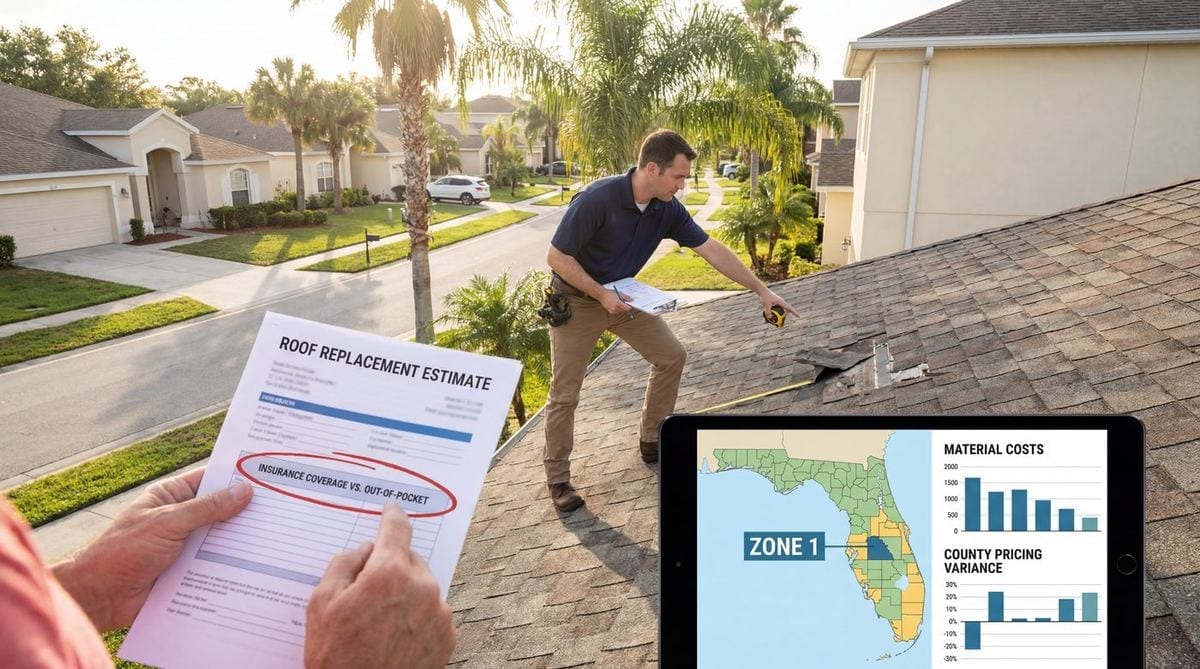
We covered the legal mechanics above. Here’s the practical dollar impact, because this is where homeowners get blindsided.
Scenario: a hailstorm damages 28% of your 18-year-old shingle roof. Your adjuster visits, confirms the damage, and writes a claim for partial repair. Under the pre-2022 interpretation of the 25% rule, the insurer would have been required to fund a full replacement because the damaged area exceeded the 25% threshold. Under SB 4-D and the current Florida Building Code updates, if your roof was installed under the 2007 or later code, the insurer can pay for the damaged portion only. Even though the 25% threshold was crossed.
For a 2,000 sq ft home, this is the difference between an $18,000 full replacement and a $5,500 partial repair. The insurer is not doing anything illegal; the law simply changed. Your permit year and code edition determine which scenario applies.
How to find your permit year: your county property appraiser’s website (Hillsborough, Pinellas, Pasco, Polk all publish this) lists the original build date and any major permits pulled. If the roof was reroofed in 2008 or later, you’re in the post-2007 code lane. If it’s still the original 1998 roof, the 25% rule likely triggers a full replacement on any qualifying claim. Before you agree to a partial-repair settlement, confirm with your contractor which code edition applies to your roof.
4. How Roof Size Is Measured (and Why Two Houses the Same Square Footage Get Different Quotes) (Zone 1)
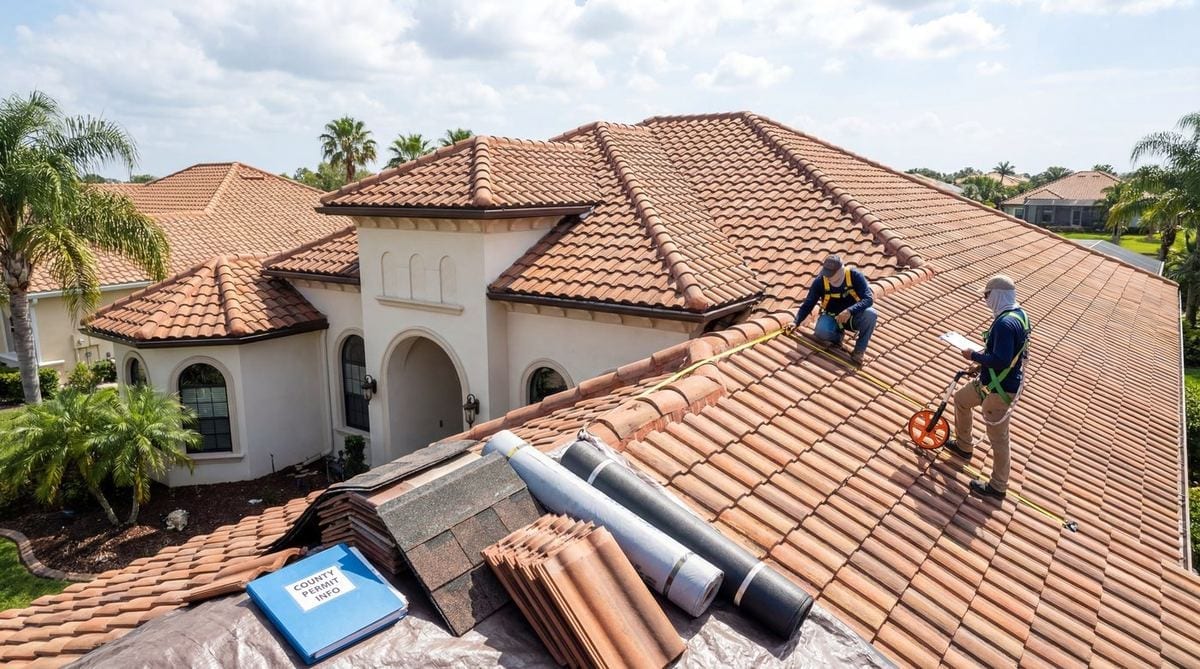
This is the question we get more than any other: “My neighbor has the exact same house and their quote was $6,000 less. Why?”
Three reasons, always:
Pitch multiplier. A 4/12 roof (standard Florida ranch) has a pitch multiplier of about 1.06. Meaning the roof surface is 6% larger than the footprint. A 9/12 roof (steeper contemporary or Mediterranean) has a multiplier of 1.25. 25% larger. Same footprint, 19% more material, 25% more labor because the crew has to work harnessed. We see this show up in Tampa Bay most on two-story homes in Westchase, South Tampa, and parts of Clearwater where 1990s-2000s builders used steeper pitches.
Plane complexity. A simple gable roof has 2 planes. A hip roof has 4. A cut-up roof with dormers, multiple valleys, and a couple of skylights can have 10+. Every valley is linear feet of flashing, every plane is a hip or ridge cap line, every penetration is a boot. Two 2,400 sq ft homes can have 28 squares vs. 34 squares of actual material, plus an entire extra day of labor on the cut-up one.
Access. Can the dump trailer park in the driveway? Is there a pool to tarp? Is the gate wide enough for the dumpster? Are there mature oaks you can’t back a truck under? Access issues add $500–$2,500 to a Florida reroof, and they’re why coastal and gated-community jobs price higher.
The U.S. Census Bureau’s construction cost indexes confirm that roofing labor is the single largest variable in residential reroof cost variance across metros. In Florida specifically, the Bureau of Labor Statistics Tampa-area data shows construction wages rose 14% between 2022 and 2025. Meaning a 2023 quote is no longer a useful benchmark for 2026 work.
5. Hidden Cost Drivers Contractors Don’t Always Explain Upfront (Zone 2)
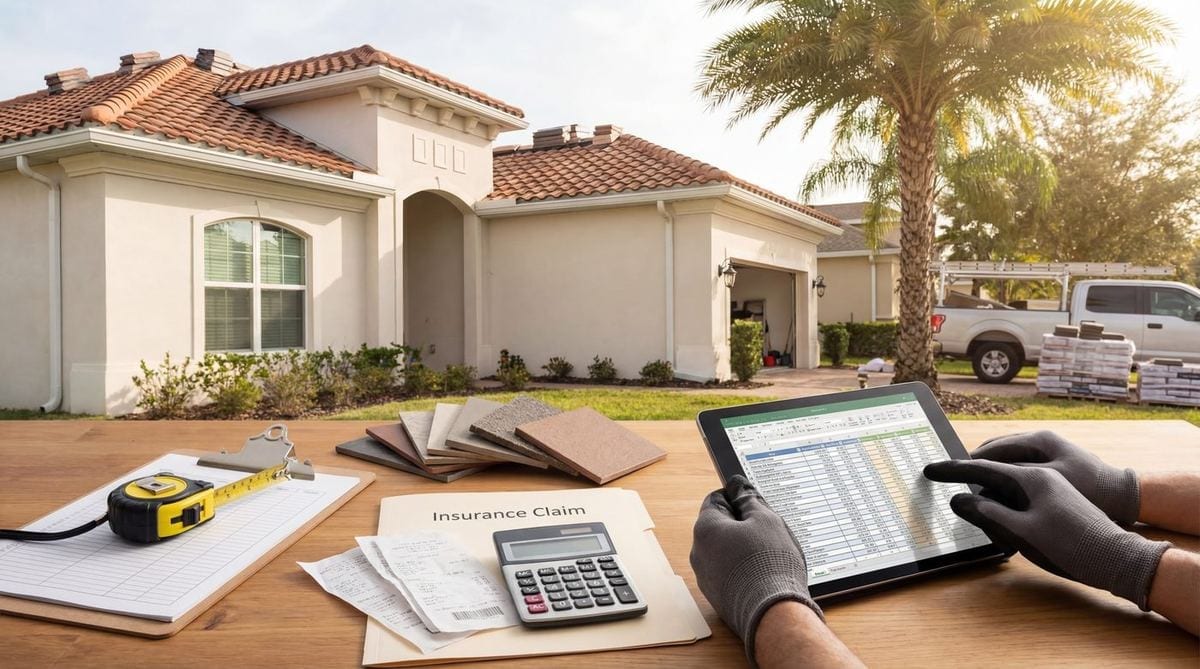
This is the section where most cost articles wave their hands. The truth is, the “surprise” items on a Florida roof quote are almost never surprises to the contractor. They’re line items that sometimes get left off the initial bid so the number looks competitive, then get added during the job. Here’s the honest category-level breakdown of what moves your price after the initial walkthrough.
Decking (the wood under your shingles)
Florida roofs built before 1995 often have 1/2-inch plywood or 1x6 tongue-and-groove decking that no longer meets current HVHZ nailing standards. If more than about 10–15% of your decking is compromised. Soft spots from old leaks, rotted sheathing near valleys, or insufficient thickness. The inspector will fail the reroof unless it’s brought to code. New 5/8” CDX plywood runs $95–$140 per sheet installed in 2026 Tampa Bay, and a full redeck on a 25-square roof can add $3,500–$7,000 to your final invoice.
Underlayment upgrades
The Florida code minimum is synthetic underlayment, which is a significant step up from old-school 30-lb felt. But if you’re in a coastal ZIP, we almost always recommend peel-and-stick (self-adhering) underlayment. It’s a fully adhered membrane that acts as a secondary water barrier if your primary roofing fails in a storm. It’s also what most insurers reward with a better wind-mitigation discount. Upgrade cost: $1,200–$2,800 for a typical home. Worth it in 9 out of 10 Tampa Bay addresses.
Tear-off complexity
A single-layer tear-off is the easy case. Two layers of old shingles (common on pre-2000 homes that got a “shingle-over” reroof once already) doubles dump-trailer trips, doubles disposal fees, and adds about a day to the job. Florida code disallows any further shingle-overs for new permits, so if you have two layers up there, you’re paying for a full tear-off regardless.
Roof-to-wall flashing and chimney work
This is the sleeper line item. Code now requires new step flashing on every roof-to-wall interface during a reroof. You cannot reuse old flashing. If your home has a chimney, a brick-to-stucco transition, or a second-story wall meeting a first-story roof, expect $800–$2,200 in flashing and counterflashing depending on linear feet and masonry condition.
Skylights, vents, and satellite mounts
Every penetration gets a new boot or curb during a reroof. Old skylights are almost always replaced during the reroof because reusing a 15-year-old skylight on a new 25-year roof is asking for a leak in year 3. Velux and similar units run $650–$1,400 installed per unit during a reroof. Cheaper than doing them standalone later.
In our own field experience, the single most common reason a Tampa Bay homeowner feels their final invoice is higher than the quote is decking. They didn’t budget for replacement sheathing, and once the tear-off is complete, there’s no walking away from a rotten deck. A reputable contractor will give you a per-sheet unit price upfront so there’s no ambiguity when the crew lifts the old shingles.
Permits and inspections
Every Florida reroof requires a permit. Permit fees vary by county and are based on project valuation:
- Hillsborough County: typically $250–$450
- Pinellas County: typically $300–$550 (higher in municipalities like St. Pete Beach)
- Pasco County: typically $180–$320
- Polk County: typically $200–$400
The permit fee itself is small, but the inspections (in-progress and final) gate your job timeline. A reputable contractor has a permit coordinator; a fly-by-night operator “forgets” the permit, which can void your insurance and your warranty.
Get a real Florida-specific roof quote.
Enter your address. We pull satellite measurements, factor in Tampa Bay pricing, and give you a ballpark instantly.
6. Insurance-Paid vs. Out-of-Pocket: Which Florida Homeowners Pay What (Zone 2)
Florida’s homeowners insurance market has been restructured three times since 2022. Here’s where we are in 2026 and what it means for your roof:
Insurance-paid replacements are concentrated in two buckets: (1) named-storm damage with clear causation (a hurricane, tropical storm, or tornado passed through and you can document it), and (2) sudden-peril damage like a tree falling or a lightning strike. Per FLOIR’s most recent market conduct reports, insurers have tightened standards dramatically on wear-and-tear claims. Granule loss, UV aging, and “mystery” leaks without a documented storm event are almost uniformly denied in 2026.
Out-of-pocket replacements now make up a larger share of the Tampa Bay market than they did in 2022. These are usually age-driven: roof hits 18–20 years, insurer sends a non-renewal notice unless you replace proactively, and the homeowner pays cash or rolls it into a HELOC / roofing-finance product. Most reputable Florida contractors offer 12, 18, or 24-month no-interest financing through Service Finance, GreenSky, or similar lenders; rates beyond that point run 7.99–12.99% APR depending on credit.
The Assignment of Benefits (AOB) change is worth knowing about. Florida restricted AOB agreements heavily in 2022, which means you generally cannot sign your insurance claim over to the roofing contractor the way you could a decade ago. Any contractor asking you to sign an AOB in 2026 is either behind on the law or hoping you don’t know. Handle your own claim, have the contractor provide a scope estimate that matches the insurer’s scope, and you keep control of the money.
- Full cost on the homeowner. Typically $12,000-$35,000 for average FL home
- Any upgrade (material, underlayment, decking) paid 100% by owner
- Payment due at project milestones or completion
- No adjuster involvement, no paperwork battles
- Timeline: scheduled as soon as contractor availability allows
- Homeowner pays deductible ($1,000-$5,000 typical) plus any code-upgrade gaps
- Code-mandated upgrades (25% rule) covered at actual cost per Florida statute
- Payments issued by carrier directly to contractor or homeowner
- Adjuster + contractor meeting required; claim documentation essential
- Timeline: 4-12 weeks typical from filed claim to completed install
7. Roof Replacement Cost by Tampa Bay County (Zone 2)
County matters more than you’d think. Permit fees, inspection timelines, wind zone designations, and labor availability all shift within an hour’s drive. Pricing in our home market of Hillsborough County and Tampa reads differently than the coastal Pinellas numbers below. Here’s the 2026 variance across the four counties we work in most:
| County | Avg. shingle reroof (2,000 sq ft) | Avg. metal reroof | Avg. tile reroof | HVHZ status | Typical permit turnaround |
|---|---|---|---|---|---|
| Hillsborough | $15,800–$21,500 | $30,000–$46,000 | $34,000–$58,000 | Non-HVHZ (140 mph zone) | 5–10 business days |
| Pinellas | $16,500–$23,000 | $32,000–$48,000 | $36,000–$62,000 | Non-HVHZ (coastal 150 mph zones) | 7–14 business days |
| Pasco | $14,900–$20,500 | $28,500–$44,000 | $32,000–$54,000 | Non-HVHZ (130–140 mph zone) | 3–7 business days |
| Polk | $14,200–$19,800 | $27,500–$42,000 | $30,500–$50,000 | Non-HVHZ (130 mph zone) | 3–7 business days |
Why Pinellas is the most expensive: salt exposure, tighter coastal building setbacks, and municipality-level permit layering on top of county permits (a reroof in St. Pete Beach has city and county review). Why Polk is typically cheapest: less coastal exposure, faster permitting, and a deeper labor pool with lower wage pressure.
Florida is not designated as an HVHZ state except for Miami-Dade and Broward counties (where code is even stricter). All four Tampa Bay counties are outside the HVHZ but are still subject to the 2023 Florida Building Code with its 130–150 mph wind-zone requirements depending on your specific address. Your contractor should be pulling a wind zone confirmation from your address, not guessing.
8. How to Get an Honest Quote for Your Florida Home (Zone 3)
If you’ve read this far, you already have the tools to evaluate a quote better than 90% of Tampa Bay homeowners. Here’s the checklist we’d hand a friend:
Get three itemized quotes, not three numbers. “Full reroof. $18,500” is not a quote; it’s a guess. A real Florida quote lists squares, material brand and model, underlayment type, drip edge gauge, flashing spec, decking replacement per-sheet price, permit fee, dump fee, and warranty terms. If a contractor won’t itemize, they’re pricing on vibes.
Verify the license and insurance. Every licensed Florida roofer has a CCC or CGC license number you can look up at myfloridalicense.com. Ask for their general liability certificate and workers’ comp certificate. A subcontractor without workers’ comp means you’re liable if someone falls off your roof.
Ask what code edition they’re pricing to. “Current Florida Building Code” is the correct answer. “Whatever the inspector wants” is not.
Confirm permit pull. Permit number on the contract, pulled by the contractor, not “you pull it.” A homeowner-pulled permit means the contractor doesn’t want their license on the inspection.
Get the warranty terms in writing. Manufacturer warranty (the shingle/tile/metal manufacturer) and workmanship warranty (the installer) are separate. Florida workmanship warranties run from 2 years (low end) to lifetime (premium installers). Read the fine print on transferability if you might sell within 10 years.
Why Integrity Roofing of Florida
We’ve been reroofing Tampa Bay homes since before SB 4-D changed the 25% rule, before the insurance market restructured, and before metal roofing became mainstream here. Every quote we write is itemized, every job is permitted, every roof installation is handled by an in-house crew (no subcontracted labor), and every inspection is handled by our permit coordinator. If you want a competitive quote from a team that will explain exactly why the number is what it is. Including which of the cost drivers above apply to your specific home. We can usually get you a preliminary number in under 60 seconds online and a full on-site quote within a week.
9. Get Your Instant Estimate (Zone 3 CTA)
You don’t have to pick up the phone to get a starting number. Our instant estimate tool pulls your roof’s measurements directly from satellite imagery using Google’s Solar API, factors in your ZIP code’s wind zone and county permit schedule, and returns a 2026 price range for asphalt, metal, and tile. In about a minute.
Get your instant roof estimate →
If the number makes sense for your budget, we’ll schedule a free on-site verification within the week to confirm decking condition, pitch, penetrations, and any access considerations. If the number doesn’t work, you still have a hard benchmark to compare other quotes against. Either way, you leave with a real Florida number. Not a national average, not a calculator from 2019, not a neighbor’s guess.
Questions about a specific scenario. An insurance claim, an age-based non-renewal, or whether your 2008 roof qualifies under the current 25% rule. You can also reach our team directly through the contact page. Every question goes to a working Florida roofer, not an offshore call center.
Get a real Florida-specific roof quote.
Enter your address. We pull satellite measurements, factor in Tampa Bay pricing, and give you a ballpark instantly.
Want a real estimate on your Tampa Bay roof?
Enter your address and we'll pull satellite measurements instantly.
The Integrity Roofing Team · Florida Roofing Experts · Licensed & Insured
The Integrity Roofing of Florida team installs and repairs tile, metal, and shingle roofs across Tampa Bay. With decades of combined field experience, we've helped more than a thousand homeowners navigate hurricane-damage claims, material choices, and the gap between what's marketed and what actually holds up in Florida conditions. Every post is written by working Florida roofers. Not content writers.
Ready to talk to a real human?
No phone tree, no pressure. Owner-level attention on every call.