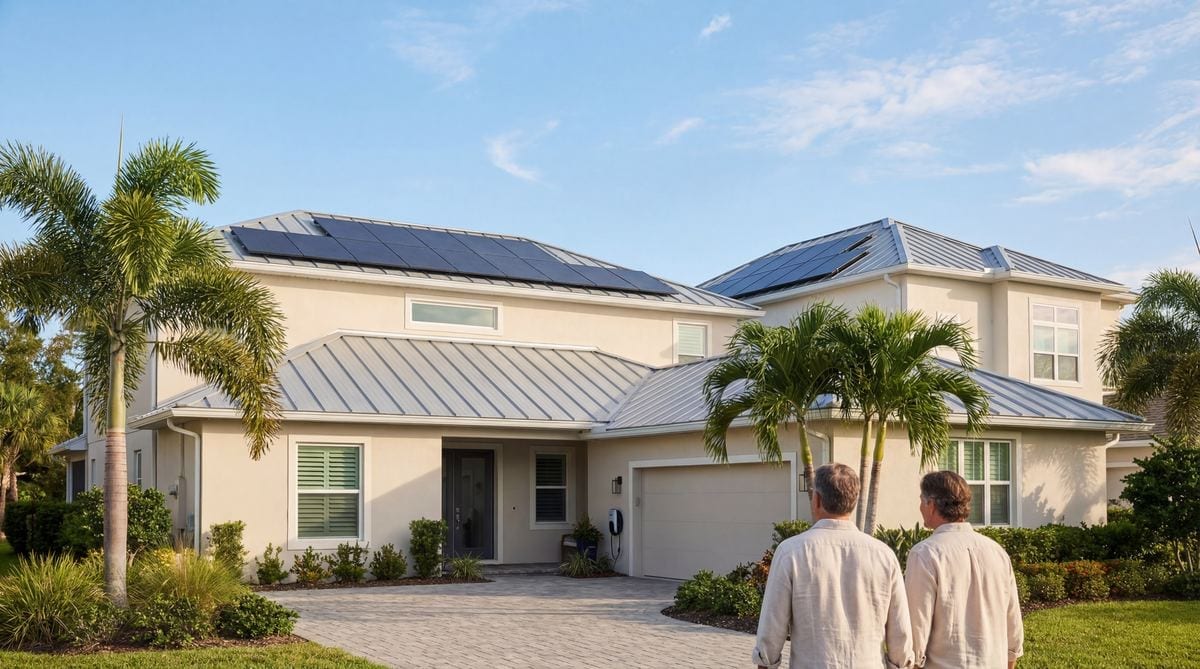
Florida Solar Incentives & Tax Credits (2026 Homeowner Guide)
A working roofer's 2026 guide to Florida solar incentives. Federal tax credits, state exemptions, net metering, and why combining solar installation with roof replacement makes economic sense.
- The federal Residential Clean Energy Credit covers 30% of solar installation cost through 2032, with no cap on the credit amount.
- Florida offers 100% property tax exemption on the added home value from solar installation and sales tax exemption on solar equipment.
- Net metering lets Florida homeowners sell excess solar generation back to the grid, typically offsetting 60-90% of annual electricity cost on properly-sized systems.
- Combining solar installation with roof replacement or metal roofing is economically superior to separate projects. Avoids removing and reinstalling panels later.
Florida solar incentives are substantial in 2026, and the overall economics for Florida homeowners have improved meaningfully over the last few years. Federal tax credits remain at their peak level, Florida state exemptions make the upfront cost cheaper, and net metering produces meaningful offset against utility electricity costs. For Tampa Bay homeowners planning a full roof replacement anyway, combining the roof work with solar installation is often the right economic move.
This article walks through the specific incentives available to Tampa Bay homeowners in 2026, how they stack together, and why the roof-plus-solar combination is usually better than solar-only installation.
The Federal Residential Clean Energy Credit
The federal Residential Clean Energy Credit, extended through the Inflation Reduction Act, covers 30% of qualifying residential solar installation costs through 2032. The credit phases down after 2032 (26% in 2033, 22% in 2034, expires 2035), so 2026 is effectively the peak-incentive window.
Key details for Tampa Bay homeowners:
- Credit amount: 30% of total qualifying solar installation cost. For a typical $25,000-$35,000 residential solar system in Tampa Bay, that equals $7,500-$10,500 in federal tax credit.
- No cap on the credit amount. Unlike previous solar tax credits, the current program has no dollar limit.
- Applies to labor, equipment, and permitting. The 30% covers the full installation cost, not just equipment.
- Non-refundable but carries forward. If your federal tax liability is lower than the credit amount, the excess carries to future tax years until claimed.
- Qualifying systems include solar panels, solar water heaters, battery storage (for systems installed 2023+), and fuel cells.
The credit is claimed via IRS Form 5695 on your federal tax return in the year of installation. We recommend coordinating with your tax preparer to confirm the credit claim structure for your specific situation.
Florida State Incentives
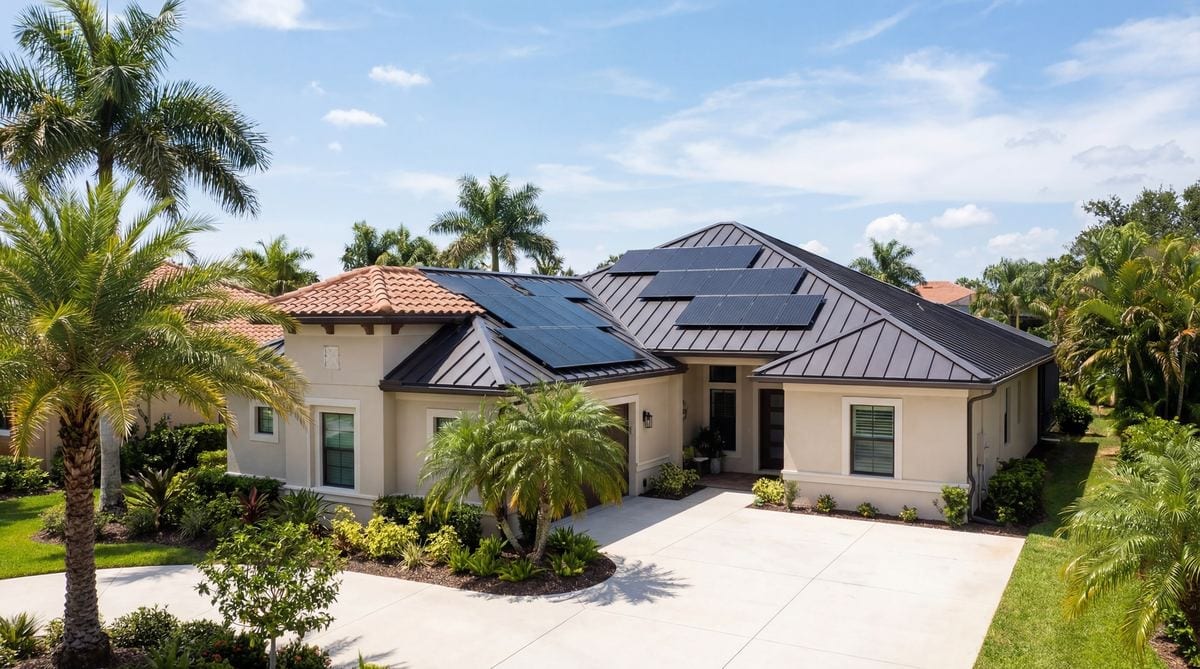
Florida does not offer direct state-level solar tax credits or rebates, but the state provides two significant exemptions that effectively reduce installation cost:
Solar Property Tax Exemption: Florida homeowners do not pay additional property taxes on the added home value from solar installations. A typical Tampa Bay residential solar system adds $15,000-$30,000 in home value, but that added value is exempt from Florida property tax assessment. Over the life of the system (25-30 years), the property tax exemption saves roughly $3,000-$7,000 on typical Tampa Bay homes.
Solar Sales Tax Exemption: Florida exempts solar equipment from state sales tax (currently 6%). On a $25,000-$35,000 solar installation, the sales tax exemption saves $1,500-$2,100 on the equipment portion of the cost.
Together, the two Florida exemptions save Tampa Bay homeowners $4,500-$9,000 over the life of the system versus equivalent installation in a state without these protections.
Net Metering in Florida
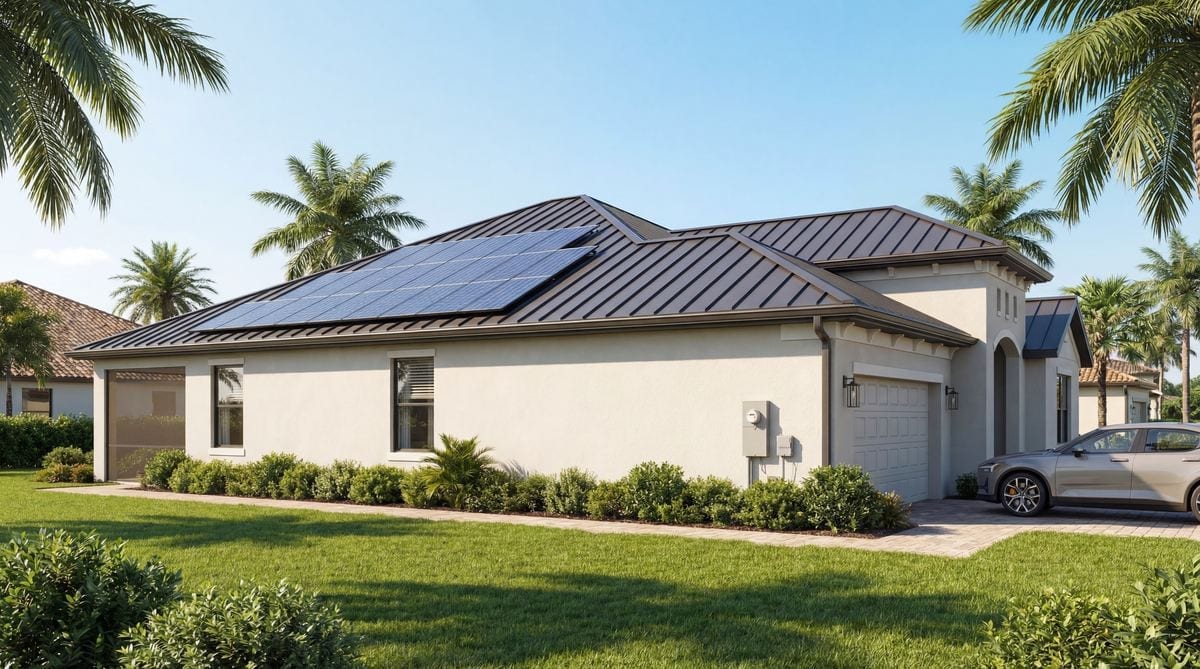
Net metering is the billing arrangement that credits solar homeowners for excess electricity their panels generate and send back to the utility grid. Florida’s current net metering program, administered by each utility under Florida Public Service Commission oversight, provides roughly 1-to-1 retail credits for excess generation on most residential systems.
Tampa Bay homeowners served by Tampa Electric (TECO) or Duke Energy Florida qualify for net metering on properly-sized systems. Typical residential systems offset 60-90% of annual electricity cost, depending on home size, panel orientation, and shading. For a Tampa Bay home with a $200-$350 monthly electricity bill, that offset means $1,500-$3,800 in annual utility savings.
Net metering policies have faced legislative debate in Florida over the last several years. Current policy remains favorable for residential solar but future changes are possible. Homeowners installing solar under current rules are generally grandfathered at existing rate structures for the system’s lifetime.
Why Combine Solar with Roof Replacement
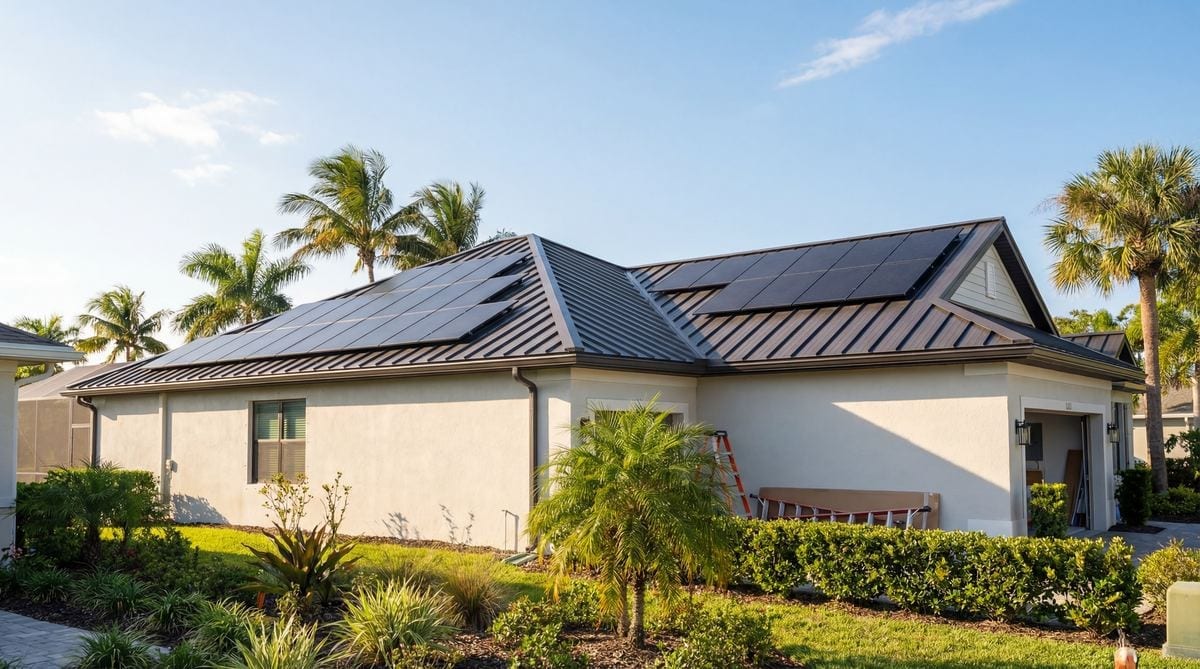
The most economically significant reality for Tampa Bay solar buyers: if your roof is over 15 years old, you should replace it before installing solar. Here is why.
Solar panel systems have 25-30 year service lives. If panels are installed on a roof with 5-10 years of remaining life, you will pay to have the panels removed and reinstalled when the roof is replaced. Panel removal and reinstallation typically costs $3,000-$8,000 depending on system size and installer. That cost erases much of the solar economic benefit.
Installing solar on a newly-replaced roof matches the panel service life to the roof service life. A 25-30 year panel system on a 20-25 year architectural shingle roof means one panel removal at end-of-roof-life. A 25-30 year panel system on a 50-70 year standing seam metal roof means no panel removal during the panels’ entire service life.
The metal roof + solar combination is the gold standard for Tampa Bay long-term homeowners. Standing seam metal roofing accepts solar mounting via specialized clamping hardware that attaches to the metal seams without penetrating the roof surface. That eliminates the primary long-term failure point of rooftop solar (roof penetrations around panel mounts) while extending roof life dramatically beyond the panel service life.
Planning solar for your Tampa Bay home?
Start with a roof assessment. A new roof paired with solar is usually the right economic move for Tampa Bay homeowners.
Typical Tampa Bay Solar Economics
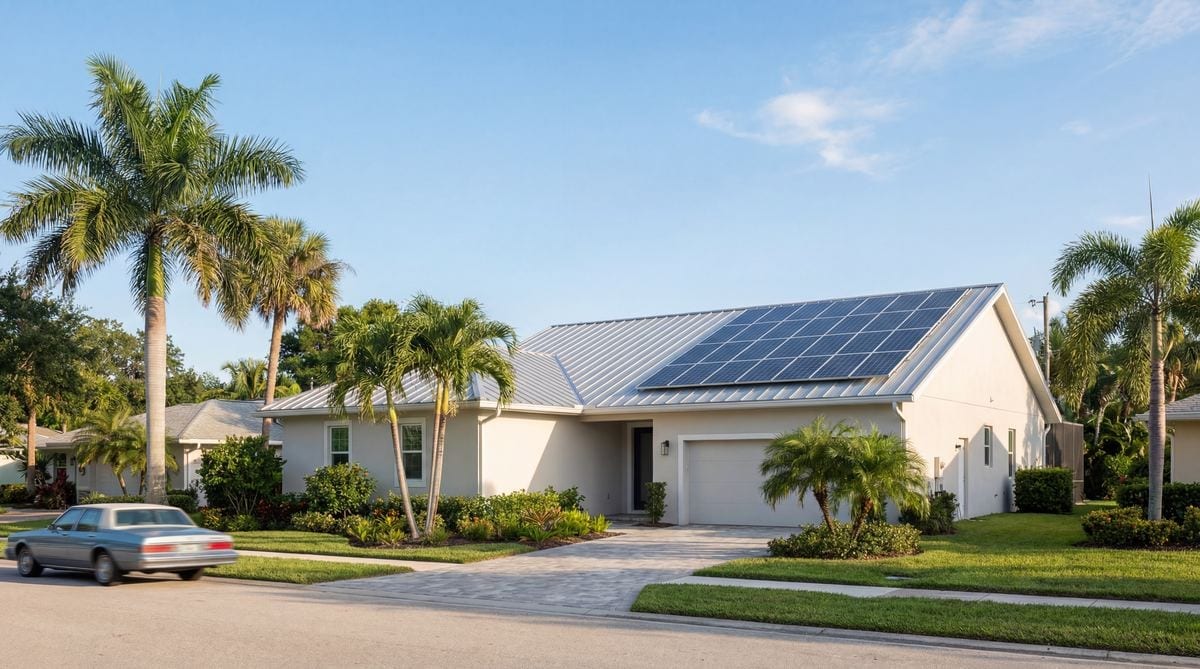
Sample economics for a 2,000 sq ft Tampa Bay home installing a 10 kW residential solar system on a newly-replaced roof:
- Solar system installed cost: $28,000 (before incentives)
- Federal tax credit (30%): -$8,400
- Florida sales tax exemption: -$1,680
- Net installed cost to homeowner: $17,920
- Annual utility offset: ~$2,400 (on typical $250/month electricity bill)
- Simple payback period: 7.5 years
- 25-year net savings: ~$42,000 (after equipment degradation, inverter replacement)
Combined with a metal roof replacement ($30,000-$48,000 before accounting for extended service life and insurance savings), the total roof + solar investment of $48,000-$66,000 generates $60,000-$100,000+ in lifetime value through energy savings, insurance reductions, property value increases, and avoided replacement cycles.
Installation Coordination
Licensed solar installers handle the solar-specific work (panels, inverters, electrical, utility interconnection). Our Tampa Bay roofing team handles the roof replacement or upgrade and makes sure the new roof is built solar-ready for your Tampa Bay home. For combined projects, we coordinate directly with the solar installer on timing, layout, and any specific roof preparation required for the chosen mounting system.
Standard coordination sequence:
- Roof inspection and replacement spec
- Solar system design and financing (typically parallel to roof planning)
- Roof replacement completion
- Solar installation on the new roof
- Utility interconnection and net metering activation
The full timeline from decision to operational system typically runs 6-12 weeks for Tampa Bay homeowners.
Who Should and Should Not Go Solar
Should consider solar:
- Tampa Bay homeowners with roofs under 10 years old or planning replacement soon
- Homes with south, east, or west-facing roof area with minimal shading
- Homeowners planning to stay in the home 7+ years (for payback period)
- Homeowners with electricity bills over $200/month
Should probably not go solar:
- Heavy shading from mature trees with no plans for tree removal
- Very short ownership horizon (under 5 years)
- North-facing primary roof with no alternate orientation
- Extremely low electricity use (under $100/month)
- Historical homes with HOA or designation restrictions on roof modifications
Ready to combine a Tampa Bay roof replacement with solar installation? Schedule a free inspection for the roof assessment, or start with our roof cost calculator for baseline roof pricing. We coordinate with qualified Tampa Bay solar installers for the complete project.
Want a real estimate on your Tampa Bay roof?
Enter your address and we'll pull satellite measurements instantly.
The Integrity Roofing Team · Florida Roofing Experts. Licensed & Insured
The Integrity Roofing of Florida team installs and repairs tile, metal, and shingle roofs across Tampa Bay. With decades of combined field experience, we've helped more than a thousand homeowners navigate hurricane-damage claims, material choices, and the gap between what's marketed and what actually holds up in Florida conditions. Every post is written by working Florida roofers. Not content writers.
Ready to talk to a real human?
No phone tree, no pressure. Owner-level attention on every call.