Roof Maintenance Plans in Florida: What They Include, What They Cost, and Whether They Pay Off
What a roof maintenance plan includes on a Florida roof, what national benchmarks say the pieces cost, when a plan pays off, and when a roof is past one.
- A residential roof maintenance plan is a scheduled roofer visit, once or twice a year, that clears valleys, gutters and drains, reseals boots and flashing, fixes small items on the spot and leaves a dated photo report.
- National benchmarks price the pieces separately: a standalone roof inspection at $400 to $484 per building and gutter cleaning at $1.10 to $1.35 per linear foot (Homewyse, January 2026). We publish no plan price; we quote it after a free inspection.
- The math is a band comparison. What a plan visit catches is, at worst, a $300 to $800 small repair; what it prevents lives in $800 to $2,500 and up, and an early shingle replacement starts at $10,800 for a 2,400 square foot roof.
- A plan is the wrong purchase for a roof at the end of its life. Past 15 years, the conversation is s. 627.7011 and five years of useful life, not a maintenance schedule.
A roof maintenance plan is a scheduled visit from a licensed roofer, once or twice a year, that clears valleys, gutters and drains, reseals pipe boots and flashing, replaces backed-out fasteners and cracked tiles, and leaves you a dated photo report. In Florida the visits are timed around hurricane season, and the price follows a free inspection.
In Tampa Bay the question is never whether a roof needs looking after. It is whether paying a roofer to do it on a calendar beats paying for the leak.
What a Roof Maintenance Plan Visit Covers on a Florida Roof
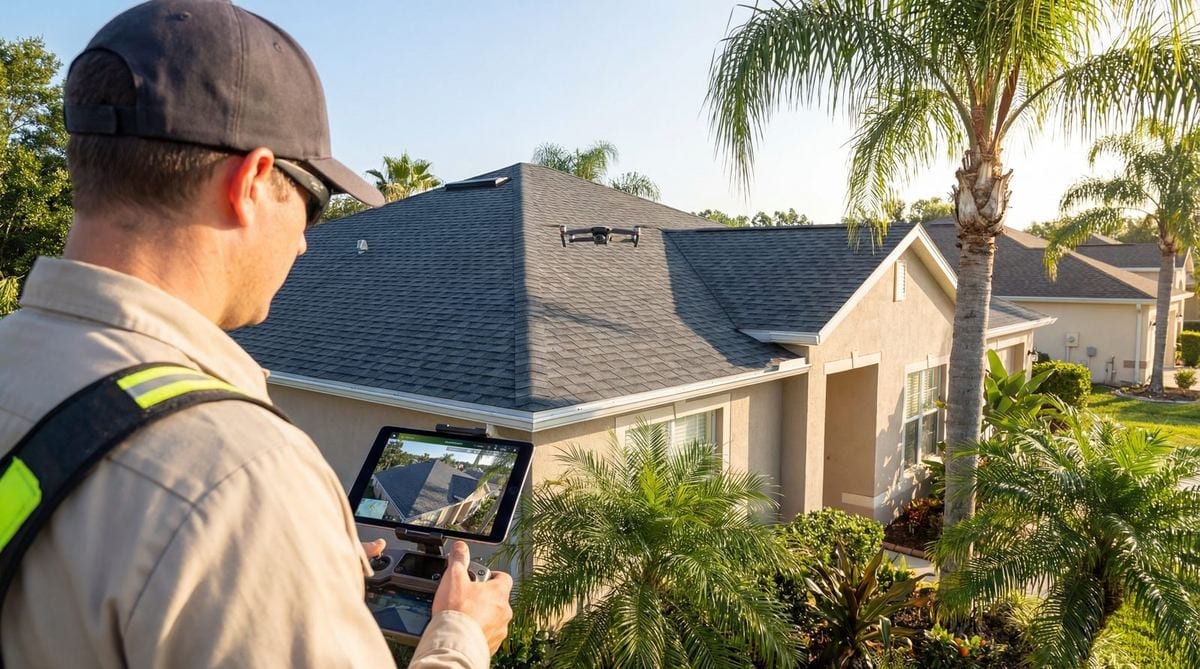
Most of what you will read about maintenance plans is written for 40,000 square feet of commercial TPO and a property manager with a binder. A house in Carrollwood is a different job. Here is what a plan visit covers, by the part of the roof that fails first.
Valleys and gutters under the oaks. The live oaks over Seminole Heights, Temple Terrace and Old Northeast drop leaves in March and pollen strings right behind them, and the valleys pack solid. Water that cannot run down a valley runs sideways, under the shingle edge. We blow out the valleys, clear the gutters and downspouts, and check the first course above every valley for lifted edges.
Drains and scuppers on flat sections. A 1960s block ranch in Town ‘n’ Country or St. Pete often carries a flat section over a Florida room that drains through one scupper, and one tennis ball of debris turns it into a pond. We clear it and look for ponding rings, the first warning on a flat roof.
Pipe boots and sealant. The neoprene collar on a plumbing vent splits at the top after a few summers of UV. We check every boot and every sealant bead, and reseal or replace on the spot.
Flashing at stucco walls. Where a lower roof meets a two-story stucco wall, the kick-out flashing is either there or it is not, and if it is not, water runs behind the stucco. We check step flashing, counterflashing and kick-outs at every wall.
Tile slippage and cracked tiles. On a barrel tile roof in Westchase or a flat concrete profile in Lakewood Ranch, we look for slipped tiles, cracked tiles and broken ridge mortar from the ladder and the ground. Nobody walks the field. Every cracked tile is a path to the underlayment, the layer that keeps the house dry.
Fastener back-out on exposed-fastener metal. 5V crimp and R-panel roofs are held down with screws through neoprene washers, and the panels move with every temperature swing, so the screws back out a thread at a time and the washers dry out. We walk the panel lines, snug or replace fasteners, and look for rust at the laps.
Skylight curbs. A skylight is a hole in the roof with a frame around it. We check the curb flashing, the sealant at the glass and the cladding, because the manufacturer’s skylight warranty covers the unit, not the water that got in around it.
The photo report. Every finding and every fix, dated and filed. More on why that file matters below.
That is the on-roof list. The Florida roof maintenance checklist covers what you can do from the ground between visits.
Two Visits a Year, Timed to June 1 and November 30
The National Hurricane Center puts it plainly: “The Atlantic hurricane season runs from June 1 to November 30,” with a peak on September 10 and most activity between mid-August and mid-October.
So that is the calendar. A semi-annual plan puts the first visit in April or May, so the roof goes into June 1 with clear drainage, fresh sealant and tight fasteners, and the second in December, after November 30, to fix what six months of afternoon storms loosened.
the day the Atlantic hurricane season opens, which is why the spring maintenance visit has to land before it, not after
Source: NOAA National Hurricane CenterAn annual plan is one visit, in late April: after the oak drop, before the afternoon storms start.
Who needs two? Tile roofs, exposed-fastener metal, any roof past ten years, anything with a tree canopy over it, and anything within a few miles of the Gulf or the bay, where salt air eats fasteners. A five-year-old architectural shingle roof in a treeless subdivision in Wesley Chapel can run on one.
A roof maintenance plan is not a product. It is a calendar with a roofer attached to it.
The two-week and 48-hour windows around a named storm are a different job, covered in our Tampa Bay hurricane season roofing prep guide. The plan is what keeps those windows short.
Roof Maintenance Cost: National Benchmarks, Then Our Answer
Search “roof maintenance cost” and you get commercial numbers or a national average with no Florida in it. Here are the pieces of a plan visit priced separately by the national cost guides. Benchmarks, not our prices.
| Task, bought on its own | National benchmark | Source and date |
|---|---|---|
| Roof inspection, 2,000 sq ft roof | $400 to $484 per building | Homewyse, January 2026 |
| Roof inspection | $426 average, most pay $307 to $571 | Fixr, updated January 2025 |
| Gutter cleaning | $1.10 to $1.35 per linear foot | Homewyse, January 2026 |
| Roof cleaning | $0.24 to $0.45 per square foot | Homewyse, January 2026 |
| Roof cleaning, soft wash | $0.30 to $0.75 per square foot; typical job $450 to $700 | Fixr, updated January 2025 |
Two things stand out. The inspection benchmark alone is $400 to $484, and Homewyse describes it as checking “flashings, vents, gutters and downspouts for serviceable life, code issues and repair costs.” A look, not a fix. Nobody reseals a boot for that money.
Stack it on a gutter cleaning and a soft wash and you are in the hundreds before anyone has touched a fastener. A plan bundles the look, the clearing and the small fixes into one visit, which is the point of buying it that way.
Now our answer, and it is a straight one: we do not publish a plan price, because the right number depends on the roof: size, material, pitch, complexity and visits per year. A 1,600 square foot shingle ranch in Pinellas Park is not a 3,400 square foot tile two-story in Lutz with four skylights.
So the price comes after a free roof inspection: we measure, photograph, say which plan fits, and put the plan price in writing before you commit. Our roof maintenance plans page lists what every visit includes.
The free inspection is a diagnosis; the plan visit is the work.
Want the plan price for your roof?
Book the free inspection. We measure the roof, photograph every slope and the attic, and give you the price for an annual or semi-annual plan in writing.
The Math: A Plan vs a $300 Repair vs an Early Replacement

Here is how we would decide it for our own house, using our installed price ranges rather than national averages.
| What you pay for | Our installed range | When it happens |
|---|---|---|
| Small repair (a few shingles, a boot, a flashing patch) | $300 to $800 | Caught on a visit, or called in after a stain |
| Medium repair (skylight reflash, chimney flashing, about 100 sq ft) | $800 to $2,500 | After water has been in for a season |
| Large storm damage (partial or full replacement) | $8,000 to $25,000+ | After a storm finds the weak spot |
| Architectural shingle replacement, 2,400 sq ft roof | $10,800 to $13,200 | At $4.50 to $5.50 per sq ft, end of life |
What a plan visit catches lives in the first row, at worst. Everything it prevents sits in the rows below it, and our Florida roof maintenance checklist walks the boot-in-March versus boot-in-October math line by line. The plan’s job is the calendar. It is what makes the first row happen instead of the second.
The repair row is the cheapest row on that table. The calendar is what keeps you in it.
The replacement row is the one people forget. In our experience the top of every material’s expected life belongs to the roofs that were maintained, and our post on how long a roof lasts in Florida runs the ranges material by material.
Where it does not pay off is further down. First, two reasons it pays off that have nothing to do with leaks.
Your Shingle Warranty Excludes Everything a Plan Catches
Homeowners ask us whether a maintenance plan keeps the manufacturer warranty valid. The honest answer is more useful than a yes: the warranty does not require maintenance. It excludes the damage that skipping maintenance causes.
Read TAMKO’s current fiberglass-asphalt shingle limited warranty, which covers a Heritage roof installed today. It is a manufacturing defect warranty, and the exclusions rule out “shading, staining, discoloration or damage from any cause whatsoever, including, but not limited to algae … moss, fungus, overhanging trees, other biological growth, birds, or animals,” then “damage by traffic on the roof,” then the catch-all: “leaks or damage to the Shingles from any cause other than an inherent manufacturing defect in the Shingles.” TAMKO also states it “is not responsible for the cost of any materials (including, but without limitation, underlayment, flashings, metal work, etc.).”
Overhanging trees. Debris. Foot traffic. Flashing. That is the maintenance list, excluded.
Two more clauses matter. The owner “must notify TAMKO of claims under this Limited Warranty within thirty (30) days following discovery of the potential problem,” and if asked must deliver “a warranty questionnaire, photographs of the roof and samples of two Shingles.” A roof nobody looks at does not get discovered on time, and a roof nobody photographs cannot answer the questionnaire.
The warranty covers the shingle. The plan covers everything around the shingle, which is where Florida roofs fail.
Under that document Heritage carries a 10-year Full Start non-prorated period. TAMKO’s enhanced system warranties run longer (its warranties page says a current TAMKO Certified Contractor must install and register them within 90 days, and the ProShield sample reaches 50 non-prorated years on Titan XT) and carry the same exclusions. Which warranty your roof carries is in our post on roof warranties in Florida.
Skylights are the same story: VELUX warrants its skylights for 10 years on the product and 20 years against seal failure, and the same page says “it is the responsibility of the end user to mitigate and minimize water damage.” The plan visit is how you meet that sentence. Past the seal, our skylight replacement cost post prices the swap.
A Dated Photo File Is What an Insurance Claim Runs On

The second reason, stated carefully, because the insurance words matter.
We document; we do not adjust. Our insurance documentation support means photos, measurements, an itemized estimate, and meeting the adjuster on site if you want us there. The carrier decides the claim, and nobody honest promises how it comes out.
What a maintenance plan adds is the before. Florida’s s. 627.70132 says a claim is barred “unless notice of the claim was given to the insurer in accordance with the terms of the policy within 1 year after the date of loss.” The date of loss is the whole argument after a storm, and a file of dated photos showing the roof intact in April is how you show that the damage in September is September’s. Without that file, the conversation starts with “was it already like this?”
Then roof age. Under s. 627.7011, once a roof is at least 15 years old the insurer must allow an inspection by an authorized inspector at your expense before requiring replacement, and it “may not refuse to issue or refuse to renew a homeowner’s insurance policy solely because of roof age if an inspection … indicates that the roof has 5 years or more of useful life remaining.” That inspection looks at boots, flashing, fasteners, valleys and tile, which is the plan’s list, so a 17-year-old roof in Palm Harbor with a plan file behind it reads as a roof with years left. The age rules in full are in our Florida 15-year roof rule post, and the maintenance checklist covers the stricter Citizens thresholds.
Two things the plan is not: a wind mitigation inspection, which is a separate form and a separate visit, and a promise about your premium or renewal, which is the carrier’s call. Our guide to whether homeowners insurance covers roof replacement in Florida covers the rest.
Who Should Not Buy a Roof Maintenance Plan

We sell these plans, so take this section as the part we would say across the kitchen table.
A roof at the end of its life. If your architectural shingle roof went on in 2003 and is shedding granules into the gutters, a plan cannot buy back years it no longer has. The conversation you need is the 15-year one: an inspection, the five years of useful life question, and a replacement date. Read how old is my roof if you are unsure of the install date, our Florida 15-year roof rule post for what the carrier will ask, then price the shingle replacement.
A roof leaking right now. Fix the leak first. An active leak with wet decking is a roof repair in the $300 to $800 or $800 to $2,500 band, priced on its own with its own photos; the plan goes on after. Our post on roof leak repair cost in Tampa Bay prices the common ones.
A brand-new roof under a clear sky. A two-year-old shingle roof with no trees over it and no flat section does not need two visits a year. It needs one, and we would rather say so than sell you the second.
Anyone buying it as an insurance guarantee. A plan builds a file; it does not change a policy. If a maintenance program pitch promises a discount, a renewal or a claim outcome, walk away.
A gutter problem wearing a roof problem’s clothes. If every visit is a gutter clearing and nothing else, you may need new gutters with guards, not a roof plan; our gutter cost in Tampa Bay post covers that.
Everyone else, which is most roofs between year five and year twenty in a county with oaks, afternoon rain and a hurricane season, is who the plan is for.
Start With the Free Inspection, Then Pick the Plan
Book the free inspection first. Nobody should buy a plan for a roof they have not seen the photos of, and we should not price one that way either.
From that visit you get the photo report, the price for an annual or semi-annual plan, and a straight answer on whether your roof belongs on a plan or on a replacement calendar. A repair first? You get that number too, itemized.
Then the calendar does the remembering: spring before June 1, December after November 30, same roofer, same file, year after year.
That is how we run every plan at Integrity Roofing of Florida, Florida license CCC1334243, across Hillsborough, Pinellas, Pasco, Polk, Manatee and Sarasota.
Put your roof on a calendar
Free inspection first, then a written price for an annual or semi-annual roof maintenance plan, photo-documented and timed around hurricane season. Same-week response.
Frequently Asked Questions
What does a roof maintenance plan include in Florida?+
A scheduled visit from a licensed roofer, once or twice a year. On the roof that means clearing valleys, gutters, drains and scuppers, checking and resealing pipe boots and every sealant bead, checking step and kick-out flashing at walls, looking for slipped or cracked tiles, snugging backed-out fasteners on exposed-fastener metal, and checking skylight curbs. Small fixes happen on the visit. Anything larger is photographed and quoted separately, and you get a dated photo report every time.
How much does a roof maintenance plan cost?+
We do not publish a plan price, because it depends on roof size, material, pitch, complexity and how many visits you want a year; we put the plan price in writing after a free inspection. For scale, national benchmarks put a standalone roof inspection at $400 to $484 per building (Homewyse, January 2026) and gutter cleaning at $1.10 to $1.35 per linear foot, and a plan bundles those tasks with the small fixes into one visit.
How often should a Florida roof get a maintenance visit?+
Once a year is the floor, and the visit belongs in spring, after the oak drop and before the Atlantic hurricane season opens on June 1. Twice a year is the better fit for tile, exposed-fastener metal, any roof past ten years, roofs under a tree canopy and homes near the Gulf or the bay. The second visit goes in December, after the season ends on November 30, to fix what the summer loosened.
Is a roof maintenance plan the same as a roof tune up?+
Close, but a tune up is one visit and a plan is a schedule. A roof tune up is a single appointment to reseal penetrations, snug fasteners, clear drainage and replace a few shingles. A maintenance plan repeats that visit every six or twelve months, on a calendar, with the same roofer and a growing photo file. The repeat visits and the dated record are what make the plan worth more than a one-time tune up.
Does a roof maintenance plan keep my shingle warranty valid?+
The warranty does not require maintenance, but it excludes what skipping it causes. TAMKO's current shingle limited warranty rules out damage from overhanging trees, moss, algae, biological growth and traffic on the roof, excludes flashing and underlayment entirely, and requires the owner to notify TAMKO within 30 days of discovering a problem, with photographs on request. A plan is how a problem gets discovered on time and photographed.
Can a maintenance plan help with homeowners insurance in Florida?+
It builds the file an insurance conversation runs on, and nothing more. Dated photos of a roof in good condition help show when storm damage happened, which matters because Florida law bars a claim unless notice is given within one year of the date of loss. Past 15 years, Florida law lets you show five or more years of useful life with an inspection, and a maintained roof inspects better. We document; we do not adjust, and the carrier decides.
Should I put a 20-year-old shingle roof on a maintenance plan?+
Usually not. Our installed architectural shingle carries an expected life of 20 to 25 years, so a roof at 20 is near the end of its range, and a plan cannot give back years it no longer has. The better conversation is an inspection, the five years of useful life question your carrier will ask, and a replacement date. A plan can keep it dry for a season while you plan the replacement, and that is all it should promise.
Want a real estimate on your Tampa Bay roof?
Enter your address and we'll pull satellite measurements instantly.
Mike Shepherd · Co-Owner, Integrity Roofing of Florida
Mike Shepherd co-owns Integrity Roofing of Florida with Bettina Savorelli. The company is a Florida-licensed roofing contractor (license CCC1334243), a TAMKO Pro Gold and GAF-certified installer, and a BBB A+ rated business serving Hillsborough, Pinellas, Pasco, Polk, Manatee and Sarasota counties. His crews install and repair tile, metal and shingle roofs across Tampa Bay and document storm damage for homeowners' insurance claims. Every article is written from the field, not from a content desk.
Ready to talk to a real human?
No phone tree, no pressure. Owner-level attention on every call.