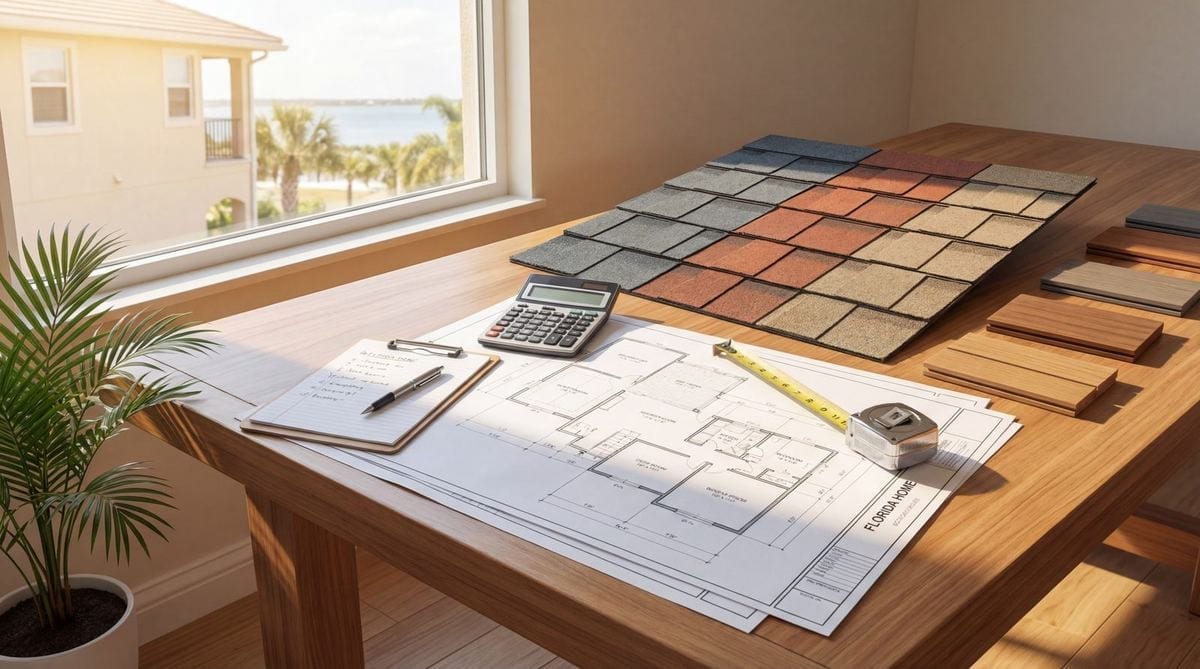
Flat Roof Replacement Cost in Florida (2026): TPO, Modified Bitumen, Coatings and Repair
Flat roof replacement cost in Florida by system: TPO, PVC, modified bitumen and coatings per square foot, what the code requires, and when to repair.
- National 2026 benchmarks put TPO at $4 to $14 per square foot installed, modified bitumen at $4 to $9, PVC at $5 to $16 and a silicone or acrylic recoat at about $0.50 to $5. We publish no flat roof price of our own; we quote after a free inspection.
- The Florida Building Code wants a quarter inch per foot of slope on modified bitumen and TPO, a drain at every low point, and a membrane tested for wind uplift. On a dead-flat 1960s deck, tapered insulation is where that money goes.
- Most of the flat roof repairs we do are at the tie-in where the flat section meets the pitched roof, or in a spot that holds water. Our published repair bands are $300 to $800 small and $800 to $2,500 medium.
- The 25 percent rule counts each roof section on its own, so a 400 square foot lanai roof can cross the line with a 100 square foot patch. The permit date on the existing roof decides which version of the rule applies.
Flat roof replacement cost on a Florida home runs about $4 to $14 per square foot installed for TPO and $4 to $9 for modified bitumen, based on 2026 national benchmarks, with PVC and low-slope metal above that. On a 600 square foot lanai or addition roof, that math is $2,400 to $8,400 before tear-off, tapered insulation and code work.
Tampa Bay is full of these roofs. The 1950s and 1960s concrete-block ranches in Seminole Heights, Town ‘n’ Country, Disston Heights and Gulfport almost all carry a flat or low-slope section somewhere: a converted carport, a Florida room, a lanai somebody enclosed in 1978.
Flat Roof Replacement Cost Per Square Foot, System by System

We publish installed ranges for shingle, metal and tile. We do not publish one for flat roofs, and we are not going to invent one here.
Too much of a flat roof’s price lives under the old membrane: wet insulation, rotted decking, a drain that was never there, a tie-in somebody caulked instead of flashed. So the numbers below are national benchmarks, and the number for your roof comes after a free inspection.
| System | National benchmark, installed per sq ft | Benchmark life | Where it fits on a Tampa Bay home |
|---|---|---|---|
| TPO, 45 to 80 mil | $4 to $14 (Fixr); $8 to $11 (This Old House) | 20 to 30 years | White, reflective, heat-welded seams. Our default on a lanai, addition or carport that bakes all afternoon |
| PVC | $5 to $16 (Fixr) | 20 to 30 years | The upgrade when a kitchen exhaust or grease vent lands on the flat section |
| Modified bitumen, torch or cold applied | $4 to $8 (Fixr); $7 to $9 (This Old House) | about 20 years | The granulated gray roof on most 1960s block homes; easy to repair, tolerates foot traffic |
| Modified bitumen, self-adhered | Same bands; no separate national line | Same | Our pick next to wood soffits and screen cages; no open flame |
| Silicone or acrylic coating over a sound roof | $0.50 to $5, depending on coating type (Fixr) | Recoat about every five years | Only over a dry membrane with intact seams. Never a fix for a wet roof |
| Metal on low slope (standing seam at 1/4:12 or steeper) | $15 to $21 (This Old House) | 40 to 100 years | When the flat section is visible from the street and the main roof is already metal |
Read what those benchmarks leave out. Fixr prices removal and disposal of the old roof at $1 to $5 per square foot on top, and Homewyse’s May 2026 membrane figure of $8.04 to $10.29 per square foot carries tear-off and disposal as separate lines.
TPO thickness moves the number too. Fixr’s September 2026 TPO guide puts 45-mil at $3.00 to $4.50, 60-mil at $4.00 to $6.50 and 80-mil at $5.50 to $8.50 per square foot installed, with insulation adding $1.60 to $15 per square foot, flat board to full tapered package.
Now the square math. A 20 by 30 foot enclosed lanai is 600 square feet, six squares. At the TPO benchmark that is $2,400 to $8,400 for the membrane, plus $600 to $3,000 to strip what is there, plus tapered insulation if the deck is dead flat.
That is the honest residential flat roof replacement cost in this market: a range, then an inspection. On our flat and low-slope roofing jobs we install GAF EverGuard TPO, GAF LIBERTY self-adhered and Mule-Hide systems, and the quote names which one and why.
Why National Flat Roof Averages Run From $8,000 to $24,510
Two reputable guides, two very different averages. Fixr says flat roof replacement costs $4,000 to $21,000, with a national average of $8,000. This Old House says $24,510 on average, with a range of $11,311 to $37,709.
Neither is wrong. This Old House is pricing a 2,000 square foot flat roof, which is a whole flat-roofed house or a small commercial building. Most of the flat roofs we replace on homes in Pinellas and Hillsborough are a lanai, an addition or a carport behind a pitched main roof, a fraction of that area.
An average is a building you do not own. Price your roof by the square, then add the tear-off and whatever is under it.
If the roof in question is on a strip center or a warehouse, that is a different job. Our commercial roof replacement page and our commercial roof replacement cost in Florida guide cover tear-off versus recover, core samples and phasing around tenants.
What the Florida Building Code Demands on a Low-Slope Roof
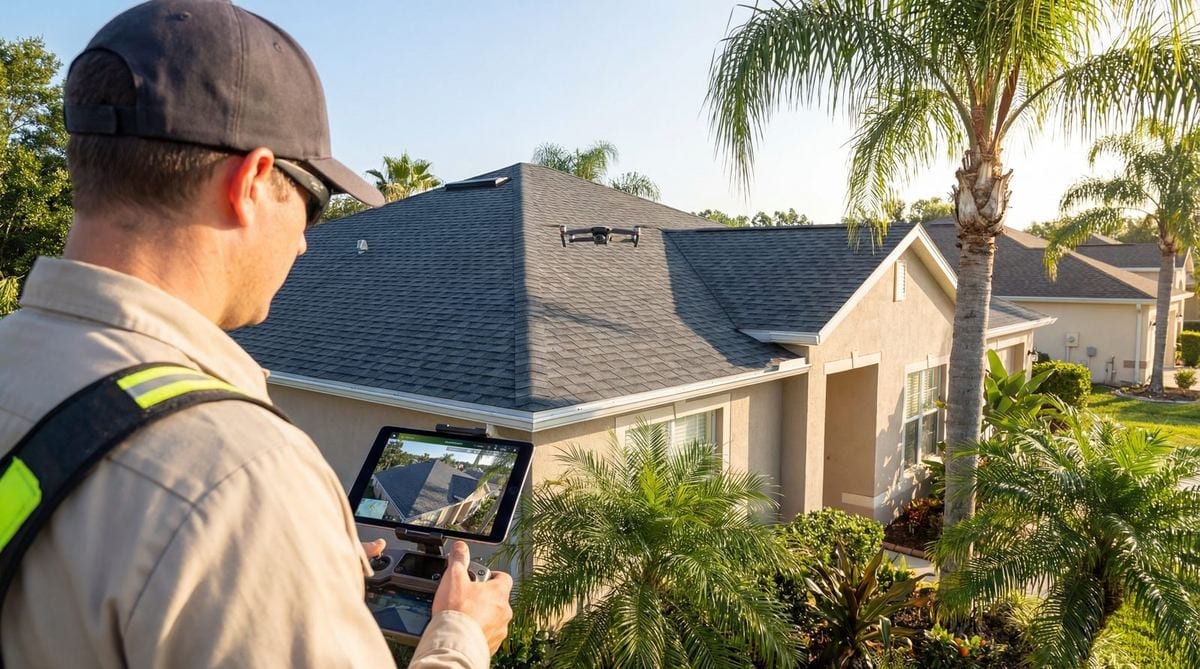
Four code items decide more of a Florida flat roof’s price than the membrane brand does.
Slope. The Florida Building Code, Residential, says modified bitumen membrane roofs “shall have a design slope of not less than one-fourth unit vertical in 12 units horizontal,” and the thermoplastic single-ply section (TPO and PVC) uses the same one-fourth in 12. Standing seam metal gets the same minimum. A 1962 carport deck in Town ‘n’ Country was built dead level. The only way to get a quarter inch per foot on it is tapered insulation or a cricket, and that is a line item, not a trick.
Drainage. The residential code is blunt: “Unless roofs are sloped to drain over roof edges, roof drains shall be installed at each low point of the roof.” The building code defines positive roof drainage as a roof where “additional slope has been provided to ensure drainage of the roof within 48 hours of precipitation.” That 48 hours is the test we use on every flat section we inspect.
How quickly the Florida Building Code expects a positively drained roof to shed a rain. Water still standing on day three is a design problem, not a weather problem.
Source: 2023 Florida Building Code, Building, Section 1502.1Wind. The residential code requires roof coverings to be “installed to resist the component and cladding loads specified in Table R301.2(2),” and the building code requires built-up, modified bitumen and single-ply systems to be “tested in accordance with FM 4474, UL 580 or UL 1897.” The membrane, the fastener pattern and the edge metal have to match the design pressure for your address, and that pressure climbs toward the Gulf. A Gulfport lanai and a Plant City carport do not get the same screw spacing.
Mitigation. Florida’s s. 553.844 lists “strengthening or correcting roof-decking attachments and fasteners during reroofing” and a secondary water barrier among the techniques that apply at reroof. On a plank deck from 1958, re-nailing is real labor.
One more rule kills the cheapest quote you will get. The residential code says new roof coverings shall not be installed without first removing all existing layers where “the existing roof or roof covering is water soaked” or where “the existing roof has two or more applications of any type of roof covering.” Plenty of the mod bit roofs we open in Disston Heights have two layers. “We’ll just go over it” is not a price. It is a permit problem.
Tie-Ins and Ponding: Where Flat Roof Repairs Actually Happen

The flat roof almost never leaks in the middle. It leaks where it meets something else.
On a Tampa Bay home, “something else” is the pitched roof. The shingle slope above dumps every afternoon storm onto the flat section, and the joint has to take it: a base flashing turned up the wall, a counterflashing above it, and the membrane terminated so the shingle course sheds over it, not under it. When that joint was done with roofing cement in 1994, the leak shows up in the Florida room ceiling two feet in from the wall.
The second place is the pond. A low spot that holds water past that 48 hour mark cooks in the sun, cools at night, and works the membrane until a seam opens or a blister lifts. On mod bit it shows as bare asphalt where the granules used to be. On TPO it shows as a seam you can slide a putty knife into.
The third is anything that pokes through: a bath fan, a plumbing vent, the rail of a screen cage screwed straight through the membrane.
What that costs to fix, from our published repair bands and the national benchmarks:
| Repair | Our published band | National benchmark (Fixr, 2026) |
|---|---|---|
| Small: one lifted seam, a pipe boot, a flashing patch | $300 to $800 | Seams $200 to $1,000; flashing $200 to $750 |
| Medium: rebuild a tie-in, cricket a ponding spot, about 100 sq ft | $800 to $2,500 | Ponding $70 to $750; blisters $250 to $1,500 |
| Any flat roof repair | Quoted after inspection | $300 to $1,100, average $700 |
The national flat roof repair cost line lands inside our small band for a reason: most of these are a half day for one crew with a heat gun or a roll of self-adhered cap sheet. Our roof repair page covers how we scope them, and our roof leak repair cost in Tampa Bay guide prices the leak itself.
Not sure if your flat section needs a patch or a new roof?
We inspect for free, moisture-check the deck, photograph the tie-in and tell you which row of the decision table you are in before anyone talks price.
Repair, Recoat or Replace: The Decision Table We Use
Three options, and the cheap one is only cheap if the roof qualifies for it.
| What we find | What we recommend | What it tends to cost |
|---|---|---|
| One failed seam, a bad pipe boot, flashing pulling away at the tie-in; deck and insulation dry | Repair | $300 to $800 (our small band) |
| Several seams, a ponding spot that needs a cricket, a tie-in rebuilt end to end | Repair, medium | $800 to $2,500 (our medium band) |
| Membrane dry and bonded, seams tight, surface chalked and sun-worn | Recoat | $0.50 to $5 per sq ft national; we quote after inspection |
| Wet insulation, two layers, blisters across the field, water standing past 48 hours, deck soft underfoot | Replace | TPO $4 to $14 and mod bit $4 to $8 per sq ft national (Fixr), mod bit $7 to $9 (This Old House); we quote after inspection |
| Repair would cover more than 25 percent of the section and the roof predates March 2009 | Replace the section to current code | Priced as a replacement of that section |
A coating is sunscreen, not surgery. It protects a roof that is already dry. It does not dry out a roof that is already wet.
Coatings earn their keep in one situation: a sound membrane that has lost its surface to the sun. A white silicone or acrylic topcoat puts reflectivity back. The EPA lists liquid-applied coatings and single-ply membranes among the cool roof products for low-slope roofs, and says a reflective roof on an air-conditioned home can “reduce peak cooling demand by 11 to 27 percent.” Mule-Hide says the same of its TPO: the “reflective white surface reduces rooftop and indoor temperatures.” On a west-facing Florida room in St. Petersburg, you feel that in August.
Coatings fail in one situation too: anything wet under them. Silicone over a soaked mod bit roof seals the moisture in, and the first blister shows up by the next rainy season. That is why we moisture-check before we quote one.
The self-adhered question comes up on every lanai. Polyglass builds its Polyflex SA P cap sheet on a dual-compound self-adhered base so that, with its Elastoflex SA V base sheet, the system “removes the need for torches, hot asphalt, or bonding adhesives on the job site.” Or, as Polyglass puts it, “Self-adhered systems do not require any heat or open flames to be installed.” Next to a wood soffit, a screen cage and a neighbor’s fence, that is the system we want on the truck.
Our roof repair versus replacement in Florida guide walks the same decision for shingle and tile, and the roof maintenance plan cost guide covers what a twice-a-year drain and seam check is worth.
The 25 Percent Rule Applies to Each Roof Section
Florida’s building code says: “Not more than 25 percent of the total roof area or roof section of any existing building or structure shall be repaired, replaced or recovered in any 12-month period unless the roof covering on the entire existing roof system or roof section is replaced or recovered to conform to the requirements of this code,” per FRSA’s Florida Roofing magazine. The residential code carries the same language in section R908.1.1.
Read the words “roof area or roof section.” On the homes we work, the flat addition behind a pitched main roof is its own section. Its 25 percent is 25 percent of the flat area, not 25 percent of the whole house. A 400 square foot enclosed lanai roof crosses the line at 100 square feet of repair, which is one medium ponding fix.
The exception has a date. FRSA notes SB 4-D added, effective May 27, 2022, that for a roof built or replaced under the 2007 Florida Building Code or later, “only the repaired, replaced, or recovered portion is required to be constructed in accordance with the Florida Building Code in effect,” and that the 2007 code was not effective until March 1, 2009.
So on a flat section permitted in 2012, a big repair stays a repair. On the original 1960s mod bit, or the 1998 re-cover nobody pulled a permit for, a repair past a quarter of the section becomes a replacement of that section to current slope, drainage and wind code. We would rather say so before the inspector does. Our Florida 25 percent roof rule explained post covers how adjusters and inspectors read it.
Permits, Timeline and Paying for a Flat Roof in Tampa Bay

A flat section is a reroof. It gets a permit, a progress inspection and a final like any other roof. Our published reroof permit fee ranges by county:
| County | Reroof permit fee range |
|---|---|
| Hillsborough | $150 to $350 |
| Pinellas | $175 to $400 |
| Pasco | $125 to $300 |
| Manatee | $150 to $350 |
| Sarasota | $175 to $425 |
| Polk | $125 to $275 |
The fee is small. The inspection it brings is what catches a membrane fastened at the wrong spacing or a skipped drain. Our Tampa Bay roof permit guide by county covers each office.
Timeline. On a lanai or addition section, the on-roof work is short: tear-off and dry-in, tapered insulation, membrane, edge metal and the tie-in. The permit and the inspections are what stretch the calendar, and summer afternoons decide which days we can open a roof at all. Done with the main roof, it goes in the same permit and the same week.
Paying for it. A flat section on its own is a smaller check than a full roof. When it rides along with a full replacement, our roof financing page covers the credit-based GreenSky loan and the Ygrene PACE option repaid through the property tax bill, both subject to approval. Run PACE past your mortgage lender first.
Insurance. If a storm lifted the membrane or dropped a limb through it, your homeowners policy may be the payment path. We are not adjusters and we never promise an outcome. We document: photos, measurements, an itemized estimate and meeting the adjuster on site. Our guide to whether homeowners insurance covers roof replacement in Florida covers what the policy looks at. Slow wear, ponding and sun damage are maintenance, not a claim, and we say so up front.
What to Do Before You Sign a Flat Roof Quote
A flat section on a Tampa Bay ranch is where the cheapest contractor hides the most: a coating over a wet roof, a recover over two layers, a tie-in caulked instead of flashed.
Ask every bidder four things. The square footage and the price per square foot. Whether tear-off and tapered insulation are in the number. How the tie-in to the pitched roof will be flashed. And which membrane, by brand and thickness.
Then run the instant roof estimate for the main roof if it is due too; a flat section and a shingle roof in the same permit is the cheapest version of both.
We inspect for free, we respond the same week, and every flat roof estimate from Integrity Roofing of Florida names the system, the slope fix, the tie-in detail and the permit line, so the only variable left on job day is what the tear-off finds.
Get a flat roof estimate that names the system and the slope fix
Free inspection, same-week response, and an itemized quote for TPO, self-adhered modified bitumen or a recoat, with the tie-in detail and permit line written down.
Frequently Asked Questions
How much does flat roof replacement cost per square foot in Florida?+
National 2026 benchmarks put TPO at $4 to $14 per square foot installed, modified bitumen at $4 to $9, PVC at $5 to $16, and metal on a low-slope roof at $15 to $21. Those figures come from Fixr and This Old House, not from us. We do not publish a flat roof price because tear-off, wet insulation, tapered slope and the tie-in to the pitched roof move the number too much. We measure the roof and quote after a free inspection.
How much does a TPO roof cost on a house?+
For a 1,500 square foot flat or low-slope roof, Fixr's 2026 TPO guide gives $6,500 to $24,000 with a national average around $10,700, or $4.50 to $16 per square foot installed. Thickness matters: 45-mil membrane is the cheapest, 80-mil the most expensive and the most puncture resistant. Most residential flat sections in Tampa Bay are smaller than 1,500 square feet, so a lanai or addition roof usually lands well under those totals.
Is modified bitumen cheaper than TPO?+
Usually, by a little. Fixr's 2026 flat roof guide lists modified bitumen at $4 to $8 per square foot against $4 to $14 for TPO, and This Old House has modified bitumen at $7 to $9 against TPO at $8 to $11. The gap is small on a 600 square foot lanai roof. We choose by the roof, not the price: self-adhered modified bitumen where a torch would be a bad idea, white TPO where heat and drainage are the problem.
How much does it cost to coat a flat roof instead of replacing it?+
Fixr puts roof coatings at $0.50 to $5 per square foot depending on the coating type, and This Old House says a flat roof should be coated about every five years. That only makes sense over a dry, sound membrane with its seams and flashings intact. A coating over wet insulation or a failed seam seals the water in. We moisture-check the roof before we recommend one, and we say no when the roof is not a candidate.
How much does flat roof repair cost in Tampa Bay?+
Our published repair bands are $300 to $800 for a small repair such as a lifted seam or a flashing patch, and $800 to $2,500 for a medium repair such as rebuilding a tie-in or a ponding area of roughly 100 square feet. Fixr's 2026 national figure is $300 to $1,100 with an average of $700. Most of the flat roof repairs we do are at the joint with the pitched roof or in a spot that holds water.
Does the 25 percent rule apply to a flat section of my roof?+
Yes. The Florida Building Code limits repair, replacement or recovery to 25 percent of the total roof area or roof section in any 12-month period unless the whole section is brought to current code. A flat addition or lanai roof is its own section, so a 100 square foot repair on a 400 square foot flat roof crosses the line. The exception for roofs built under the 2007 code or later depends on when your roof was permitted.
How much slope does a flat roof need in Florida?+
The Florida Building Code, Residential, requires a design slope of not less than one-fourth inch per foot for modified bitumen, thermoplastic single-ply such as TPO and PVC, built-up roofs and standing seam metal. A truly flat 1960s deck does not have that, which is why tapered insulation or crickets show up on the estimate. The code also requires a drain at each low point unless the roof is sloped to drain over its edges.
Want a real estimate on your Tampa Bay roof?
Enter your address and we'll pull satellite measurements instantly.
Mike Shepherd · Co-Owner, Integrity Roofing of Florida
Mike Shepherd co-owns Integrity Roofing of Florida with Bettina Savorelli. The company is a Florida-licensed roofing contractor (license CCC1334243), a TAMKO Pro Gold and GAF-certified installer, and a BBB A+ rated business serving Hillsborough, Pinellas, Pasco, Polk, Manatee and Sarasota counties. His crews install and repair tile, metal and shingle roofs across Tampa Bay and document storm damage for homeowners' insurance claims. Every article is written from the field, not from a content desk.
Ready to talk to a real human?
No phone tree, no pressure. Owner-level attention on every call.