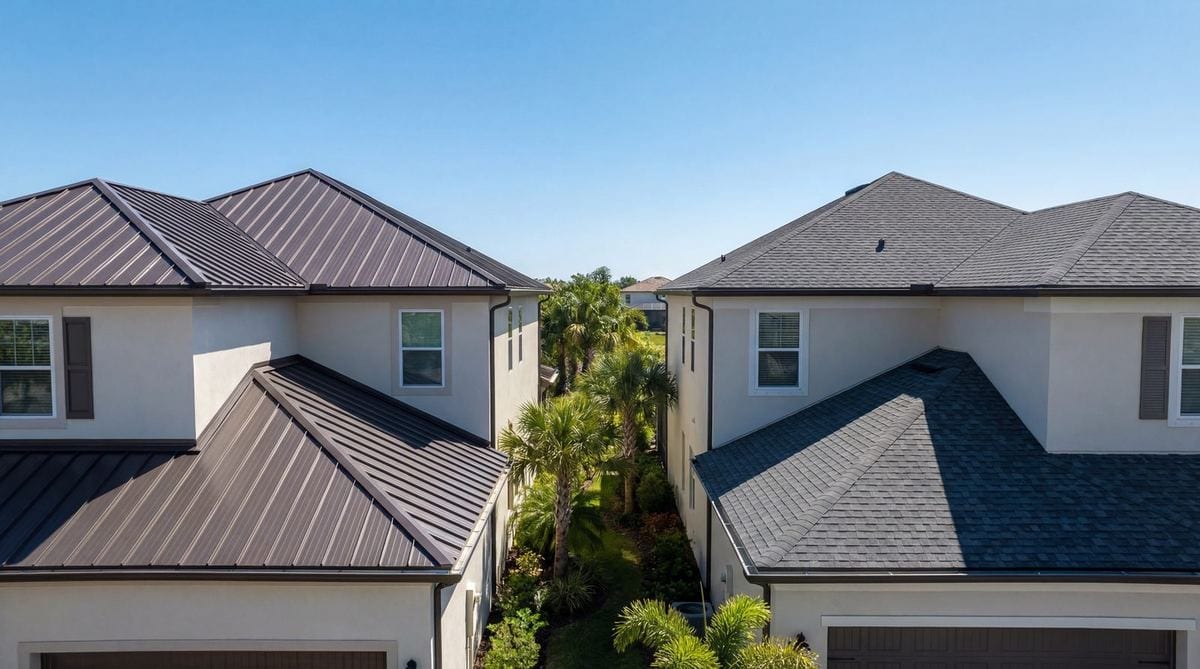
Metal Roof Cost in Florida (2026): 5V Crimp vs Exposed-Fastener vs Standing Seam
Metal roof cost in Florida, panel by panel: 5V crimp and R-panel at $8.50 to $11 per sq ft, standing seam at $10 to $16, and what moves the price.
- Exposed-fastener metal (5V crimp, R-panel) runs $8.50 to $11.00 per square foot installed in Tampa Bay and standing seam runs $10.00 to $16.00. Those are our published ranges, not national averages.
- On a 2,000 sq ft home carrying about 2,400 sq ft of roof, that is roughly $20,000 to $26,000 for 5V crimp and $24,000 to $38,000 for standing seam, before steep-pitch, complexity or coastal-finish adders.
- 5V crimp is a screw-maintenance roof. The neoprene washers under its exposed screws are the wear item, so budget at least one re-screw visit in the roof's life. Standing seam hides its fasteners and skips that job.
- Over 30 years, standing seam usually beats architectural shingle because the shingle roof gets replaced at least once in that window, and a quality metal roof may cut your premium 5% to 35% depending on the insurer.
Metal roof cost in Florida runs $8.50 to $11.00 per square foot installed for exposed-fastener panels (5V crimp, R-panel) and $10.00 to $16.00 for standing seam, based on our published Tampa Bay ranges. A 2,000 sq ft home carries about 2,400 sq ft of roof, so budget roughly $20,000 to $38,000 depending on panel, gauge and finish.
That spread matters more here than almost anywhere: Tampa Bay sits in a wind zone that rewards metal, much of our service area breathes salt air, and the gap between a 26-gauge 5V barn panel and a 24-gauge Kynar standing seam system can change which house you can afford to put it on. Here is how we quote it, panel by panel.
Metal roof cost in Florida: our Tampa Bay price per sq ft
Ignore the national numbers first. Angi puts metal roofing anywhere from $4 to $30 per square foot, with standing seam alone spanning $7 to $30. A range that wide tells you nothing about a house in Riverview.
Our ranges are narrower because they are ours. Every figure below is an installed price from our published Tampa Bay price ranges, with tear-off, disposal, underlayment, flashings and the county permit inside the number. Structural repairs such as rotted decking are quoted separately, because nobody can see them until the old roof is off.
| Panel system | Installed cost (our range) | Expected life | Wind rating | The look | Maintenance |
|---|---|---|---|---|---|
| 5V crimp | $8.50 to $11.00 per sq ft | 30 to 40 years | Up to 140 mph | Old Florida: cracker houses, bungalow porches, fish camps | Exposed screws and neoprene washers; plan at least one re-seal or re-screw visit |
| Exposed-fastener rib (R-panel) | $8.50 to $11.00 per sq ft | 30 to 40 years | Up to 140 mph | Agricultural and modern farmhouse; wide flat pans | Same screw schedule; the wide pans show more oil-canning |
| Standing seam | $10.00 to $16.00 per sq ft | 50 to 70 years | 160 to 180+ mph | Clean vertical lines; premium modern and coastal | Concealed clips, no screws through the field; check sealants at flashings |
Now do the math. A 2,000 sq ft home usually carries about 2,400 sq ft of roof once pitch, overhangs and waste are counted, so you land at roughly $20,000 to $26,000 for either exposed-fastener panel and $24,000 to $38,000 for standing seam.
What pushes a job toward the top of its range:
- Pitch. Steep roofs slow the crew and need more safety gear. Angi’s national data has steeper pitches adding 15% to 35%, and the two-story colonials in Westchase bear that out.
- Complexity. Hips, valleys, dormers, a dozen penetrations. On standing seam every one is custom trim, so complexity moves standing seam further than 5V. Angi puts complex hip roofs and dormers at 15% to 25% extra.
- Labor. Roughly 60% of a metal roof’s price is labor, which is exactly why the standing seam gap exists.
- Tear-off surprises. Removal is inside our quote (Angi prices it at $1,000 to $5,000 on its own); rotten decking is priced per sheet after tear-off, and we show you the photos.
Permit fees are inside our quotes too, but you should know the line: Hillsborough $150 to $350, Pinellas $175 to $400, Pasco $125 to $300, Manatee $150 to $350, Sarasota $175 to $425, Polk $125 to $275.
These are Tampa Bay ranges. Metal roof installation cost in South Florida, inside the High-Velocity Hurricane Zone, is a different market and we do not quote there.
5V crimp: the Old Florida roof we love on the right house
5V crimp is the roof Florida wore before Florida had air conditioning. A steel sheet with five V-shaped ribs, two at each edge so the panels overlap and one down the middle, screwed straight through the face into the deck. Each screw head sits on a neoprene washer, and you can see every one from the driveway. That is not a flaw. That is the look.
We love it on the 1920s bungalows in Old Seminole Heights and Ybor, on the cracker-style new builds around Parrish and Myakka City, on the fish camps out toward Cortez, and on every barn and pole building from Plant City to Dade City. Bare Galvalume 5V over a deep porch is as Florida as a screened lanai.
Exposed screws are not a defect. They are a maintenance schedule.
Here is the part the brochures skip. Steel moves. Every August afternoon the panel heats up and pulls against a screw pinned to the deck; every night it shrinks back. The neoprene washer under each screw head is all that keeps water out of the hole, and eventually, in our sun, those washers harden and the screws back out. We see it on the acreage homes north of Lutz all the time: a rust streak below a screw, then a drip in the utility room.
The fix is a service visit, not a new roof: oversized screws, fresh washers, re-sealed laps. Budget for it once or twice and a 5V roof will go its full 30 to 40 years.
Where we push back: waterfront homes (salt plus screw holes is a bad marriage), low-slope sections where the lap cannot shed water, roofs cut up with hips and skylights, and any two-story house nobody will ever climb to check a screw. On those we quote standing seam.
Exposed-fastener vs standing seam: what the price gap buys

Standing seam flips the fastening. The panels lock together at a raised seam and are held to the deck by concealed clips, so there is not a single screw through the field of the roof. The panel floats on those clips and can expand and contract all summer without fighting a fastener: no hole, no washer, nothing to back out.
Two flavors matter in Tampa Bay. Snap-lock panels click together and are fine inland. Mechanically seamed panels get their seams folded closed by a machine on the roof, and that is what we spec within sight of the water and wherever wind is the reason you are buying metal. Rated 160 to 180+ mph, against up to 140 mph for exposed-fastener systems.
Nationally, Angi has exposed-fastener systems costing 30% to 50% less than hidden-fastener systems. Our gap is narrower: $1.50 to $5.00 per square foot, which is $10.00 minus $8.50 at the bottom of the two ranges and $16.00 minus $11.00 at the top. The tear-off, the underlayment and the crew are the same under both panels, so the extra money buys the panel itself, the clips and the hours it takes to seam and trim. Snap-lock panels sit at the bottom of our standing seam range. Mechanically seamed 24-gauge Kynar, the coastal spec, sits at the top.
Angi’s standing seam guide lands between $9,400 and $32,600 with an average of $19,000, and a 2,400 sq ft mechanically seamed roof here usually lands above that average. That is the price of building for a hurricane zone.
Two things under the panel decide whether any of it lasts. Metal runs hotter than shingle, so the underlayment beneath it should be a high-temperature synthetic or self-adhered sheet, not the felt-grade sheet a shingle roof gets away with. Ask for it by name on every metal quote, ours included. Decking is the other. Nobody knows how many sheets are soft until the old roof is off, so a good contract carries a per-sheet price and the photos to back up the count.
The cheapest metal roof is the one nobody ever has to walk on. That is the standing seam argument in one sentence.
- $8.50 to $11.00 per sq ft installed
- Screws through the panel face; the washers are the wear item and need service
- Rated up to 140 mph
- 30 to 40 year expected life
- Usually 26 gauge; bare Galvalume is the classic look
- Best on simple gables, barns, porches and cracker-style homes
- $10.00 to $16.00 per sq ft installed
- Concealed clips; no fasteners through the field
- Rated 160 to 180+ mph
- 50 to 70 year expected life
- 24 gauge with Kynar 500 or aluminum for coastal homes
- Best on primary homes you plan to keep, and anything near the water
Our metal roofing service page and our Tampa metal roof page go deeper on the systems we install.
Gauge and finish: 26 vs 24, Galvalume vs Kynar 500
Lower gauge, thicker steel. Our standing seam goes on in 24 gauge because the wide flat pan needs the stiffness; thinner steel oil-cans, that wavy reflection you see on cheap metal roofs at noon, and it dents when a palm frond comes down in a squall. 5V and R-panel usually ship in 26 gauge, which is fine because the ribs stiffen the sheet. What we will not put on a house is 29 gauge. That is carport steel, whatever the big-box price tag says.
Finish is the second decision and the bigger one near the water.
Bare Galvalume is steel with an aluminum-zinc coating and no paint. It weathers to a soft silver, it is the cheapest finish we sell, and inland it is a fine roof. Plant City, Lakeland, Zephyrhills, Wesley Chapel: buy it with a clear conscience.
SMP paint (silicone-modified polyester) is the mid-tier finish. It chalks and fades sooner under our UV, and we mostly see it on budget R-panel jobs.
Kynar 500 is the brand name for a PVDF fluoropolymer paint and what we spec on every painted standing seam roof. It holds color, shrugs off the sun, and is a big part of why a standing seam quote sits at the top of the range instead of the bottom.
Now the coastal upcharge. If you can see the bay, the Intracoastal or the Gulf from the roof, salt is in the air every day, and salt goes after cut panel edges, bare Galvalume and galvanized flashings first. So within sight of the water, from Apollo Beach up through Davis Islands and Shore Acres, along the beaches from Pass-a-Grille to Tarpon Springs, and down to Anna Maria, our spec changes: Kynar 500 painted steel or aluminum panels, aluminum flashings and drip edge, coated or stainless long-life fasteners. That pushes a standing seam quote toward the top of the $10 to $16 range, and it is the one place we will not let a homeowner value-engineer. We have replaced coastal metal that rusted through long before its time; our guide to whether metal roofs are good in Florida covers what fails first.
Color is its own decision. It changes the look, the attic temperature and the HOA conversation more than most people expect; our guide to metal roof colors in Florida walks through it.
Want the number for your roof, not the range?
We measure the roof, check the decking, and price 5V crimp, R-panel and standing seam side by side for your address. Free, no pressure, same-week scheduling.
What a metal roof does (and does not do) to your premium
the premium reduction a quality metal roof may earn, depending on your insurer and location
Source: Metal Roofing AllianceMetal earns its keep here, but read the fine print with us. The Metal Roofing Alliance says a quality metal roof may reduce your homeowners premium by 5% to 35% depending on location and provider, and in the same breath says not every insurer offers the discount. Both halves are true in Tampa Bay.
The law is on your side here. Florida Statutes s. 627.0629 says residential property rate filings “must include actuarially reasonable discounts, credits, or other rate differentials” for construction features shown to reduce windstorm loss, and it names “roof covering performance” and “roof-to-wall strength” specifically. Since October 1, 2023 every insurer has also had to describe its hurricane mitigation discounts on its website. Go read yours before you sign anything.
You do not get the credit by telling your agent you have a metal roof. You get it by handing them a completed Uniform Mitigation Verification Inspection Form, OIR-B1-1802, filled out by an authorized inspector after a wind mitigation inspection. The Office of Insurance Regulation says the form is valid for up to five years provided nothing material changes on the structure, and an updated form took effect April 1, 2026. A new metal roof changes the roof covering line; roof-to-wall strength is a separate question that a new roof covering does not answer by itself.
A discount you have to ask for is a discount most people never collect. Ask.
Two honest caveats. We are roofers, not adjusters or agents: we hand you the inspection form and the product approvals, and your insurer decides what they are worth. And carriers may also credit a Class 4 impact-rated shingle roof, at $5.50 to $7.50 per square foot, for a lot less money up front; if the premium is the whole reason you are looking at metal, read our guides to Class 4 shingles and the Florida insurance discount and whether a new roof lowers homeowners insurance in Florida first.
Metal vs architectural shingle over 30 years of ownership

Here is the math we run at kitchen tables from Brandon to Bradenton, using nothing but our published ranges and the 2,400 sq ft roof from earlier.
Architectural shingle. $4.50 to $5.50 per square foot installed, about $11,000 to $13,000 for the roof, rated to 130 mph, 20 to 25 years in our sun. Over a 30-year window you buy it twice. Two roofs, two tear-offs, two permits: about $22,000 to $26,000 in current dollars, and at year 30 you own a 5 to 10 year old roof headed for the same cycle.
5V crimp or R-panel. $8.50 to $11.00 per square foot, about $20,000 to $26,000 once, rated to 140 mph, 30 to 40 years, one roof in the window plus a screw and washer service visit or two.
Standing seam. $10.00 to $16.00 per square foot, about $24,000 to $38,000 once, rated 160 to 180+ mph, 50 to 70 years. At year 30 the roof has 20 to 40 years left and nothing to re-screw.
Read those honestly. At the low end, one standing seam roof costs about what two shingle roofs cost. At the high end, a Kynar coastal standing seam job is a real step up, roughly $12,000 more over the window. The difference is what you own at year 30: decades of roof left, or a second tear-off coming.
What the numbers do not show: the second shingle tear-off is a second crew on your roof and a second roof age of zero on a policy that cares about roof age. Add a possible 5% to 35% premium reduction, if your carrier offers one, and standing seam usually wins for anyone who will still be in the house when the first shingle roof comes off.
Shingle wins the first check. Metal wins the second one, because there is no second one.
For the full head-to-head, including energy and resale, read our metal roof vs shingles comparison for Florida. If you are replacing an aging shingle roof either way, our roof replacement service page covers how a tear-off actually goes.
When metal is the wrong roof (we will tell you)
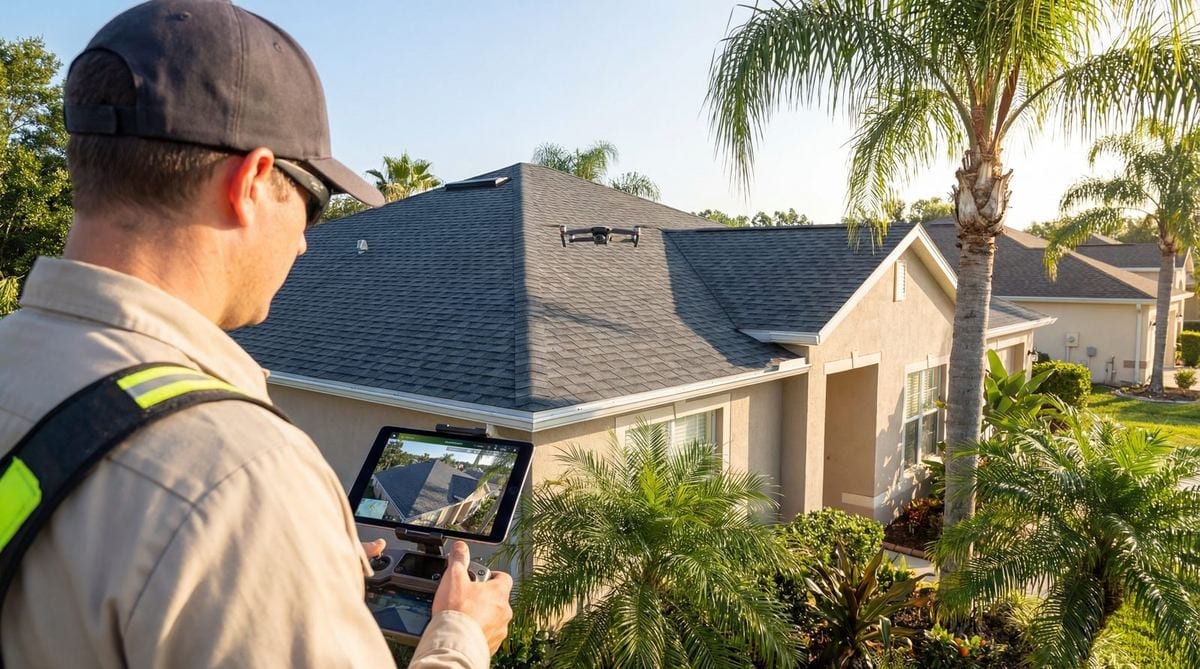
We sell a lot of metal. We also talk people out of it every week, because the wrong roof at the right price is still the wrong roof.
You are selling in the next few years. You would pay for 50 years of roof and enjoy three. A new architectural or Class 4 shingle roof gives the buyer and their insurer what they care about: a new roof with a date on the permit.
The HOA says no. Several newer master-planned communities restrict panel profile, exposed fasteners or color; a board may approve dark bronze standing seam and reject bare 5V on the same street. Get the guidelines before you fall in love with a sample.
The roof is mostly low slope. The flat additions all over Pinellas and the low-pitch sections on mid-century ranches need a system that can sit in water. Exposed-fastener laps cannot. Those sections get a membrane roof and the metal goes on the pitched part, or the whole thing goes shingle.
The house is the wrong style for it. A Mediterranean in Hyde Park or a barrel-tile Spanish revival in Palma Ceia wants tile back, not metal.
The budget only stretches to the cheapest metal. If the only way to afford metal is 29-gauge panels, SMP paint at the beach or skipping the high-temperature underlayment, do not. A well-built Class 4 shingle roof at $5.50 to $7.50 per square foot beats a badly built metal roof at $8.50 every time.
That is the honest pros-and-cons list for a metal roof in Florida. When metal is right, it is very right. When it is wrong, we would rather install the shingle roof and keep the referral.
Get a panel-by-panel metal roof quote for your address

Ranges get you to a budget. A quote gets you to a decision.
We come out, measure the roof, check the decking from the attic and the surface, and note pitch, complexity and distance from salt water. Then you get three numbers side by side, 5V crimp or R-panel, snap-lock standing seam, and mechanically seamed 24-gauge Kynar standing seam, with gauge, finish and the permit line written out. Inspections are free, we respond the same week, and the number is (813) 388-9190. Bring your insurance declarations page; it changes the conversation more than the color chips do.
Ready to price a metal roof in Tampa Bay?
Book a free inspection. You get a measured roof, a decking check, and three metal options priced side by side, with the wind mitigation paperwork explained before you sign anything.
Frequently Asked Questions
How much does a metal roof cost in Florida in 2026?+
Our installed ranges in Tampa Bay are $8.50 to $11.00 per square foot for exposed-fastener metal such as 5V crimp and R-panel, and $10.00 to $16.00 per square foot for standing seam. A 2,000 square foot home usually carries about 2,400 square feet of roof, which works out to roughly $20,000 to $26,000 for exposed-fastener panels and $24,000 to $38,000 for standing seam. Steep pitch, complex rooflines, coastal finishes and decking repairs push a job toward the top of those ranges.
What is a 5V crimp metal roof?+
5V crimp is the classic Old Florida metal panel: a steel sheet with five V-shaped ribs, two at each edge that overlap the next panel and one down the middle. It is fastened straight through the face with screws that carry a neoprene washer, which is why you can see the screw heads from the street. It is the roof on most cracker houses, Ybor casitas and fish camps, and it is the least expensive way to put a real metal roof on a Florida home.
Is standing seam worth the extra cost over 5V crimp in Florida?+
On a primary home you plan to keep, usually yes. Standing seam hides its fasteners under a raised seam, carries wind ratings of 160 to 180+ mph against up to 140 mph for exposed-fastener panels, and is expected to last 50 to 70 years instead of 30 to 40. You also skip the screw and washer maintenance that every exposed-fastener roof eventually needs. On a barn, a workshop, a detached garage or a cracker-style house where the 5V look is the point, we are happy to install 5V.
Does a metal roof lower homeowners insurance in Florida?+
It can, but nobody should promise you a number. The Metal Roofing Alliance says a quality metal roof may reduce premiums by 5% to 35% depending on your location and insurer, and that not every insurer offers the discount. Florida law requires residential rate filings to include discounts for roof covering performance and roof-to-wall strength. You claim them with a wind mitigation inspection form, which is valid for up to five years. Your insurer makes the final call.
Should I get 24 gauge or 26 gauge metal roofing in Florida?+
Lower gauge means thicker steel. We install standing seam in 24 gauge because the wide flat pans of a standing seam panel need the extra stiffness to resist oil-canning, foot traffic and flying debris. 5V crimp and R-panel are usually 26 gauge, and that is fine, because the ribs stiffen the sheet. What we will not put on a house is 29 gauge. That is shed and carport material, whatever the big-box price tag says.
Do I need Kynar 500 paint or is bare Galvalume enough near the coast?+
Inland, bare Galvalume is a fine roof and the cheapest metal finish we sell; Plant City, Lakeland and Wesley Chapel homes wear it for decades. Within sight of Tampa Bay or the Gulf, we spec a Kynar 500 painted panel or aluminum, with aluminum flashings and coated or stainless fasteners, because salt air attacks cut edges and bare steel first. Ask for the finish warranty in writing and read the coastal language before you sign.
Want a real estimate on your Tampa Bay roof?
Enter your address and we'll pull satellite measurements instantly.
Mike Shepherd · Co-Owner, Integrity Roofing of Florida
Mike Shepherd co-owns Integrity Roofing of Florida with Bettina Savorelli. The company is a Florida-licensed roofing contractor (license CCC1334243), a TAMKO Pro Gold and GAF-certified installer, and a BBB A+ rated business serving Hillsborough, Pinellas, Pasco, Polk, Manatee and Sarasota counties. His crews install and repair tile, metal and shingle roofs across Tampa Bay and document storm damage for homeowners' insurance claims. Every article is written from the field, not from a content desk.
Ready to talk to a real human?
No phone tree, no pressure. Owner-level attention on every call.