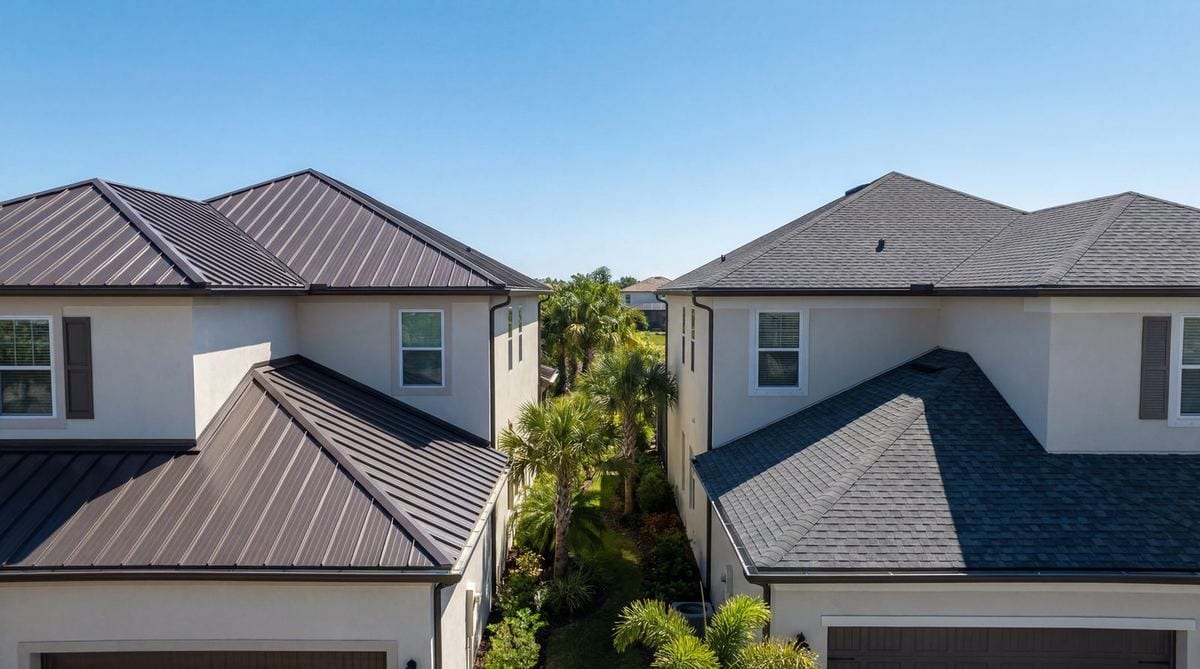
Metal Roof vs. Shingles in Florida: Cost, Durability & Which One Wins
A Florida homeowner's guide to choosing between metal and shingle roofs. With real hurricane ratings, 30-year cost comparisons, and insurance premium impacts specific to the Tampa Bay market.
- Metal roofs last 40-70 years in Florida versus 18-22 for architectural shingles in the same climate.
- Product-approved metal systems can cut the wind portion of your homeowners premium by 15-45%. Often $800-$2,400/year in Tampa Bay.
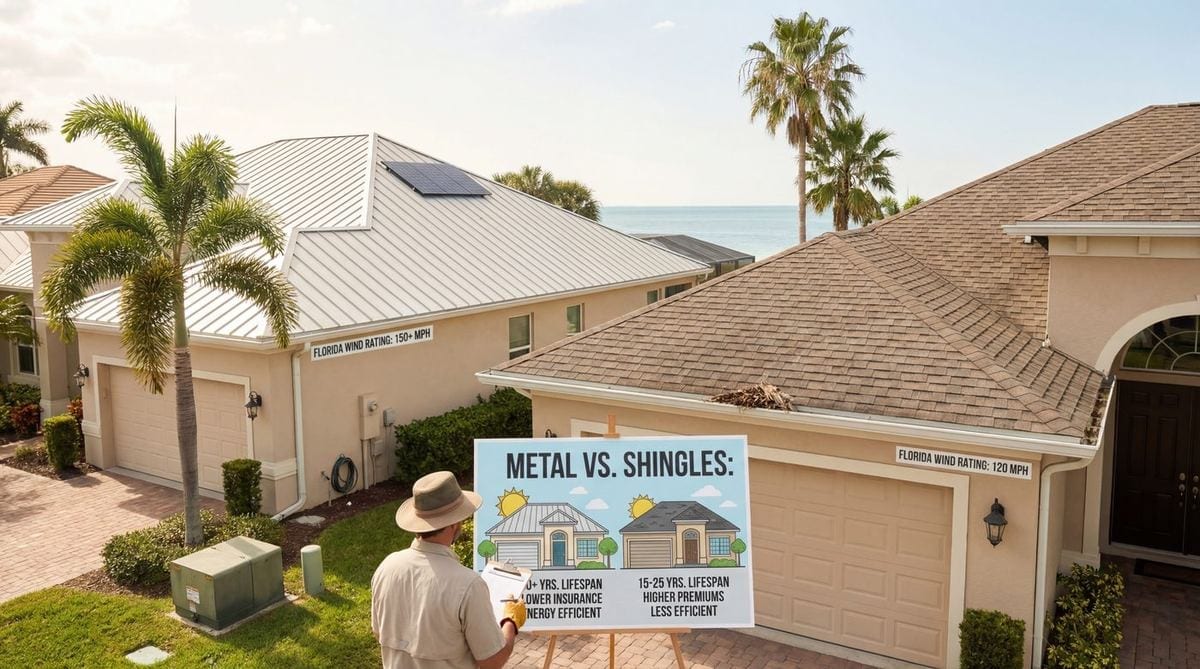
- Standing seam metal meets Florida's 150+ mph HVHZ wind standards; premium shingles top out around 130 mph.
- Over 30 years, metal is usually a one-and-done install while shingles require 1.5-2 roof replacements.
The Florida Roofing Reality: Why Material Choice Matters Here
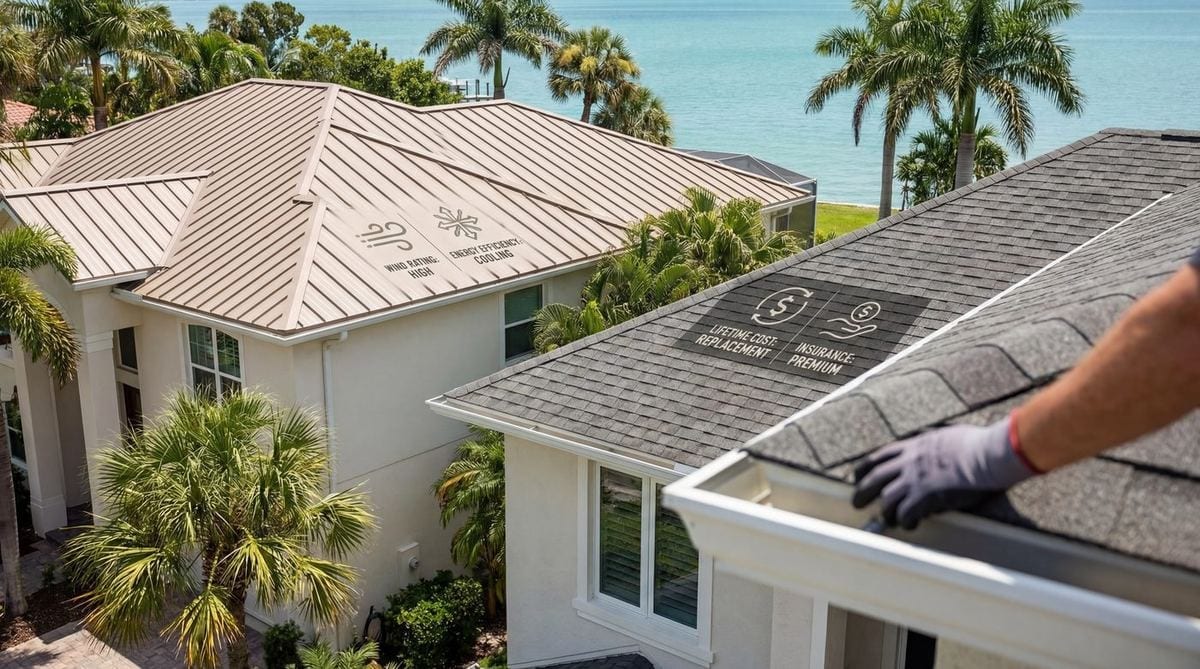
If you live anywhere along the Gulf Coast, Tampa Bay, or central Florida, your roof is not just a building component. It is the single most important piece of storm armor on your house. The decision between metal and architectural shingles carries weight here that it simply does not carry in Ohio or Tennessee. A roof that performs beautifully in a temperate climate can fail in a single Florida hurricane season. A roof that handles 150 mph gusts will also shrug off the daily punishment of UV, salt air, and 95-degree attic heat.
Florida receives more direct hurricane strikes than any other U.S. state. According to the NOAA National Hurricane Center, roughly 40% of all hurricanes that hit the United States make landfall in Florida, and the 2024 season alone brought Hurricanes Helene and Milton across the Tampa Bay region within two weeks of each other. Combine that with intense UV exposure, near-daily summer thunderstorms, and coastal salt air, and you have a climate that exposes every weakness in roofing materials faster than almost any other state in the country.
That is why choosing between metal and shingles in Florida is not really a style question. It is a risk-management, insurance, and long-term-cost question. This guide walks through what the building code, insurance industry, and independent testing labs actually say. Then how Tampa Bay homeowners typically decide.
Metal Roof Lifespan and Hurricane Performance in Florida
A properly installed metal roof installation. Typically 24-gauge standing seam or exposed-fastener galvalume. Is engineered to last 40 to 70 years under normal conditions. The Metal Roofing Alliance documents service lives of 50+ years for galvalume and aluminum systems, with some premium coated steel products carrying manufacturer warranties that stretch beyond half a century. Panels do not crack, curl, or lose granules the way asphalt does, and UL-class-rated coatings resist the UV fading that bleaches color out of shingles by year ten in Florida sun.
Wind performance is where metal earns its reputation on the Gulf Coast. The Florida Building Code (FBC). Specifically the High-Velocity Hurricane Zone provisions applied in Miami-Dade and Broward. Requires roofing assemblies to resist uplift pressures consistent with 150-mph ultimate design wind speeds, and the rest of the state uses ASCE 7 wind maps ranging from 130 to 170 mph depending on proximity to the coast. Standing seam metal, when installed with concealed clips and proper fastener schedules, routinely earns Miami-Dade NOA approvals at or above this threshold. Independent testing by the Insurance Institute for Business & Home Safety (IBHS) has repeatedly shown that mechanically seamed metal systems remain intact under test winds that strip standard three-tab asphalt roofs cleanly off the deck.
ultimate design wind speed required for roofing assemblies in Florida's High-Velocity Hurricane Zones. A threshold standing seam metal meets, but most shingles do not.
Source: Florida Building CodeA few durability numbers worth remembering:
- Hail: UL 2218 Class 4 impact-rated metal resists the largest hail sizes tested, while standard shingles are typically Class 3 or lower.
- Fire: Most metal roofs carry a Class A fire rating. The highest available. Straight out of the box.
- Wind uplift: Properly installed standing seam can meet or exceed ASTM E1592 requirements for the 170-mph coastal zones in Pinellas and Hillsborough counties.
Architectural Shingle Lifespan and Performance
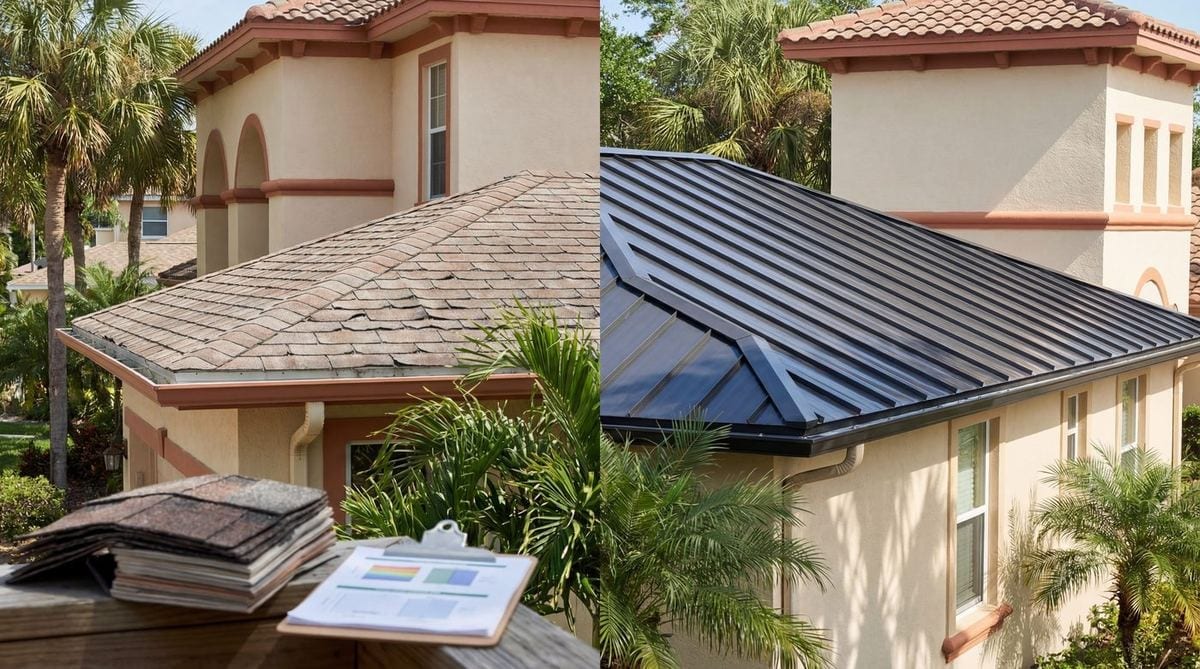
Architectural (sometimes called “dimensional” or “laminated”) shingles are the workhorse of residential roofing nationwide, and for good reason. They are affordable, widely available, come in dozens of color blends, and install quickly. In temperate climates, manufacturers like GAF and Owens Corning quote service lives of 25 to 30 years on their premium architectural lines.
In Florida, that number is almost always shorter. The combination of UV intensity, thermal cycling, humidity, and named-storm exposure typically shaves 5 to 10 years off the nationwide average. The U.S. Department of Energy has noted that asphalt surface temperatures in southern climates can exceed 150 to 180 °F on summer afternoons. A thermal load that accelerates binder breakdown and granule loss. Most Florida roofers, including our crews, see architectural shingle roofing realistically delivering 18 to 22 years before needing replacement.
Modern architectural shingles are still credible storm performers when rated and installed correctly. Premium lines. GAF Timberline HDZ, Owens Corning Duration Flex, Atlas StormMaster. Carry wind warranties up to 130 mph and meet Florida Product Approval requirements throughout most of the state. What shingles cannot do, however, is match metal’s wind, hail, or lifespan performance one-to-one. And per the National Weather Service, every named storm that touches your ZIP code effectively reduces shingle warranty coverage, because most manufacturer warranties carry wind-event exclusions.
A quick durability summary:
- Typical Florida lifespan: 18–22 years for architectural, 12–15 for three-tab
- Wind rating (premium lines): 110–130 mph
- Impact rating: UL 2218 Class 3 (Class 4 available at premium)
- Warranty notes: Pro-rated after 10 years on most products; named-storm damage handled under homeowners insurance, not manufacturer warranty
Both materials can protect a Florida home. The question is which one protects it longer, at what total cost, and with what insurance consequences.
The Real Cost Comparison: Upfront vs. 30-Year Total
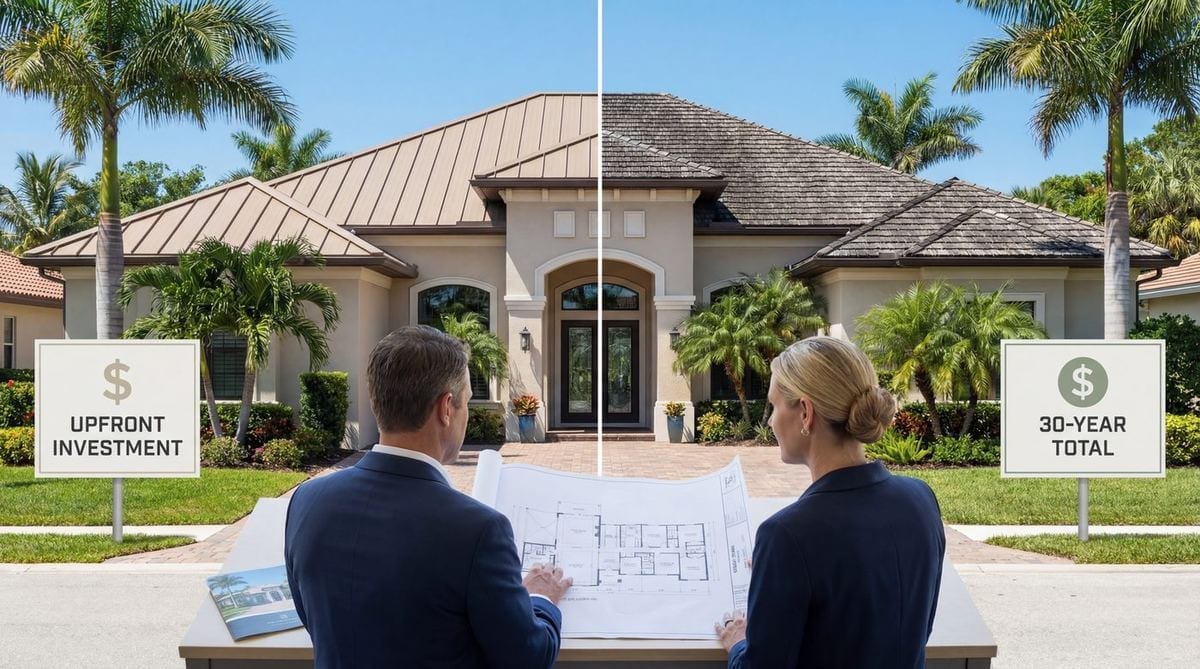
Here is how Florida homeowners typically start to decide between the two: they begin with the sticker price, then gradually realize the 30-year number tells a different story.
Nationally, HomeAdvisor’s cost guide places metal roof cost between $8 and $16 per square foot installed, translating to roughly $15,000–$30,000 on a typical 2,000-sq-ft Florida home. Angi reports a similar national range and notes that standing seam metal roof cost lands on the higher end. Generally $10–$18 per square foot. Because of the concealed-fastener system, heavier-gauge steel, and more skilled labor involved.
Architectural shingles, by comparison, typically land at $4.50–$8 per square foot installed in the Tampa Bay market, putting the same 2,000-sq-ft roof at roughly $9,000–$16,000. So yes, the upfront delta between metal and shingles is real. Often $8,000 to $15,000 on a mid-sized home.
What changes the picture is the replacement cycle. Over 30 years, a shingle roof in Florida is almost always a 1.5–2 roof investment: you pay for a full roof replacement once now and you pay again in year 18–22. A metal roof is a one-and-done investment over that same window, and often with decades of remaining service life left on the clock. When you layer in the insurance savings and energy savings covered in the next sections, the 30-year total cost of ownership frequently favors metal. Even though the upfront number looks higher.
- Upfront cost: $4.50-$8 per sq ft installed
- Lifespan: 18-22 years in Florida heat
- Wind rating: 110-130 mph typical
- Insurance discount: baseline to minimal
- Replacement required: 1.5-2x in 30 years
- Upfront cost: $10-$18 per sq ft installed
- Lifespan: 40-70 years in Florida climate
- Wind rating: 150-170+ mph HVHZ-compliant
- Insurance discount: 15-45% on wind premium
- Replacement required: 0-1x in 30 years
Insurance Premium Impact: What Most Homeowners Don’t Know
This is the section that shifts most homeowners’ thinking, and it is where our experience on Tampa Bay roofs matters most.
In our 20+ years serving Tampa Bay, the single most underappreciated factor in the metal-vs-shingle decision is the homeowners insurance impact. Florida’s insurance market has been under brutal pressure since 2020. Carriers have pulled out of the state, premiums have roughly doubled in many ZIP codes, and wind-mitigation discounts have become one of the only legal ways to push a premium down.
Here is how the discount math actually works in Florida:
- Carriers use the state’s standardized Uniform Mitigation Verification Inspection (OIR-B1-1802) form.
- The form credits homeowners for roof covering rated to Florida Building Code, secondary water resistance, roof deck attachment, roof-to-wall connections (clips, straps, double wraps), and roof geometry.
- A roof covering upgrade to a product-approved metal system typically maxes out the “roof covering” credit line and often pairs with a secondary water resistance (SWR) upgrade during installation.
According to industry data compiled by the Insurance Institute for Business & Home Safety, Florida homeowners who combine a code-compliant roof covering, an SWR underlayment, and strong roof-to-wall connections can see total wind-mitigation credits of 15% to 45% off the wind portion of their premium. Given that the wind portion often represents 60–70% of a Florida homeowner’s total premium, that discount is large. We regularly see real-world annual savings of $800 to $2,400 for Tampa Bay households that move from an older shingle roof to a modern, product-approved metal roof.
wind-portion premium discount available to Florida homeowners who combine a product-approved roof covering, SWR underlayment, and verified roof-to-wall connections.
Source: Insurance Institute for Business & Home SafetyInsurance is not the only lifetime-cost factor, but it is the one most shingle-focused quotes quietly leave out.
Energy Efficiency: Metal vs. Shingles in Florida Heat
Florida’s cooling season effectively runs nine months of the year, and your roof is the single largest heat-gain surface on the house. According to the U.S. Department of Energy’s cool-roof program, a “cool” roofing surface can stay 50 °F cooler than a dark asphalt surface under peak summer sun, directly reducing attic temperatures and HVAC runtime.
Metal roofs. Particularly light-colored or ENERGY STAR-rated reflective finishes. Are natively cool roofs. The reflective pigment technology embedded in modern Kynar 500 and SMP paint systems can reflect 25% to 70% of incoming solar radiation, compared to 5% to 20% for a standard dark architectural shingle. The cooling-cost savings published across multiple DOE and Florida Solar Energy Center studies typically land between 10% and 25% of annual cooling spend. Which, in a market where Tampa Bay electric bills routinely exceed $3,000/year, represents a meaningful recurring benefit.
peak surface temperature difference between a reflective cool-roof finish and a dark asphalt shingle under Florida summer sun. Directly reducing attic heat and HVAC runtime.
Source: U.S. Department of EnergyThere is a second, less-discussed energy factor: radiant heat transfer into the attic. Metal panels reradiate heat quickly once the sun moves off them. Asphalt shingles hold heat for hours after sunset, keeping attic temperatures elevated well into the evening. That difference changes how hard your AC works at 9pm on a July night. The exact time your utility is hitting you with peak demand charges.
Category-level, metal simply outperforms asphalt on the energy axis in a Florida climate. The only shingle products that narrow the gap are dedicated cool-shingle lines from major manufacturers, and those are priced closer to mid-range metal per square foot installed.
See what your Tampa Bay roof actually costs.
Get a ballpark in 60 seconds. We pull satellite measurements and price out metal vs. shingles for your exact home.
Which One Is Right for Your Tampa Bay Home?
After installing thousands of roofs for homeowners across Tampa, the honest answer at Integrity Roofing of Florida is: it depends on your time horizon and your insurance situation. Both materials can be a correct choice. They just serve different homeowners.
Here is the Florida-specific cost comparison we walk every customer through:
| Factor | Architectural Shingles | Standing Seam Metal |
|---|---|---|
| Upfront cost (2,000 sq ft) | $9,000 – $16,000 | $18,000 – $32,000 |
| Typical Florida lifespan | 18 – 22 years | 40 – 60+ years |
| Wind rating | 110 – 130 mph | 150 – 170+ mph |
| Impact rating | UL 2218 Class 3 | UL 2218 Class 4 |
| Insurance premium impact | Baseline to small discount | Up to 30–45% wind-portion discount |
| Annual energy savings | Baseline | 10 – 25% cooling reduction |
| 30-year replacement count | 1.5 – 2 | 0 – 1 |
| Typical 30-year total cost | $22,000 – $35,000 | $18,000 – $32,000 |
A few plain-language recommendations we give Tampa Bay homeowners:
- Choose metal if: you plan to stay in the home 10+ years, your current homeowners premium is painful, your house is exposed (coastal, no mature tree canopy), or you want the longest possible replacement cycle.
- Choose architectural shingles if: you are managing a tighter upfront budget, you are likely to sell in the next 5–7 years, or your home is heavily shaded and energy/wind exposure is lower.
- Do not choose three-tab shingles in Florida. Three-tab products are still legal in many jurisdictions, but the cost-per-year over a Florida roof’s realistic lifespan is worse than either architectural shingles or metal.
On standing seam metal roof cost specifically, budget for the upper end of the metal range. The concealed-fastener system is more labor-intensive than exposed-fastener profiles, but it is also the profile we see outperforming in major named storms. If you are asking how much does a metal roof cost in Tampa Bay in 2026, a typical installed figure on a 2,000-sq-ft single-story home lands at $22,000 to $28,000 for 24-gauge standing seam with a synthetic underlayment and full product approvals documented for your insurance carrier.
Get a Real Florida-Specific Estimate
Every roof and every home is different. The numbers above are honest ranges drawn from real Tampa Bay installations. But your actual quote depends on pitch, square footage, deck condition, tear-off complexity, penetrations, and whether your existing roof needs a secondary water resistance (SWR) upgrade underneath the new covering.
If you want real numbers for your specific home, Integrity Roofing of Florida can pull satellite measurements and generate an instant ballpark estimate in about 60 seconds. No in-home appointment required to get the first number. From there, if the range works, we schedule a free on-site inspection to confirm deck condition and walk you through the wind-mitigation form your insurance carrier will need.
Florida homeowners who upgrade from an older shingle roof to a modern product-approved metal system routinely save $800 to $2,400 per year on homeowners insurance, eliminate a replacement cycle, and drop summer cooling bills by up to a quarter. Over 30 years, that is often a five-figure swing. On top of the peace of mind that comes with a roof engineered for 150-plus-mph winds.
Ready to see what your roof would actually cost?
- Get an instant estimate on your specific address in about a minute.
- Call us directly at (813) 388-9190 to talk through metal vs. shingle for your home.
- Schedule a free on-site inspection. No pressure, no sales pitch, just a straight read on your roof’s condition and your best options for the next 30 years.
Whether you end up with metal or architectural shingles, the most expensive roof in Florida is always the one that gets installed twice. We’re here to make sure yours only gets installed once.
Ready for real numbers on your roof?
Instant satellite-based estimate in 60 seconds, or talk to a Tampa Bay roofer directly. No pressure, no in-home sales pitch.
Want a real estimate on your Tampa Bay roof?
Enter your address and we'll pull satellite measurements instantly.
The Integrity Roofing Team · Florida Roofing Experts · Licensed & Insured
The Integrity Roofing of Florida team installs and repairs tile, metal, and shingle roofs across Tampa Bay. With decades of combined field experience, we've helped more than a thousand homeowners navigate hurricane-damage claims, material choices, and the gap between what's marketed and what actually holds up in Florida conditions. Every post is written by working Florida roofers. Not content writers.
Ready to talk to a real human?
No phone tree, no pressure. Owner-level attention on every call.