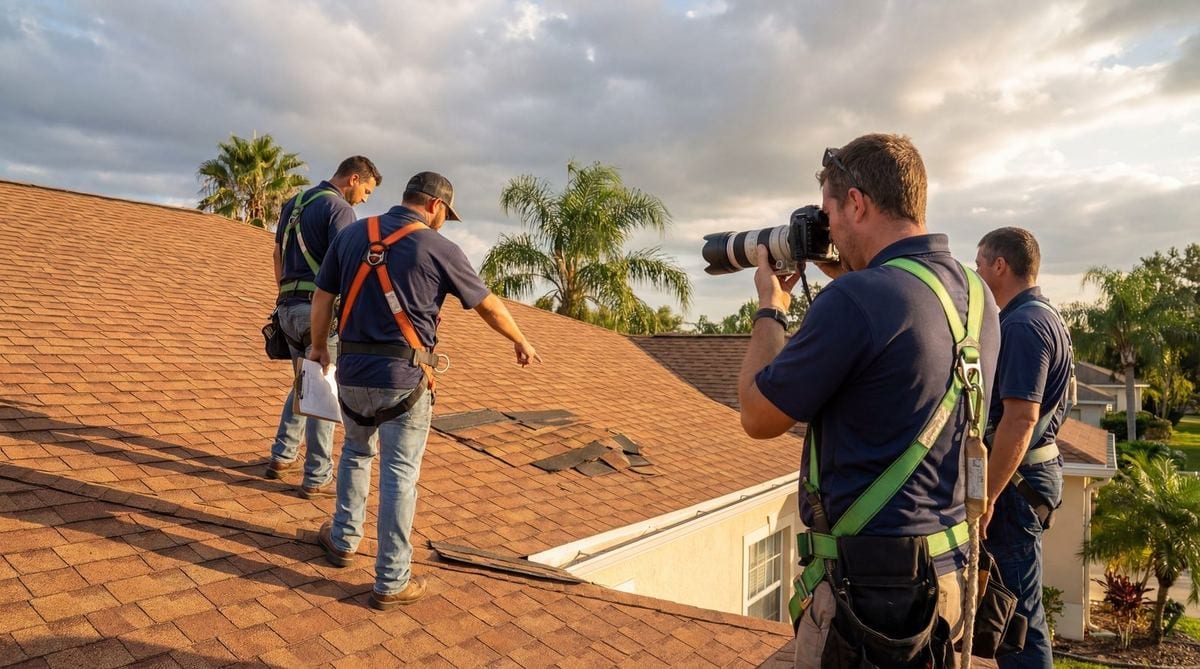
Roof Insurance Claim Denied in Florida: What to Do Next (2026)
What to do if insurance denied your roof claim in Florida: read the letter, get a roofer's documentation, request re-inspection, then DFS mediation.
- A denial letter is an argument, not a verdict. It cites policy language and an adjuster's opinion on cause, and dated photos, measurements and a licensed condition statement can answer both.
- You can ask for a re-inspection with a different adjuster, and you can request Florida DFS mediation, which the insurer pays for when the dispute is $500 or more after the deductible.
- A licensed roofer documents and estimates. We do not negotiate, adjust or handle claims, and no contractor can take an assignment of your benefits on a policy issued since January 1, 2023.
- A contractor who offers to waive or pay your deductible is committing a third-degree felony. That is the end of the conversation.
What to do if insurance denied your roof claim in Florida: read the letter for the exact policy language and the cause the adjuster named, get a licensed roofer’s dated photos, measurements, itemized estimate and written condition statement, request a re-inspection in writing, then use state mediation, the policy’s appraisal clause, or a licensed public adjuster or attorney.
In Tampa Bay the letter tends to land weeks after the storm, when the blue tarp on a Riverview or Seminole roof is already fraying at the battens. This post starts where our Florida roof insurance claim guide stops: with the denial in your hand.
Why Insurers Deny Florida Roof Claims: Seven Patterns
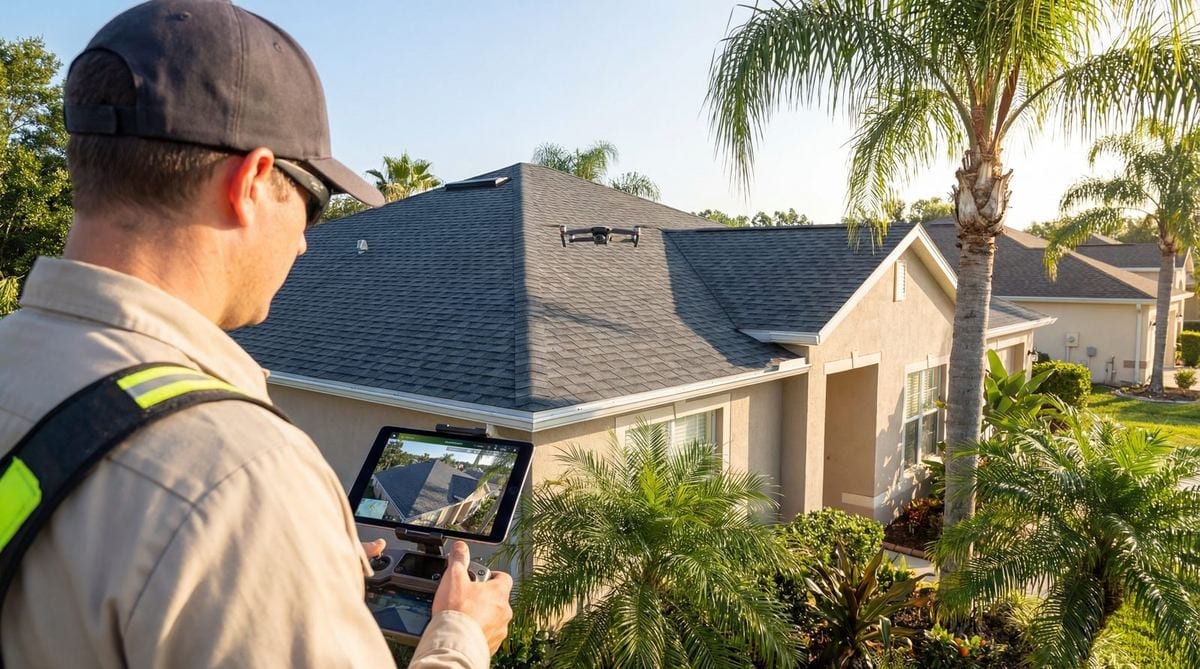
Homeowners hand us denial letters at the free roof inspection and ask one question. Was the adjuster right? Sometimes. Often the letter is answering a question nobody documented.
After a hurricane, volume changes how a roof insurance claim works: inspections get farmed out, and the letter may come from a desk adjuster who never saw your street.
1. Wear and tear, called instead of wind. The letter cites granule loss and deterioration consistent with age, all excluded. Sometimes true. But a shingle creased in a straight line above the seal strip is a wind signature, not an age signature, and it does not show from the driveway or a drone pass.
“Wear and tear” is a conclusion, not an observation. Ask what observation it rests on.
2. The 25% rule, quoted for the wrong roof. The Florida Building Code’s rule reads: “Not more than 25 percent of the total roof area or roof section of any existing building or structure shall be repaired, replaced or recovered in any 12-month period unless the roof covering on the entire existing roof system or roof section is replaced or recovered to conform to the requirements of this code,” per the FRSA’s summary of the rule. SB 4-D, effective May 27, 2022, added an exception for roofs built or replaced under the 2007 code or later: “only the repaired, replaced, or recovered portion is required to be constructed in accordance with the Florida Building Code in effect.”
The trap is the date. The 2007 code did not take effect until March 1, 2009, so a 2004 roof in Carrollwood gets no exception, however the letter reads it. Whether your policy pays for the code-driven portion is a coverage question; whether the code requires it is a fact, and our estimate states it. Longer version: our Florida 25% roof rule explainer.
3. Late notice. Florida Statutes s. 627.70132 bars a claim “unless notice of the claim was given to the insurer in accordance with the terms of the policy within 1 year after the date of loss,” and bars a supplemental claim unless notice was given “within 18 months after the date of loss.” The ceiling stain in a Palm Harbor guest room that becomes a roof leak insurance claim in Florida fourteen months after the storm gets a short letter.
the deadline after the date of loss to give your insurer notice of a claim in Florida; supplemental claims get 18 months
Source: Florida Statutes s. 627.70132 (Online Sunshine)4. Pre-existing damage with no “before” record. If the last picture of your roof is the 2016 listing photo, the adjuster gets to guess when the cracks happened, and on the flat concrete tile of 1990s Carrollwood, old foot-traffic breaks from AC techs pass for storm breakage.
5. No photo record at all. If nobody photographed the roof between the storm and the tarp, the file has one set of pictures in it, and they are the carrier’s.
6. Unpermitted or unlicensed prior repairs. A 2019 handyman patch with no permit shows up as a different shingle lot, face-nailed, with mastic troweled across a valley. The letter says faulty repair, excluded. The permit history for your address is public record, and we pull it before we write a word.
7. Roof age, used as a stand-in for cause. Roof age is an underwriting question, not a claims question, but the two get tangled. Under s. 627.7011, for policies issued or renewed on or after July 1, 2022, an insurer “may not refuse to issue or refuse to renew a homeowner’s policy insuring a residential structure with a roof that is less than 15 years old solely because of the age of the roof.” At 15 years or older, the insurer must allow an inspection by an authorized inspector at the homeowner’s expense, and may not refuse solely for age if it shows 5 years or more of useful life remaining.
Citizens sets its own maximums, “older than 25 years for shingle and other types of roofs (soft)” and “50 years for tile, slate, concrete or metal roofs (hard),” with roofs past those limits needing documentation of at least five years of remaining useful life. None of that decides whether last October’s wind creased your shingles, but age gets cited anyway. Our Florida 15-year roof rule post covers the underwriting side; here, the answer is a condition statement that separates age from cause.
Read the Denial Letter Before You Argue With It
Most people read the first paragraph, see “not covered,” and call someone angry. Read the whole thing twice.
A usable letter gives you the claim number and date of loss on file, the adjuster’s stated cause (wear, faulty repair, pre-existing, age), the policy provisions relied on by form number and section, and the adjuster’s report and photos. If yours is missing any of those, ask for them in writing before you do anything else. The stated cause is the sentence the whole letter hangs on.
Then pull the full policy, not just the declarations page, and find the cited sections. “Wear and tear, deterioration, marring” is exclusion language, and the fight is about cause, a physical question a roof can answer. “Faulty workmanship” points at whoever touched the roof last, and permit records answer it. Language about a loss with more than one cause is a coverage argument for a licensed public adjuster or an attorney, not for us. And check whether you carry ordinance or law coverage, which pays for code-required work.
Note the date on the letter. Every option below runs on its own clock, and none of them care that you were busy.
The Documentation Package a Licensed Roofer Can Supply

Start with what we are not. Integrity Roofing of Florida documents and estimates. We do not negotiate with your insurer, we do not adjust or handle claims, and we cannot promise what a carrier will pay. Anyone in a roofing truck who says otherwise is describing a job they are not licensed to do.
We document. We estimate. The argument, if it comes to one, belongs to you and the licensed people you hire for it.
What we can legitimately put in your hands after a denial:
- Dated photographs from the ground, the ladder line, the roof and the attic, every slope labeled by compass direction.
- Measurements of each roof section and the damaged area inside it, so the 25% question is arithmetic instead of opinion.
- An itemized estimate by line, with the code basis noted wherever code drives the scope.
- A written condition statement under our license number, CCC1334243: what we observed, where, and what we believe caused it.
- Test-square photos. A marked 10 by 10 area on each affected slope, every creased, lifted, torn or missing shingle flagged and counted, each crease shot with the tab lifted so the fracture line shows.
- Tile breakage patterns. Impact breaks, foot-traffic breaks and age cracks look different up close. A flat concrete tile snapped clean at the batten reads differently than one crazed by thirty summers of sun.
- Wind direction consistency. Damage concentrated on the windward slopes and the leading edges of hips and ridges, with the lee side clean, fits that storm. Damage scattered evenly across every slope usually does not.
Here is how the package lines up against the letter:
| Denial reason | What the letter usually says | What documentation answers it |
|---|---|---|
| Wear and tear instead of wind | Damage is consistent with age and deterioration, which the policy excludes | Test-square photos of creased or lifted shingles, a slope-by-slope count, a condition statement separating age from cause |
| 25% rule misapplied | Repairs are limited to the damaged area; no code upgrade is owed | Measured section and damaged areas, the install year from the permit record, the code text for that year |
| Late notice | Notice was not given within the time the policy requires | Date of loss, date first reported, claim number, checked against the 1 year and 18 month limits |
| Pre-existing damage | The damage predates the reported date of loss | Prior inspection reports, dated pre-storm photos, a prior wind mitigation form, listing or drone images |
| No photo record | The insured did not substantiate the loss | Dated photos from ground, ladder and roof, attic photos of wet decking, measurements |
| Unpermitted prior repairs | Damage results from faulty or improper repair, which is excluded | Permit history, photos separating old repair from new damage, an estimate that scopes both |
| Roof age used as cause | The roof has exceeded its useful life | Age from the permit record, a written remaining-life opinion, cause evidence that stands on its own |
What “matching” means, and what we can say about it
Matching is the dispute over whether a partial repair leaves you with a roof that no longer matches: one new slope beside three faded ones, or a 2006 concrete S-tile profile that no distributor in Tampa Bay stocks anymore. Whether your policy owes a full match is a coverage question for your carrier, a licensed public adjuster or an attorney; what we can put in writing is whether the existing product is still available, and what the mismatch looks like in a photograph.
People also search for how to get insurance to pay for a roof replacement in Florida as if there were a technique. There is not one we can sell you. The policy pays for what it covers, and the documentation either shows a covered cause at the reported date of loss or it does not. What does exist is a sequence: a documented re-inspection first, then DFS mediation if the carrier still says no, then the appraisal clause or a licensed public adjuster or attorney for the dollars. Each step is below. Our job is the first one, making the physical evidence impossible to misread, which is the work on our insurance documentation support page, whether the roof took storm and hurricane damage from a named storm or a July thunderstorm that peeled a ridge cap in Wesley Chapel.
How to Request a Re-Inspection and a Second Adjuster

Do it in writing. A phone call to the claims line evaporates; a letter, an email or a portal upload with a date stamp does not. Include:
- The claim number, the date of loss, and the date of the denial letter.
- One paragraph: you disagree with the stated cause, you have new documentation, and you are requesting a re-inspection.
- The full documentation package, attached, not a link that expires.
- A request for a different adjuster, and for the inspection date and time so your contractor can attend.
Carriers are not obliged to send someone new, but asking costs nothing.
How to meet with the adjuster on a roof insurance claim
Be home, with the package printed and the photos labeled. Then let the adjuster work; walking the roof and running their own test squares is their job.
Ours is narrower. We point to the marked squares, the creases, the broken tile field and the wind pattern, and answer questions about the estimate. We do not argue coverage on the roof, and neither should you.
Before they leave, ask them to photograph what you pointed to, get a direct contact, and ask when the revised report will issue. Then send a same-day email recapping the visit. Paper wins arguments that memory loses.
Holding a denial letter?
Bring it to a free inspection. We will photograph and measure the roof, write an itemized estimate and a signed condition statement, and attend the re-inspection. Documentation only. We do not negotiate or handle claims, and we cannot promise what your carrier will decide.
Florida DFS Mediation Costs You Nothing Unless You No-Show
The Florida Department of Financial Services runs a mediation program for exactly this situation. Per DFS, property insurance mediation “may be requested only by the policyholder … or the insurer.” The insurance company “pays the entire cost ($350) of the mediation” unless the policyholder fails to appear. The dispute “must be $500 or more after the deductible is applied” and has to involve the cause of the damage or the repair amount.
The insurer pays the $350. You pay nothing unless you skip the meeting.
Request it online, by phone at 1-877-693-5236, or with form DFS-I0-2082. Then bring the package. The mediator is not a roofer and will not climb your ladder, so the photographs have to do the climbing: a dated, labeled photo next to every sentence in the denial letter.
The Appraisal Clause in Plain English

Most Florida homeowner policies carry an appraisal provision. The wording varies, so read yours before relying on anything here.
The plain-English version: when both sides agree something is covered but disagree on what it costs to fix, either side can typically demand appraisal. You pick an appraiser, the insurer picks one, the two choose an umpire, and an amount agreed by any two of the three sets the number. You pay your own appraiser, and the umpire’s fee is usually split.
Appraisal decides amount, not coverage, so it rarely helps against a flat “not covered” letter. It is also a formal step with consequences, so whether to invoke it is a question for a licensed public adjuster or an attorney, not your roofer. What we contribute is the itemized estimate the appraisers argue over.
Public Adjusters, Attorneys, and Why AOBs Are Dead
A public adjuster is a licensed third party you hire to adjust the claim on your behalf: they read the policy, write their own estimate, and argue scope and cause with the carrier’s adjuster. An attorney is the move when the letter denies coverage outright, leans on mixed-cause language, or when appraisal has been demanded and refused. Both are licensed third parties you hire, and neither is us.
The days when a contractor could step into the homeowner’s shoes on a claim are over. Under s. 627.7152, post-loss benefits under a residential or commercial property policy “issued on or after January 1, 2023” may not be assigned. The statute’s words: “An attempt to assign post-loss property insurance benefits under such a policy is void, invalid, and unenforceable.”
Nobody in a roofing truck can stand in your shoes on a claim anymore. That is the point of the 2023 change, and it is a good one.
One more guardrail. Under s. 489.147, it is insurance fraud “punishable as a felony of the third degree for a contractor to knowingly or willfully … pay, waive, or rebate all or part of an insurance deductible,” and a contractor may not offer “a rebate, gift, gift card, cash, coupon, waiver of any insurance deductible, or any other thing of value” in exchange for a roof inspection or a claim. A denial makes you a target for exactly that pitch. Our Florida roofing scams post covers the rest of the playbook; the offer itself is the red flag.
What to Do When Your Florida Roof Claim Is Denied
- Ask in writing for the adjuster’s full report and photos and a certified copy of your policy. Note the letter’s date.
- Get the roof documented while the evidence is still on it, before anyone tears off, patches or re-tarps.
- Pick the path. Re-inspection with a second adjuster first. Then DFS mediation, which costs you nothing. Then appraisal, a licensed public adjuster or an attorney if the dispute is real.
If the denial stands and the roof still needs replacing, that is a different conversation, and we have it often: our roof replacement pricing is published, and our roof financing options page covers how people pay for a roof the carrier would not.
Get the roof documented before the re-inspection date
Same-week response across Hillsborough, Pinellas, Pasco, Polk, Manatee and Sarasota. Dated photos, measurements, an itemized estimate and a condition statement under license CCC1334243, ready to attach to your request.
Frequently Asked Questions
Why do insurance companies deny roof claims in Florida?+
The denial letters we read in Tampa Bay usually rest on one of seven things: damage called wear and tear instead of wind, the 25% rule applied to the wrong roof, notice given late, damage labeled pre-existing because no earlier photos exist, no photo record at all, unpermitted prior repairs, or roof age used as a stand-in for cause. Several of those are documentation gaps, and a licensed roofer can fill the gap after the fact.
Can I get a second adjuster after a denied roof claim?+
Yes. Write to your carrier, reference the claim number and the denial date, attach new documentation, and ask for a re-inspection by a different adjuster. Ask for the date so your roofer can be on site to walk the roof with them and point to the physical evidence. If the second inspection lands in the same place, Florida DFS mediation and the policy's appraisal clause are still open to you.
What is matching coverage on a roof insurance claim?+
Matching is the dispute over whether a partial repair leaves you with a roof that no longer matches: a new slope of shingles next to three faded ones, or a discontinued tile profile that cannot be bought. Whether your policy owes a full match is a coverage question for your carrier, a licensed public adjuster or an attorney. What a roofer can do is document the existing product, confirm in writing whether it is still available, and photograph the mismatch.
How long do I have to give notice of a roof claim in Florida?+
Under Florida Statutes s. 627.70132, a claim is barred unless notice was given to the insurer, in accordance with the policy terms, within 1 year after the date of loss. A supplemental claim is barred unless notice was given within 18 months after the date of loss. Those are notice deadlines. Deadlines for disputing a denial or filing suit are separate, and a licensed attorney is the right person to ask about them.
Can a roofer handle my insurance claim for me in Florida?+
No. A licensed roofer can inspect, photograph, measure, write an itemized estimate and a condition statement, and meet the adjuster on site. Negotiating or adjusting the claim is work for a licensed public adjuster or an attorney that you hire. Assignment of benefits is also gone: for policies issued on or after January 1, 2023, an attempt to assign post-loss benefits to a contractor is void, invalid and unenforceable under s. 627.7152.
What does Florida DFS mediation cost the homeowner?+
Nothing, in the normal case. The Florida Department of Financial Services says the insurance company pays the entire cost of the mediation, which is $350, unless the policyholder fails to show up. Only the policyholder or the insurer can request it, the dispute must be $500 or more after the deductible is applied, and it has to involve the cause of the damage or the repair amount. You can request it by phone at 1-877-693-5236 or with form DFS-I0-2082.
Is it legal for a roofer to waive my deductible in Florida?+
No. Under Florida Statutes s. 489.147 it is insurance fraud, punishable as a felony of the third degree, for a contractor to knowingly or willfully pay, waive or rebate all or part of an insurance deductible. A contractor also cannot offer a rebate, gift card, cash, coupon or anything else of value in exchange for a roof inspection or a claim. Treat the offer as the end of the conversation.
Want a real estimate on your Tampa Bay roof?
Enter your address and we'll pull satellite measurements instantly.
Mike Shepherd · Co-Owner, Integrity Roofing of Florida
Mike Shepherd co-owns Integrity Roofing of Florida with Bettina Savorelli. The company is a Florida-licensed roofing contractor (license CCC1334243), a TAMKO Pro Gold and GAF-certified installer, and a BBB A+ rated business serving Hillsborough, Pinellas, Pasco, Polk, Manatee and Sarasota counties. His crews install and repair tile, metal and shingle roofs across Tampa Bay and document storm damage for homeowners' insurance claims. Every article is written from the field, not from a content desk.
Ready to talk to a real human?
No phone tree, no pressure. Owner-level attention on every call.