Emergency Roof Tarping in Tampa Bay: Cost, Insurance, and When a Tarp Is Not Enough
Emergency roof tarping in Tampa Bay: what a real dry-in is, what our crews charge, what insurance usually covers, and when a tarp is not enough.
- A proper dry-in is a self-adhering membrane bonded to the decking, not a blue poly tarp with furring strips screwed through it. We install the membrane whenever the roof lets us.
- Our emergency tarp runs $0 to $350 and is often free when we do the permanent repair. A post-storm quote far above that is pricing the panic, not the work.
- Your policy expects you to protect the home from further damage. Keep the tarp invoice and the photos, and remember that Florida gives you 1 year from the date of loss to give the insurer notice of a claim.
- A tarp buys weeks, not months. Tile, low-slope and saturated roofs need a different fix, and Operation Blue Roof only covers standard shingle roofs after a declared storm.
Emergency roof tarping is a temporary dry-in that keeps rain out of a damaged roof until the permanent repair is permitted and scheduled. A proper one is a self-adhering membrane or a well-anchored heavy poly tarp over the damage. Our crews charge $0 to $350, often nothing when we do the permanent repair, and it buys weeks, not months.
We are publishing this the week of the season’s peak, because that is when the tarping calls come in from Riverview, Wesley Chapel and Clearwater at once. If water is coming in right now, call (813) 388-9190 and read the rest while you wait; during business hours we get a crew moving, and after hours you are first in line when we open.
A Blue Tarp Is Not a Dry-In: What We Install Instead
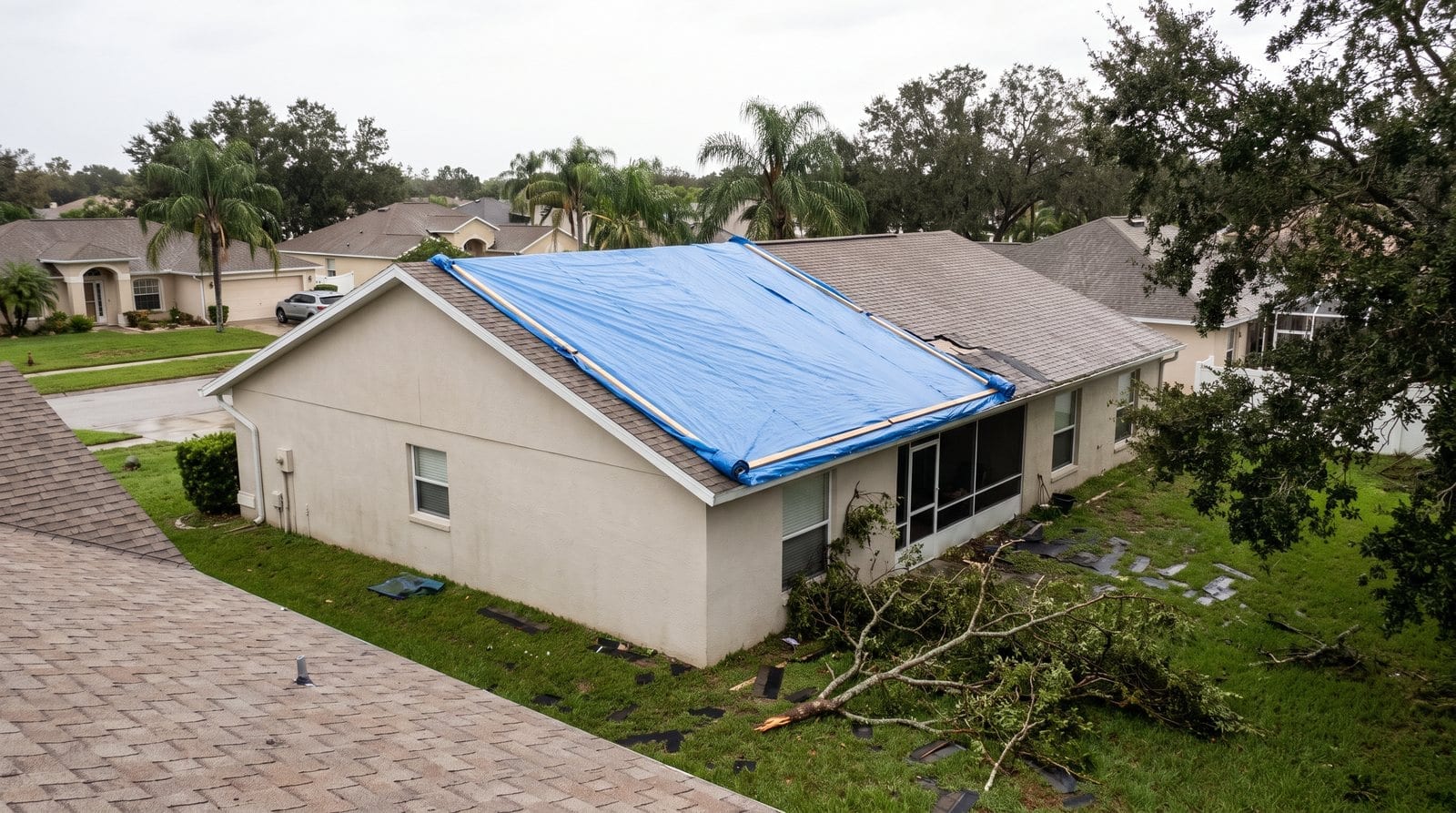
Drive through Brandon or Lutz two weeks after a storm and you will see the blue roofs. Poly tarps, wood strips screwed through them, edges lifting. Most were sold as a roof tarping service. Few are a dry-in.
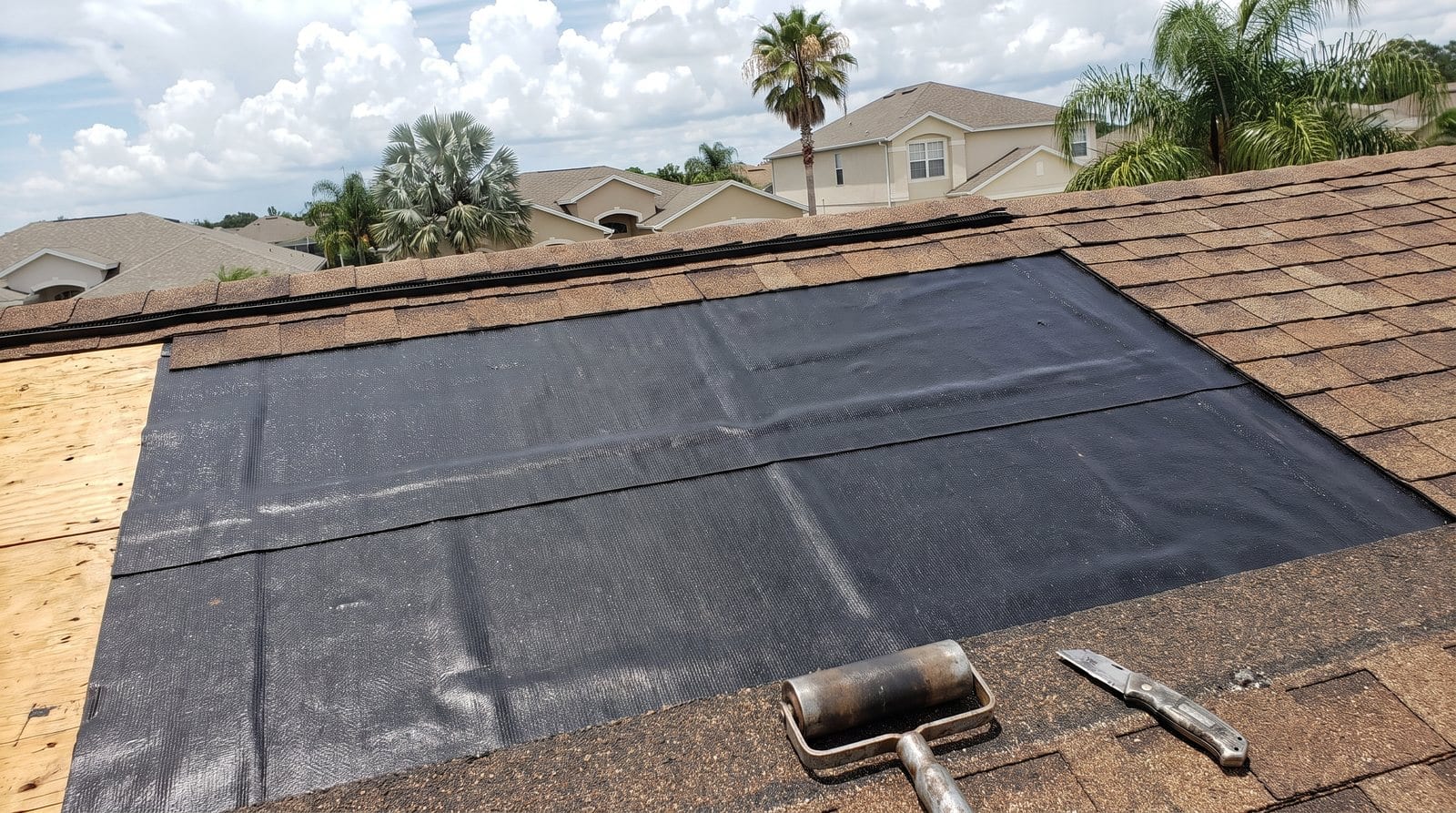
A dry-in is anything that gets the roof back to shedding water on its own. On a shingle roof with the decking intact, that means a self-adhering peel-and-stick membrane, the same modified bitumen product we use as a secondary water barrier on full reroofs. We pull the torn shingles back to sound material, sweep the deck, roll the membrane from the low side up so every lap sheds downhill, and tuck the top edge under the course above it.
No fasteners through the field. Nothing to flap. Nothing for the afternoon wind to grab.
An emergency roof tarp is a sheet of woven poly laid over the problem and held down with furring strips and screws. It works, and we carry them on every truck. But every screw is a new hole in your roof, the poly starts breaking down in Florida sun within weeks, and the first real gust finds whichever edge was not wrapped.
A tarp is a promise that someone is coming back. If nobody is coming back, it is just a blue flag that says nobody fixed this.
So why does anyone use a tarp? Because membrane needs something to stick to. If a limb went through the decking on a 1950s block ranch in Seminole Heights, there is no deck to bond to until the hole is framed and sheeted, and nothing bonds to a wet deck in the rain.
In those cases we tarp first, then come back and dry it in once the deck is fixed and dry.
Our order of preference on emergency roof repair calls is simple: membrane where the deck is sound, tarp where it is not. Never a tarp nailed through the middle of the field, which is what the unmarked truck does and what we get called to Palm Harbor and St. Petersburg to undo.
What Emergency Roof Tarping Costs in Tampa Bay
Our emergency tarp runs $0 to $350, and it is often free when we do the permanent repair. Those are our installed price ranges, the same ones we publish for every other job, not a storm-week special.
What moves the number inside that band: the size of the area, the pitch and height, debris to clear first, and whether it is a membrane job or a tarp that needs strips and a second trip. A torn valley on a one-story ranch in Land O’ Lakes is the bottom of the band. Two slopes on a two-story off Bayshore Boulevard with a branch to cut up first is the top.
The tarp is rarely the whole bill. Here is how the rest usually shapes up, using only our published bands:
| Situation | What we do | Typical cost band |
|---|---|---|
| A few missing shingles, small leak, decking sound | Membrane dry-in, same-week response, repair scheduled on the same visit | Tarp $0 to $350, often free with the repair; repair $300 to $800 |
| Leak at a skylight, chimney or wall flashing, roughly 100 sq ft | Dry-in, then reflash and re-shingle the section | Tarp $0 to $350; repair $800 to $2,500 |
| Large section blown off, partial or full replacement needed | Tarp what will hold, document, replace | $8,000 to $25,000+ |
| Tree or limb through the roof | Stabilize, tarp the opening, then structure plus roofing | $15,000 to $40,000+ |
| Tile, flat or low-slope roof with storm damage | Membrane dry-in or sealed patch, never a screwed-down tarp | Quoted after a free inspection |
Now the part nobody likes: every storm, prices spike. After Milton in 2024 we took calls from homeowners in Riverview and Wesley Chapel who had been quoted more for a poly tarp than a small permanent repair costs on our price sheet. Out-of-state crews, cash up front, no follow-up. The tarp was the product.
A fair emergency rate looks like a small job priced like a small job. A couple of people, a roll or two of material, an hour or two on the roof, and a credit toward the permanent repair if you hire the same crew. That is the whole formula.
Anyone who will not tarp until you sign a full replacement contract is running a funnel, not a roofing company. Our guide to choosing a Tampa Bay roofing contractor covers that playbook.
The tarp should be the cheapest line on the invoice, not the reason for it.
Does Florida Homeowners Insurance Cover Emergency Tarping?
Typically, yes, when the storm damage itself is a covered loss. And not because carriers are generous. Because your policy makes you do it.
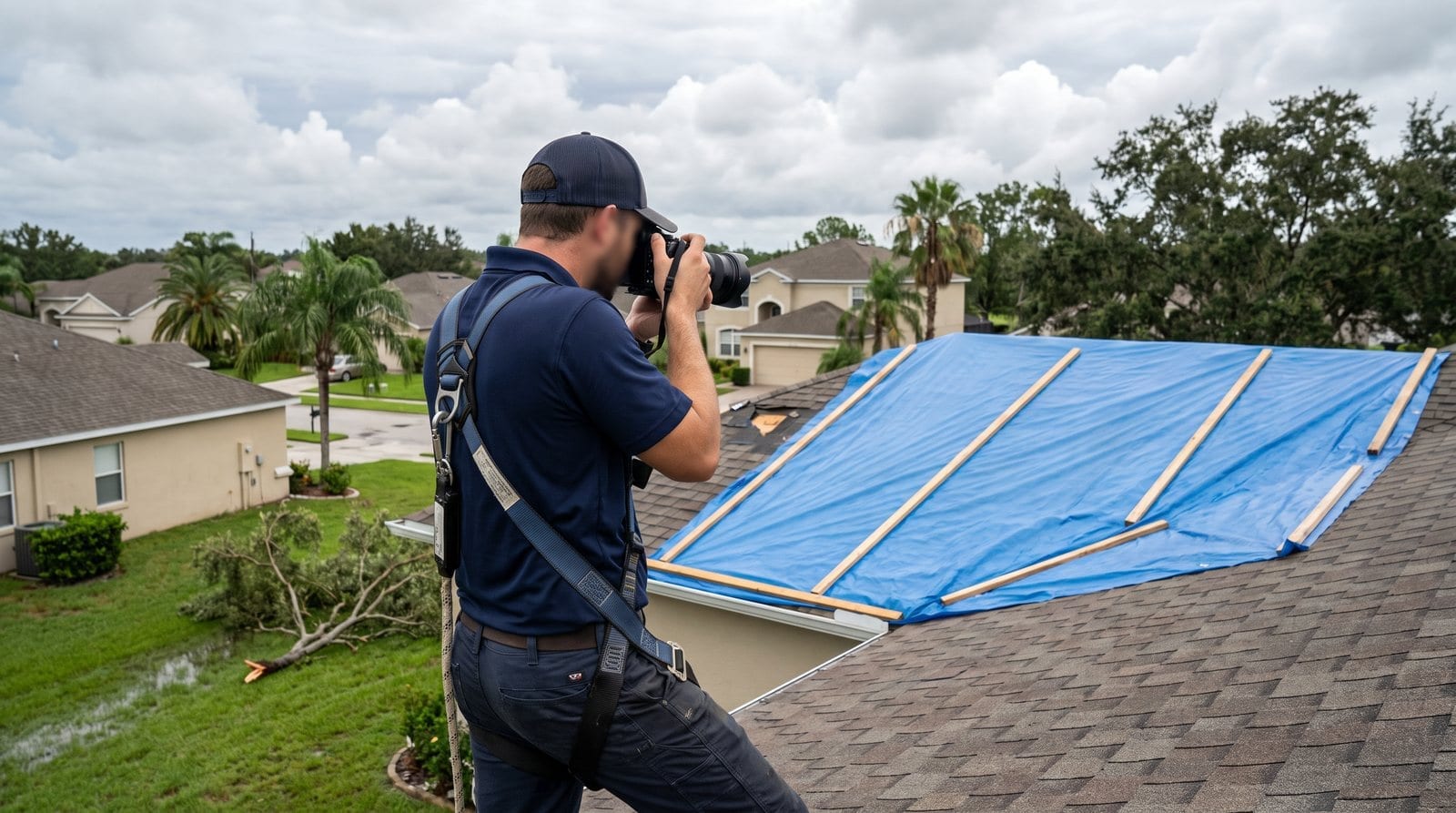
Almost every Florida homeowners policy has a duties-after-loss section that requires you to protect the property from further damage and to keep a record of what you spent doing it. The tarp is that duty in physical form. Skip it and the carrier has an argument that the ceiling damage was preventable.
The rules:
- Photograph everything before the tarp goes on. Then photograph the tarp in place. That is the first half of our insurance documentation support, and we do it before anyone touches the roof.
- Keep the tarp invoice. Same for the fans, the dehumidifier, the drywall you cut out. Mitigation expenses are typically reimbursed as part of a covered claim, and the receipt is the proof.
- Give the carrier notice fast. Florida law bars a claim unless notice was given “within 1 year after the date of loss,” and a supplemental claim unless notice was given “within 18 months after the date of loss” (s. 627.70132, Florida Statutes). A year goes fast once the adjuster visit takes weeks and the first estimate is wrong.
Where we stop: we are not adjusters, we do not argue your claim with the carrier, and we will not tell you what it is going to pay. We give you the photos, the measurements, an itemized estimate, and a roofer next to the adjuster in your driveway.
If the carrier disputes the cause or the amount, the Florida Department of Financial Services runs a property insurance mediation program. The policyholder or the insurer can request it, the insurer pays the entire $350 cost unless you fail to show, and the dispute has to be $500 or more after the deductible. Beyond that, a licensed public adjuster or an attorney is who you hire, not us. The whole process is in our Florida roof insurance claim guide.
Water coming in right now?
Call us now. We tarp or dry in the damage, photograph everything for your claim before and after, and price the permanent repair on the same visit. Same-week response across Hillsborough, Pinellas, Pasco, Polk, Manatee and Sarasota; after hours you are first in line when we open.
How Long Can a Tarp Stay On? Weeks, Not Months
A long-term roof tarp is not a thing. It is a short-term tarp that nobody came back for.
Three things kill a tarp in Florida, and they all start the day it goes on.
Sun turns woven poly chalky and brittle until it tears along the strips. Wind works the screws looser with every gust until one afternoon the whole sheet is in the neighbor’s pool. Water pooling in a low spot or a dead valley finds the screw holes within days.
Then there is the second storm. The Atlantic season runs June 1 to November 30, the climatological peak is Sept 10, and most of the activity lands between mid-August and mid-October. A tarp that goes on in late August is going to meet October. In 2024 it was Helene and then Milton, back to back, and plenty of tarps that went up after the first one were on the ground before the second cleared the coast.
the climatological peak of the Atlantic hurricane season, with most activity from mid-August to mid-October
Source: NOAA National Hurricane Center, Tropical Cyclone ClimatologyOur rule: a dry-in is meant to hold until the permanent repair is permitted and scheduled. On a small repair that means same-week response, with the repair scheduled on the same visit; on a replacement it is the permit cycle plus material lead time, still weeks, not a season. If a tarp has been on since last year, the roof under it is not waiting for you. It is rotting.
When a Tarp Cannot Work: Tile, Low Slope, Soaked Decking
Some roofs cannot be tarped, and the crews who tarp them anyway are the ones we clean up after.
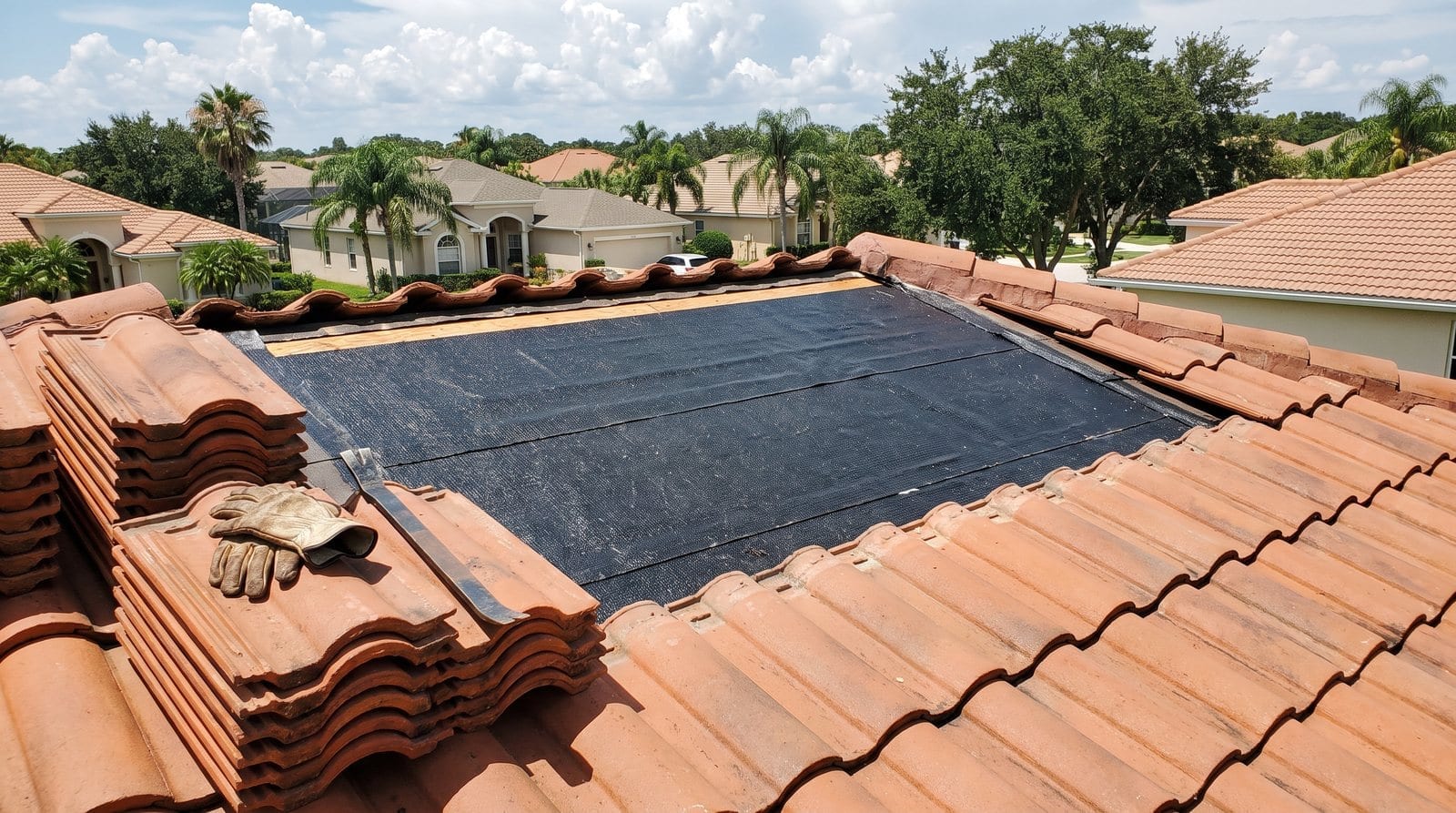
Barrel and flat tile. The tile is armor and shade; the underlayment is what keeps water out. Screw a furring strip through an S-tile or a flat concrete tile and you crack it and the two beside it, and now the underlayment has a dozen new holes on top of the one leak you started with.
On tile we lift or pull the damaged tiles, dry in the underlayment with self-adhering membrane, and stack the tiles back or stage new ones. Slower. Correct. Our tile roofing crews do it on older barrel tile in South Tampa and Palm Harbor all season.
Low slope and flat. On a flat roof over a Clearwater lanai or a St. Petersburg addition, water sits on a tarp, then under it. What works there is a sealed patch bonded to a clean, dry surface, which is a flat roof repair, not a tarp.
Saturated decking. If the decking has been soaking for a week, screws will not hold in it and membrane will not bond to it; tarping a roof leak over soaked decking is tarping a sponge. The fix is to cut out and replace the bad decking and dry in the new sheet, which is day one of the permanent repair.
More than half the roof gone. A 2,000 square foot home carries about 2,400 square feet of roof after pitch, overhangs and waste, and tarping half of that is building a sail. When a storm takes that much, we cover what will hold for days, not weeks, document everything, and move straight to storm and hurricane damage repair or replacement. The tarp is a bridge to the crew, not a plan.
Operation Blue Roof: Free, but Only for Shingle Roofs
After a federally declared storm, FEMA can task the U.S. Army Corps of Engineers with Operation Blue Roof, a free program that installs fiber-reinforced sheeting on damaged roofs as a temporary repair. After Milton in October 2024 it covered Hillsborough, Pasco, Pinellas, Polk, Manatee and Sarasota among other counties, and the sign-up window ran 21 days.
The rules matter, because many people who call us about it do not qualify:
- Primary residences or permanently occupied rentals only, with less than 50 percent structural damage. Vacation rentals are out.
- The roof must be standard shingles. Flat roofs and metal, clay, slate or asbestos tile do not qualify; metal roofs and mobile homes may be looked at case by case.
- Crews remove any tarp you already put up before they install theirs.
When the program is active, sign-up runs through blueroof.gov or 1-888-ROOF-BLU.
Our take: if you qualify, take it. Then call a roofer anyway, because Blue Roof is a temporary cover with the same weeks-not-months clock under it, and your permit and your claim do not file themselves.
If you have barrel tile in Land O’ Lakes, a metal roof in Lutz or a flat roof in St. Petersburg, do not wait on a program that may say no to your roof. Call us and we will dry it in.
Thinking About Tarping It Yourself? Read This First
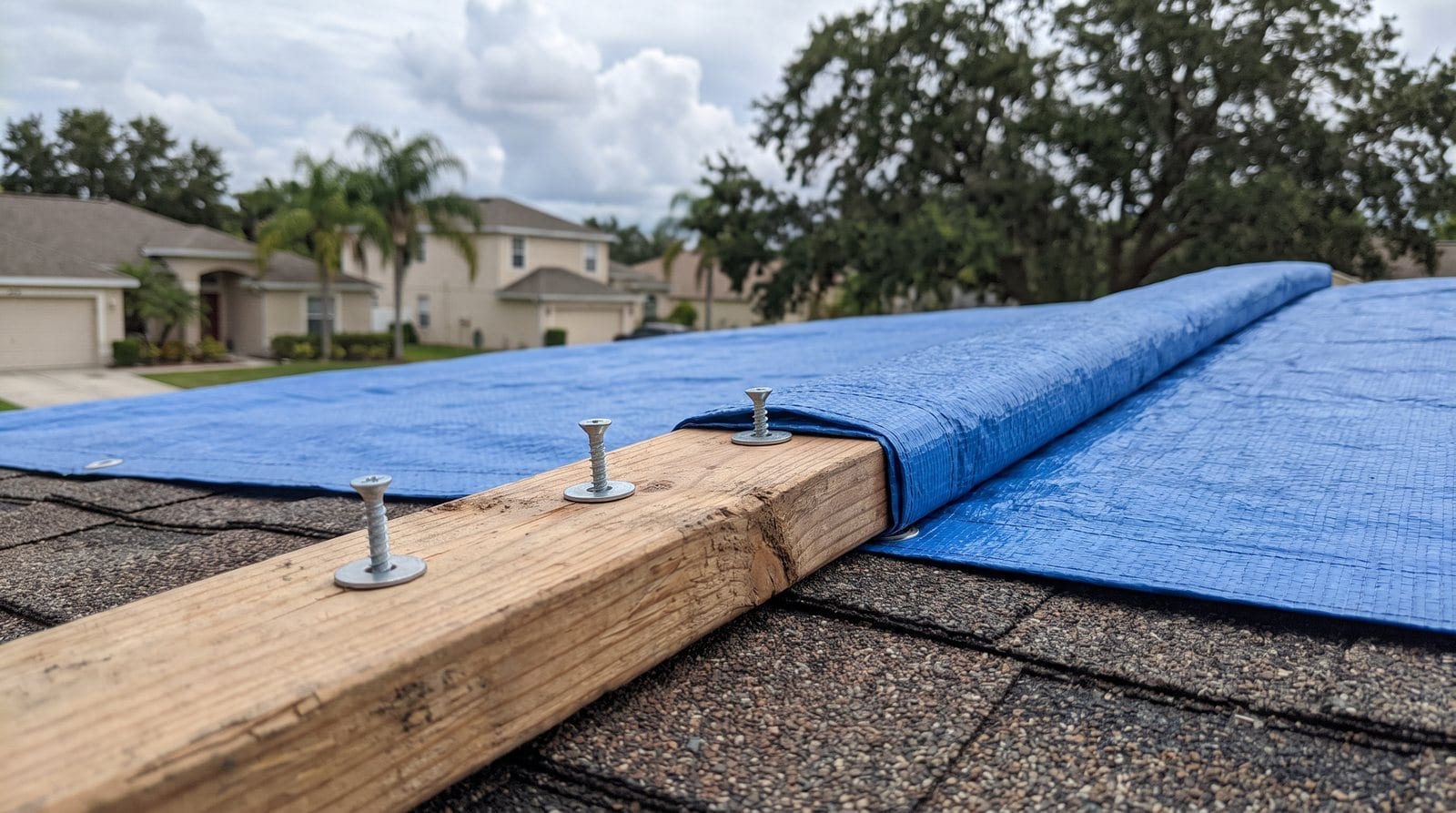
Every storm season we pick up permanent repair jobs from homeowners who now have a roof problem and a knee problem, because they searched how to tarp a roof at 9 pm and went up with a flashlight and a hardware-store tarp.
The rules are not negotiable:
- Not in the rain. A wet shingle roof has the grip of a boat ramp.
- Not in the wind. A 20 by 30 tarp in a gust is a kite with you attached to it.
- Not in the dark. You cannot see the soft spot until you are through it.
- Not alone. Nobody to foot the ladder, nobody to call it in.
- Not with lightning in the sky. Tampa Bay in September has plenty of it.
If it is dry, daylight, calm, you have a helper and a real ladder, and the damage is one small spot on a one-story roof, this is the method:
- Run the tarp past the damage and over the ridge. The top edge has to land on the far slope so water cannot get behind it. If the tarp will not clear the ridge, it is the wrong tarp.
- Roll the uphill edge around a 2x4 and screw the board, not the poly, on the far side of the ridge. The wood spreads the load; a screw through bare poly tears out in the first gust.
- Work downhill. Pull the tarp smooth down the slope so it lies flat over the damage with no folds to catch wind or hold water.
- Strip the bottom edge below the damage. Second board, same wrap, screwed down below the lowest point of the damage so runoff sheds onto sound shingles instead of under the tarp.
- Never fasten through the field of the tarp. Every screw through the middle is a new leak, and it is the first thing we undo when we get there.
That is the most you should attempt. Stay off the tarp itself, do not cut it around a vent, and do not caulk it.
And honestly, do not do it at all. Our tarp costs $0 to $350, often free when we do the repair, which is cheaper than the emergency room. Call us instead at (813) 388-9190, or read the emergency roof repair in Tampa page first to see what the visit looks like.
If the roof is wet, dark, or moving, the answer is no. Call us instead.
What to Do in the Next Hour
Tonight, in this order:
- Cut power at the breaker for the wet room. Water in a ceiling fixture or an outlet is the one part of this that can hurt you before morning.
- Bucket under the drip, then punch the ceiling bulge over the bucket. A screwdriver through the lowest point of the sag drains it in a controlled stream instead of letting the drywall come down on its own.
- Move the car out from under any limbs, and valuables out of the drop zone.
- Take timestamped photos of everything: the ceiling, the attic if you can reach it safely, the roof from the ground. Text them to (813) 388-9190 so the crew can triage before we open.
- Call your carrier for a claim number, then call us.
“When we open” means Monday to Friday, 9 am to 7 pm, and Saturday, 9 am to 2 pm. If it is 11 pm on a Tuesday, your photos are in the queue and you are first in line at 9. Same on a Sunday, for Monday morning.
The inside-the-house steps are spelled out in our emergency roof leak repair guide, and if the storm hit the whole neighborhood, our storm damage roof repair guide for Tampa walks through the next two weeks. Know the bands before anyone quotes you: tarp $0 to $350, small repair $300 to $800, and the full breakdown by leak type in our guide to roof leak repair cost in Tampa Bay.
If you typed “emergency roof tarping near me” and landed here, you found a licensed Tampa Bay crew that answers the phone. Integrity Roofing of Florida has tarped enough roofs from Brandon to Palm Harbor to know the tarp is the easy part. The part that matters is who comes back.
Get it dried in, then fixed right
Emergency tarp or membrane dry-in, full photo documentation for your claim, and a written estimate for the permanent repair. Florida license CCC1334243, TAMKO Pro Gold and GAF-certified, BBB A+.
Frequently Asked Questions
How much does emergency roof tarping cost in Tampa Bay?+
Our crews charge $0 to $350 for an emergency tarp or dry-in, and it is often free when we do the permanent repair afterward. The number moves with the size of the damaged area, the pitch, and how much debris has to come off first. Anyone quoting far above that for a poly tarp after a storm is pricing the panic, not the work.
Does homeowners insurance cover emergency roof tarping in Florida?+
When the storm damage itself is a covered loss, the tarp invoice is typically part of the claim, because almost every Florida policy requires you to protect the property from further damage after a loss. Keep the invoice and take photos before and after the tarp goes on. We cannot promise what your carrier will pay; we can make sure the damage and the emergency work are fully documented.
How long can an emergency tarp stay on a roof in Florida?+
Weeks, not months. Florida sun breaks down poly tarps, wind works the fasteners loose, and afternoon rain pools in the low spots and finds its way under the edges. Every tarp we install is meant to hold until the permanent repair is permitted and scheduled, not to get a roof through a whole hurricane season. If a tarp has been on since last year, the roof under it is getting worse.
Can a tile roof be tarped after a storm?+
Not the way most people picture it. Screwing furring strips through barrel or flat tile cracks the tile and turns one leak into a dozen. On tile we lift or remove the damaged tiles, dry in the underlayment with a self-adhering membrane, and set the tiles back or stage new ones. It takes longer than a tarp and it is the only version that actually keeps the water out.
Is Operation Blue Roof available in Tampa Bay?+
Only after a federally declared storm, and only when FEMA activates it. After Hurricane Milton in 2024 the Army Corps of Engineers ran it across Hillsborough, Pinellas, Pasco, Polk, Manatee and Sarasota counties. It is free, but it covers primary residences with less than 50 percent structural damage and standard shingle roofs only. Flat roofs and metal, clay, slate or asbestos tile do not qualify, metal is sometimes reviewed case by case, and crews remove any tarp you already put up.
Should I tarp my roof myself before the roofer arrives?+
If the roof is wet, it is dark, the wind is still blowing, or you would be up there alone, no. Contain the water inside, photograph everything, and call a licensed roofer. A fall off a wet shingle roof costs more than any tarp. If it is dry, daylight, calm, and you have a helper and a real ladder, a tarp laid over the ridge and weighted at the edges is the most you should attempt.
What if my insurer will not pay for the emergency tarp?+
The Florida Department of Financial Services runs a property insurance mediation program. Either you or the insurer can request it, the insurer pays the entire $350 mediation cost unless you fail to show, and the dispute has to be $500 or more after your deductible. You can also hire a licensed public adjuster or an attorney. We are not either of those; we supply the photos, measurements and itemized estimate the process runs on.
Want a real estimate on your Tampa Bay roof?
Enter your address and we'll pull satellite measurements instantly.
Mike Shepherd · Co-Owner, Integrity Roofing of Florida
Mike Shepherd co-owns Integrity Roofing of Florida with Bettina Savorelli. The company is a Florida-licensed roofing contractor (license CCC1334243), a TAMKO Pro Gold and GAF-certified installer, and a BBB A+ rated business serving Hillsborough, Pinellas, Pasco, Polk, Manatee and Sarasota counties. His crews install and repair tile, metal and shingle roofs across Tampa Bay and document storm damage for homeowners' insurance claims. Every article is written from the field, not from a content desk.
Ready to talk to a real human?
No phone tree, no pressure. Owner-level attention on every call.