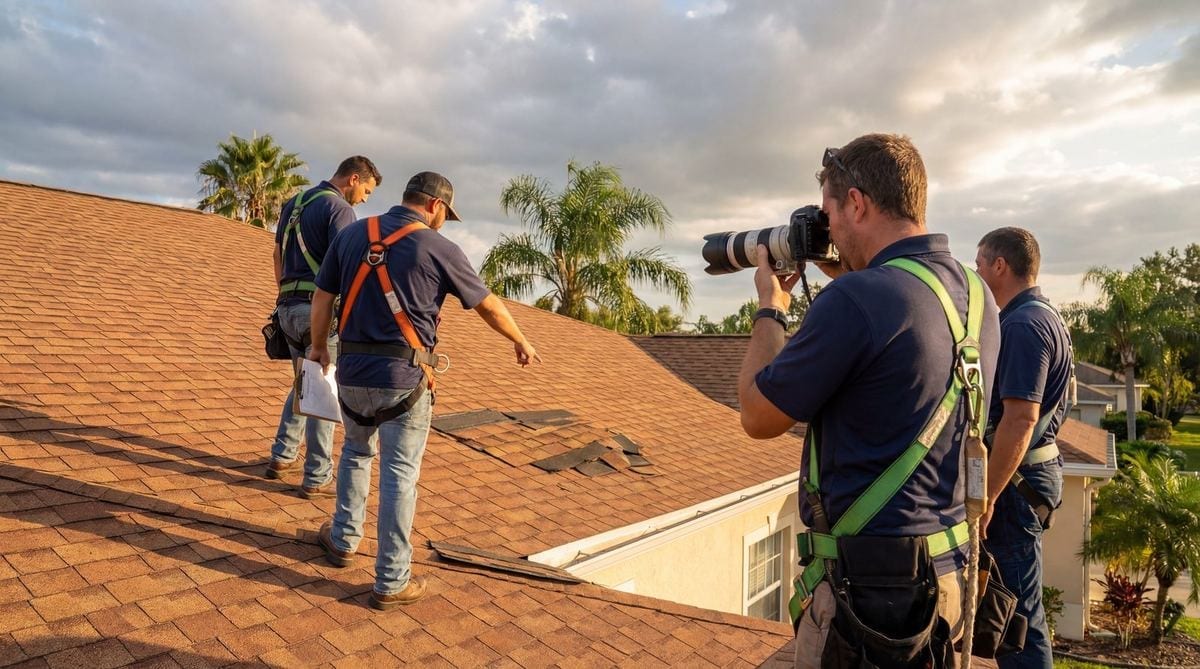
Storm & Hurricane Damage Roof Repair: The Tampa Homeowner's Guide
What to do in the first 48 hours after a hurricane, thunderstorm, or wind event damages your Tampa Bay roof. Plus the documentation mistakes that get 40% of Florida storm claims denied.
- Document roof damage within the first 24 to 48 hours. Late reporting is the #1 reason Florida storm claims get denied.
- Tarp within 48 hours using heavy-gauge poly and 2x4 anchoring. never let a roofer do a permanent repair before your adjuster inspects.
- A licensed storm-restoration roofer writing an Xactimate-aligned scope is the difference between a paid claim and an out-of-pocket repair.
- Having your roofer meet the insurance adjuster on-site changes claim outcomes more than any other single step.
If you live in Tampa Bay long enough, a storm will eventually find your roof. It might be a summer squall pushing 70 mph gusts through Carrollwood. It might be the outer bands of a named system tracking up the Gulf Coast. It might be a single rogue hailstorm over Brandon that lasts four minutes and costs you a roof. What you do in the first 24 to 48 hours after that storm determines whether your repair gets paid for by insurance. Or whether you pay out of pocket for a mistake you didn’t know you were making.
This guide walks through the homeowner checklist Florida roofing professionals wish every client had before the phone call: how to stay safe, how to document damage the way insurance adjusters expect, when to tarp, when to wait, and how to avoid the most common reasons Florida storm claims get denied. We’ll end with Tampa-specific advice for the contractor you eventually hire.
The First 24 Hours After Florida Storm Damage
The moment the wind drops below 40 mph and it’s safe to walk outside, a clock starts ticking on your insurance policy. Most Florida homeowner policies require “prompt notice” of damage, and the Florida Department of Financial Services recommends reporting within days, not weeks. The longer you wait, the easier it becomes for a carrier to argue that “subsequent weather events” or “deferred maintenance” caused the damage. Not the storm you’re claiming against.
Here is what the first day should look like, in order:
| Hour | Action | Why It Matters |
|---|---|---|
| 0–2 | Confirm the household is safe. Check for downed power lines before stepping outside. | Power lines cause most post-storm injuries. Call 911 before approaching any fallen line. |
| 2–4 | Walk the perimeter of your home from the ground. Do not climb a ladder. | Wet shingles, tile, and metal panels are extraordinarily slick. Fall injuries spike after storms. |
| 4–6 | Photograph everything. Exterior walls, roof edges visible from the ground, yard debris, fence lines, soffits, gutters. | These timestamped photos become your baseline evidence. |
| 6–12 | Check the attic with a flashlight. Look for wet insulation, daylight, or water stains on decking. | Most interior leaks start here. Early attic checks catch leaks before drywall is ruined. |
| 12–24 | Call your insurance carrier and open a claim number. Do not commit to a contractor yet. | Opening a claim preserves your rights. Signing with a contractor before the adjuster arrives often creates problems later. |
| 24–48 | Schedule a licensed roofer’s free inspection. Meet them on-site if possible. | An independent set of eyes catches damage adjusters routinely miss. |
The Federal Emergency Management Agency publishes a clear post-disaster checklist that mirrors this timeline. Save their page. You’ll use it more than once in Florida.
is the critical documentation window FEMA recommends for post-disaster loss reporting. Missing it is one of the most common reasons Florida storm claims get reduced or denied.
Source: Federal Emergency Management AgencyHow to Safely Document Roof Damage Yourself
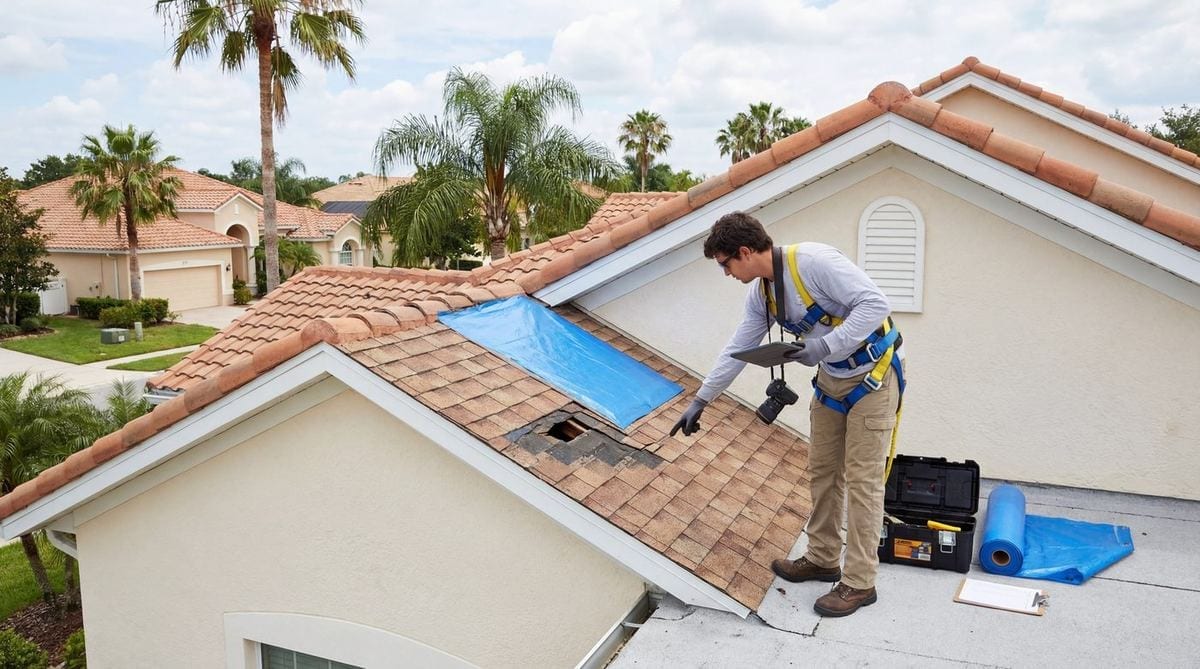
Stay on the ground. That’s the one non-negotiable. More Floridians are hurt by post-storm ladder falls than by the storm itself, according to injury data summarized by the Insurance Institute for Business & Home Safety. A smartphone camera with a decent zoom. Or a cheap pair of binoculars. Will show you everything an adjuster needs to see without risking your neck.
When you photograph, follow these rules:
- Timestamp everything. Most phones embed this automatically, but confirm it’s enabled in your camera settings.
- Shoot wide, then tight. Every close-up shot of a missing shingle should have a companion wide shot showing the section of roof it came from.
- Capture all four elevations. North, south, east, west. Even if only one side looks hit.
- Document surrounding debris. Broken branches, fence damage, and neighbor property help establish storm intensity and direction.
- Photograph the attic from inside. Stains on the underside of decking, wet insulation, and daylight through vents all matter.
- Save your pre-storm photos if you have them. Drone footage, real-estate listing photos, or even old cell-phone shots of the house establish the “before” condition.
The National Weather Service provides archived radar and wind-gust data for every named event and most severe thunderstorms. Pull the report for your ZIP code and the exact date of damage. Attach it to your claim. Adjusters take storm documentation far more seriously when it’s corroborated by federal weather data.
Types of Storm Damage Florida Roofs Experience
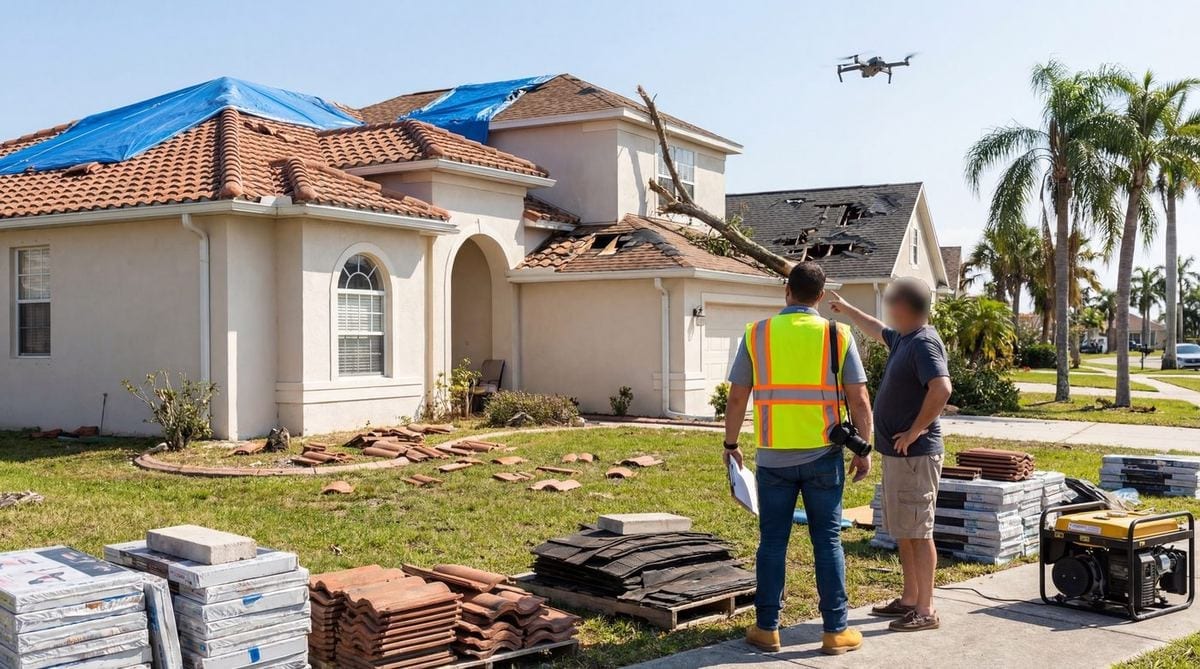
Tampa Bay roofs don’t fail the same way roofs in Ohio or Colorado fail. The damage pattern here is shaped by three forces: sustained high wind, wind-driven rain, and debris impact. Each leaves a different signature.
Wind damage is the most common and the most misunderstood. Shingles don’t always fly off in a hurricane. They often lift and reseal in a slightly rotated position, breaking the factory adhesive strip underneath. From the ground the roof looks fine. In the next storm, those shingles peel off in sheets. The Insurance Institute for Business & Home Safety has published wind-tunnel research showing this “creased shingle” failure mode is responsible for a significant share of secondary storm claims.
Wind-driven rain intrusion happens when sustained gusts force water sideways, past normal flashing and underlayment. This is the leak that appears three days after the storm passes, often at a valley, skylight, or wall-to-roof transition.
Impact damage from hail, tree limbs, and airborne debris is the most visually dramatic. In tile roofs, impact often cracks the tile without displacing it. Meaning the damage is invisible until the next rain soaks the underlayment beneath.
Soffit and fascia damage is often the first sign that wind got under the roof assembly. If you see bent soffit panels or missing fascia, assume the roof deck has been tested and needs inspection.
Gutter and drip-edge damage tells a similar story. Bent gutters and kinked drip edges change how water leaves the roof, which creates leaks months later during routine afternoon thunderstorms.
One important note on hurricane history: the National Hurricane Center publishes detailed post-storm reports for events like Hurricane Ian (2022) and Hurricane Idalia (2023). Ian alone produced more than $112 billion in damage, much of it in Florida, and its wind field extended well inland from the landfall point. Idalia, though a smaller system, produced a significant storm surge along Florida’s Big Bend and caused wind damage as far south as Pinellas County. Both events generated a wave of late-filed claims. Many of which were denied precisely because homeowners waited to document.
in damage from Hurricane Ian alone (2022). With a wind field that extended well inland, triggering a wave of late-filed Florida claims that carriers denied for documentation gaps.
Source: National Hurricane CenterWhy Most Florida Storm Claims Get Denied. And How to Avoid It
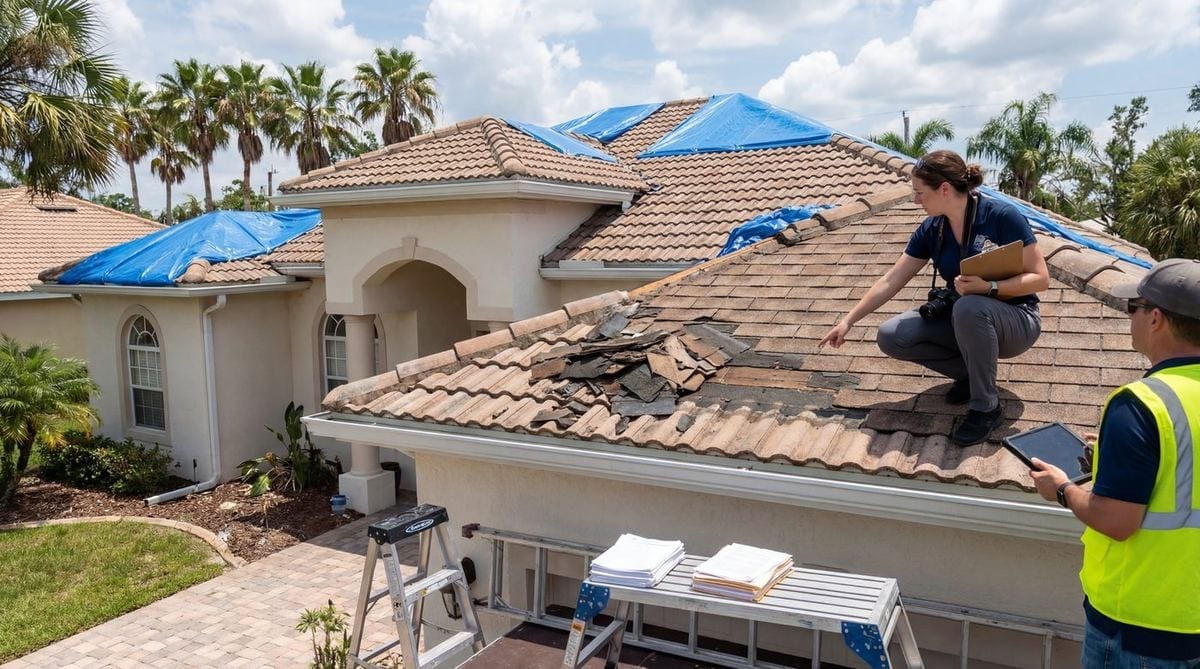
We’ve seen hundreds of Tampa Bay storm claims, and the denial reasons cluster around the same handful of mistakes. The carrier almost never says “your roof wasn’t damaged.” Instead, the denial letter cites something more technical. Something the homeowner could have prevented with better first-48-hours behavior.
Here are the denial reasons we see most often, and the fix for each:
| Denial Reason | What It Actually Means | How to Avoid It |
|---|---|---|
| ”Damage is cosmetic, not functional” | Carrier argues the damage doesn’t affect the roof’s ability to shed water. | Document interior leaks, attic moisture, and wet insulation. Cosmetic claims become functional claims when interior damage is shown. |
| ”Pre-existing wear and tear” | Carrier argues the roof was already failing before the storm. | Submit pre-storm photos if available. A roofer’s inspection report showing storm-specific damage patterns also counters this. |
| ”Late reporting” | Claim filed more than 30–60 days after the event. | Report within days, even if you don’t yet have a contractor. You can add documentation later. |
| ”Improper mitigation” | Homeowner didn’t tarp or dry out the interior promptly, and additional damage occurred. | Tarp within 48 hours or hire a licensed roofer to do it. Save receipts. Mitigation is usually reimbursable. |
| ”Excluded cause” | Carrier argues the damage came from flood, surge, or a non-covered peril. | Get a professional cause-of-loss report. Wind and wind-driven rain are usually covered under standard HO3 policies. |
| ”Insufficient documentation” | Not enough photos, no weather report, no written estimate. | Over-document. 100+ photos is normal. Pull NOAA data. Get a written scope from a licensed roofer. |
The Florida Office of Insurance Regulation publishes annual data on claims and denials, and the pattern is consistent: well-documented claims filed promptly are paid at dramatically higher rates than late or sparsely documented claims. Your first 48 hours of behavior is the single largest variable in whether your claim is approved.
of Florida homeowner roof claims are initially denied or severely reduced. The majority for documentation gaps, late reporting, or 'pre-existing wear' arguments that proper first-48-hours behavior would have prevented.
Source: Florida Office of Insurance RegulationOne nuance worth understanding: Florida homeowners have specific rights under state insurance law, including the right to hire their own licensed contractor for the repair. A carrier can recommend a contractor, but they cannot require one. If you feel pressured into using a “preferred vendor,” you are not obligated to accept.
- Photos taken from ground level missing key angles
- Scope written as 'some damage'. Claim gets lowballed
- Adjuster visits with no roofer present to document the damage
- 40%+ chance of denial or severely reduced payout
- Average settlement 50-70% below actual cost to repair
- Drone + on-roof photos documenting every vulnerable point
- Detailed scope with Florida Building Code references
- Contractor meets adjuster on site to walk damage
- Well-documented damage is far harder for a carrier to dismiss
- A clear, code-referenced scope your adjuster can act on
The Emergency Tarp Window: What Actually Works
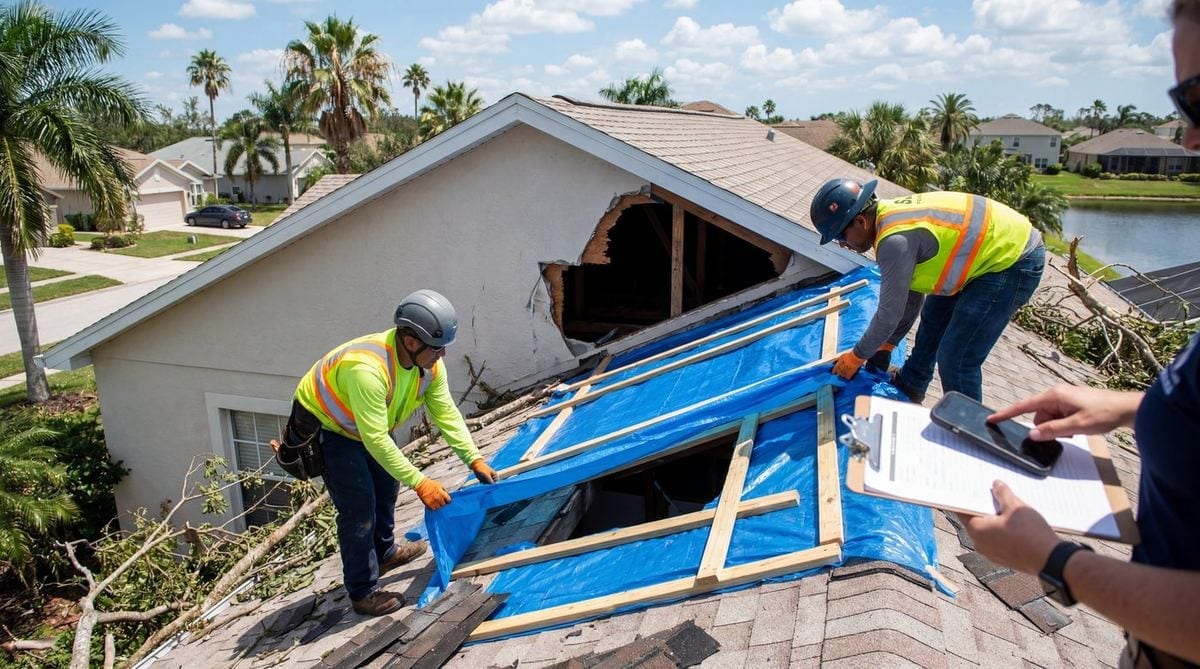
Tarping is about stopping further damage, not about fixing anything permanently. Get it wrong and you’ve voided the mitigation clause of your policy. Get it right and you’ve just protected tens of thousands of dollars in interior finishes.
A proper emergency tarp:
- Is made of heavy-gauge polyethylene, not a dollar-store picnic tarp.
- Covers the damaged area plus at least three feet of extension onto undamaged roof in every direction.
- Is anchored with 2x4 lumber sandwiching the tarp edges. Never stapled or nailed directly through the tarp into shingles.
- Is installed parallel to the slope so water sheds off, never uphill.
- Lasts 30 to 90 days maximum. Florida UV destroys tarps fast.
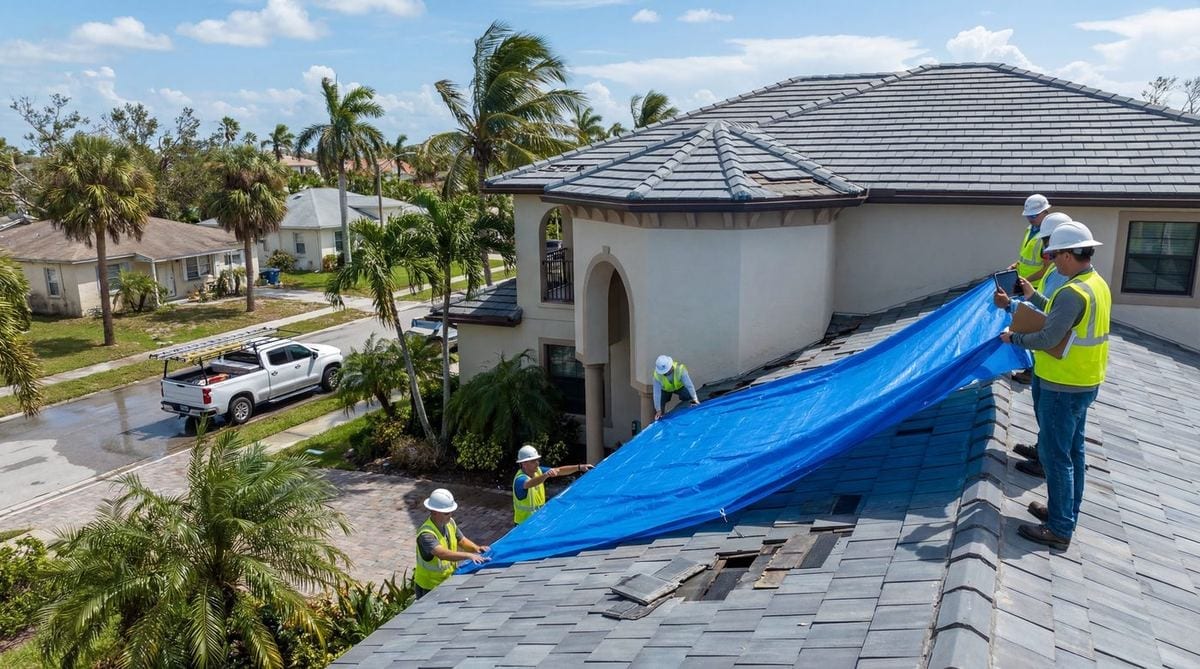
If you can’t do this safely from the ground, hire a licensed roofer to tarp. Most Tampa Bay roofing companies offer emergency roof repair in Tampa and tarp service within 24 to 48 hours of a major event, and the cost is typically recoverable under your policy’s “reasonable mitigation expenses” clause. Save every receipt. Photograph the tarp after installation. Both items go into your claim file.
Do not let a roofer install a permanent repair before your insurance adjuster has inspected. Once the evidence is gone, the claim gets harder to prove. A tarp preserves the evidence. A new roof erases it. After the adjuster signs off, that’s when our emergency roof repair crew steps in to make the permanent fix.
Hiring a Storm Restoration Roofer vs. a General Contractor
This is where homeowners lose the most money. A general contractor or handyman may quote a lower number on the repair itself, but they typically don’t know how to write a scope of work that matches insurance estimating software (Xactimate). The result: a scope the carrier underpays, a homeowner stuck with the difference, and a repair that may not pass a future sale inspection. This is exactly why storm and hurricane damage roof repair is its own specialty, separate from general contracting.
A specialist storm restoration roofer. The category, not any one company. Typically offers:
- Xactimate-aligned scopes of work that match what adjusters use.
- Knowledge of Florida Building Code requirements that trigger during replacement (the 25% rule, for example, requires full replacement if more than 25% of a roof is damaged within 12 months).
- Field experience identifying wind-creased shingles, hail bruising on tile, and wind-driven rain intrusion. The three damage types adjusters miss most.
- Licensing verified through the Florida Department of Business and Professional Regulation, which is legally required for any roofing work on a permanent structure in Florida.
- Familiarity with the claims process, including the documentation standards set by organizations like the National Roofing Contractors Association.
Verify any contractor’s state license number before signing anything. Florida has a serious problem with unlicensed “storm chasers” who appear after every named event, collect deposits, and disappear. A licensed, insured, locally based contractor will never pressure you to sign before your adjuster’s visit and will never ask for a large cash deposit up front.
Got storm damage? Document it before you file.
Free on-site inspection. We document everything and can meet your adjuster, so you have exactly what your insurer asks for.
Tampa Bay Hurricane Season Preparation Checklist
Hurricane season in Florida runs June 1 through November 30, with peak activity in August and September. Tampa Bay’s geography. A shallow bay funneling storm surge, dense tree canopy in older neighborhoods like South Tampa and Seminole Heights, and tile-roof prevalence in newer subdivisions. Creates a specific preparation list every homeowner in the region should work through before June:
- Schedule a pre-season roof inspection. A licensed roofer can identify loose tiles, aging shingles, and compromised flashing before wind finds them.
- Trim trees at least six feet back from the roofline. Broken limbs are the single most common cause of impact damage in Tampa Bay.
- Clean gutters and downspouts. Clogged drainage forces water backward into the roof assembly during wind-driven rain events.
- Photograph your entire roof, all four elevations, and the attic. Store the photos in cloud storage with a clear date.
- Review your insurance policy. Confirm wind and wind-driven rain coverage, your hurricane deductible (usually separate and percentage-based), and your claims contact number. Save it in your phone.
- Write down your roofer’s emergency phone number. If a storm hits on a Saturday night, you want a local number, not a national call center.
How Our Team Handles Tampa Storm Claims
At Integrity Roofing of Florida, we built our storm response process around the hard lessons our neighbors learned after Ian and Idalia. When a Tampa Bay homeowner calls us after a storm, here’s what actually happens:
Within 24 to 48 hours, a licensed Integrity Roofing inspector walks the roof personally. Never a subcontractor, never a commission-only salesperson. We photograph every slope, document every point of damage, and write up a plain-English inspection report you can hand to your insurance adjuster.
Before any repair begins, we meet your adjuster on-site. This one step changes claim outcomes more than any other. When the adjuster and the roofer walk the roof together, points of damage don’t get missed and scope disagreements get resolved before they become denials.
During the repair, every material we use on a Tampa Bay roof is chosen for Florida conditions specifically. High-wind-rated shingles, stainless fasteners where salt air is a factor, and Florida-Product-Approved underlayment. No shortcuts, no “it’s what the insurance paid for” compromises.
After the repair, you get a manufacturer warranty on materials and a workmanship warranty from us. Both are in writing. Both transfer with the home if you sell.
We’re licensed, insured, and based in Tampa Bay. Not a seasonal out-of-state crew. When the next storm comes through, the same team that installed your roof is the team that answers your emergency call.
Get Your Roof Inspected After the Storm
If a storm has passed over your home in the last 30 days. Whether it was a named hurricane, a Gulf squall line, or an afternoon thunderstorm that dropped hail in your yard. Get the roof inspected. A free 30-minute inspection today is the difference between a covered roof repair and an expensive surprise six months from now.
Integrity Roofing of Florida offers free, no-pressure storm damage inspections across Tampa, St. Petersburg, Clearwater, Brandon, Wesley Chapel, and the surrounding Tampa Bay region. We’ll walk your roof, document what we find, and tell you honestly whether you have a claim worth filing. Or whether the roof is sound and you don’t need us yet.
Call our Tampa office, or request an inspection online. If the storm was bad enough that your neighbors are already filing claims, don’t be the house that waits three weeks and gets denied.
Your roof is the most important system on your home. After a Florida storm, it deserves a professional set of eyes. Before the next one arrives.
The storm already hit. Don't let the claim be the second disaster.
A free 30-minute inspection from a licensed Tampa Bay roofer. Honest findings, full photo documentation, and a claim-ready report. We only recommend work you actually need.
Want a real estimate on your Tampa Bay roof?
Enter your address and we'll pull satellite measurements instantly.
The Integrity Roofing Team · Florida Roofing Experts · Licensed & Insured
The Integrity Roofing of Florida team installs and repairs tile, metal, and shingle roofs across Tampa Bay. With decades of combined field experience, we've helped more than a thousand homeowners navigate hurricane-damage claims, material choices, and the gap between what's marketed and what actually holds up in Florida conditions. Every post is written by working Florida roofers. Not content writers.
Ready to talk to a real human?
No phone tree, no pressure. Owner-level attention on every call.