Hurricane-Rated Roofing for Florida Homes: 2026 Requirements & Options
A working roofer's guide to hurricane-rated roofing in Florida. Code requirements by county, material options, wind ratings, and the real-world performance we see after Tampa Bay storms.
- Florida Building Code requires minimum 130 MPH wind ratings on residential roofing assemblies statewide, with coastal zones requiring 150-180+ MPH.
- Hurricane ratings cover the complete assembly, not just the primary material. Underlayment, fasteners, flashings, and ridge caps all factor in.
- Standing seam metal easily exceeds 180 MPH ratings. Impact-rated Class 4 shingle reaches 150 MPH. Properly-fastened modern tile exceeds 150 MPH.
- Hurricane-rated upgrades typically qualify for 10-25% Florida insurance premium reductions through wind-mitigation documentation.
Every Florida residential roof must be hurricane-rated to some degree. Florida Building Code specifies minimum wind-resistance ratings based on geography, and those requirements have tightened significantly over the last 20 years as hurricane damage data has driven code revisions. For Tampa Bay homeowners, the specific rating your home requires depends on your county, your distance from the coast, and sometimes your specific wind-zone classification within the county.
This article walks through Florida hurricane-rated roofing requirements, the material options that meet them, the real-world performance we have observed in Tampa Bay after recent hurricane events, and how homeowners can verify their roof meets both code and insurance documentation standards.
Florida Building Code Hurricane Wind Zones
Florida divides the state into progressive wind-speed zones based on hurricane risk. Current code requirements:
- Central inland Florida (Polk, inland Pasco): 130 MPH minimum rated assembly
- Tampa Bay metro (inland Hillsborough, inland Pinellas, inland Manatee): 130-140 MPH minimum
- Coastal Tampa Bay (coastal Pinellas, coastal Manatee, Anna Maria Island): 150 MPH minimum
- South Florida HVHZ (High Velocity Hurricane Zone, Miami-Dade and Broward): 150-180 MPH minimum with additional assembly requirements
- Barrier islands and direct-Gulf exposure: 150-180+ MPH
The specific rating requirement for your Tampa Bay home depends on your exact address. Your county permit office determines the code-required rating during the permit review. Our quotes for Tampa Bay replacement work always specify the minimum code rating for your specific address and recommend upgrades when economically justified.
What “Hurricane-Rated” Actually Means
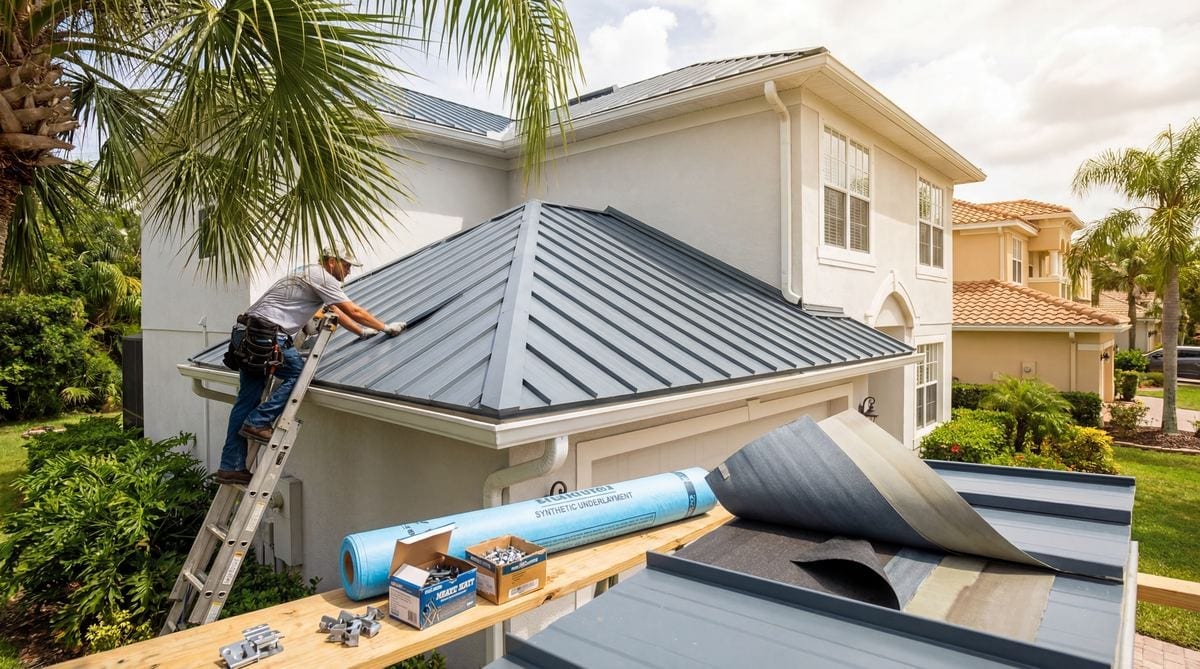
Hurricane rating on residential roofs refers to the complete assembly’s wind resistance, tested under laboratory conditions that simulate hurricane-force wind loads. The ASTM International standards and Florida Building Code specify test methods for roof covering products, underlayment systems, fastening assemblies, and complete roof system ratings.
Key components that determine the final rating:
- Roof covering material (shingle, tile, metal) and manufacturer test ratings
- Fastener specification (nail gauge, nail count per shingle, nail spacing)
- Underlayment type (synthetic, felt, peel-and-stick)
- Flashing installation around all penetrations
- Ridge cap attachment (hand-nailed versus stapled)
- Drip edge and starter strip installation
- Deck attachment (the nails or screws holding the plywood decking to the trusses)
A 150 MPH-rated shingle installed with incorrect fastener count produces an assembly that is not actually 150 MPH-rated. This is why proper installation matters as much as material selection, and why the Florida Department of Business and Professional Regulation requires licensed contractor installation for all Florida residential roofing.
Material Options by Rating
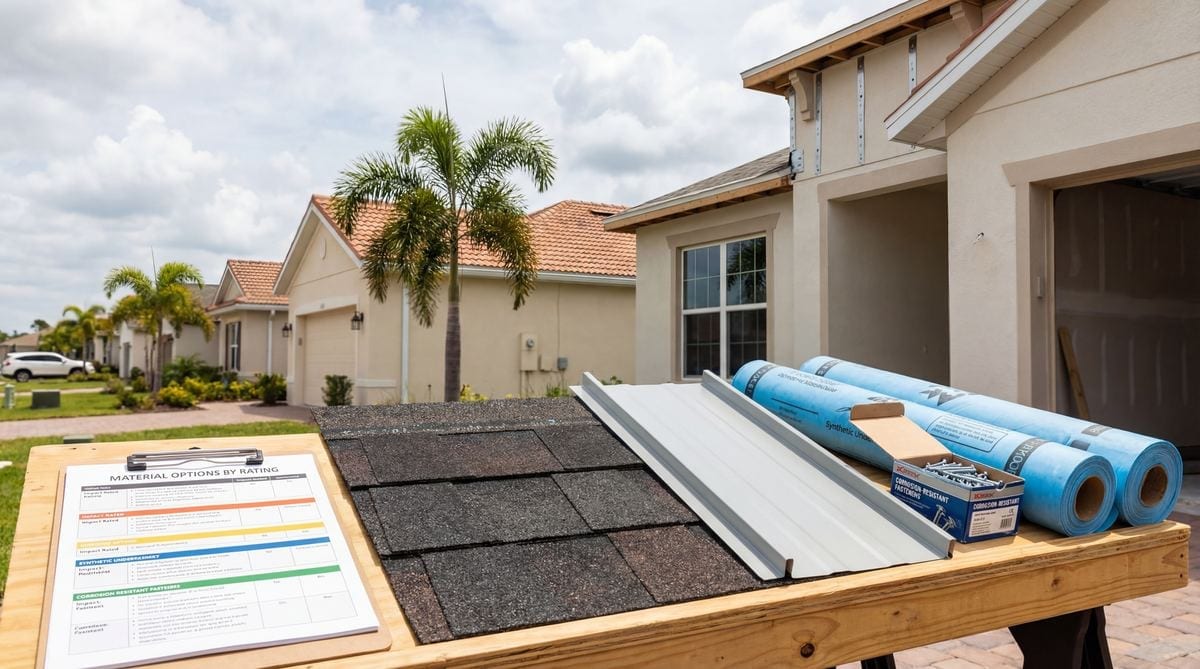
Standard architectural shingle (up to 130 MPH): Meets code in inland Tampa Bay. Baseline material for most mid-market replacements. $5.50-$8.50 per sq ft installed.
Impact-rated Class 4 shingle (up to 150 MPH): Meets coastal code requirements and qualifies for insurance premium reductions. Upgrade from standard architectural adds ~$1.50-$2 per sq ft. $7-$10 per sq ft installed.
Metal shingle (140-160 MPH): Traditional appearance with metal durability. Good fit for HOA-restricted neighborhoods. $8.50-$13 per sq ft installed.
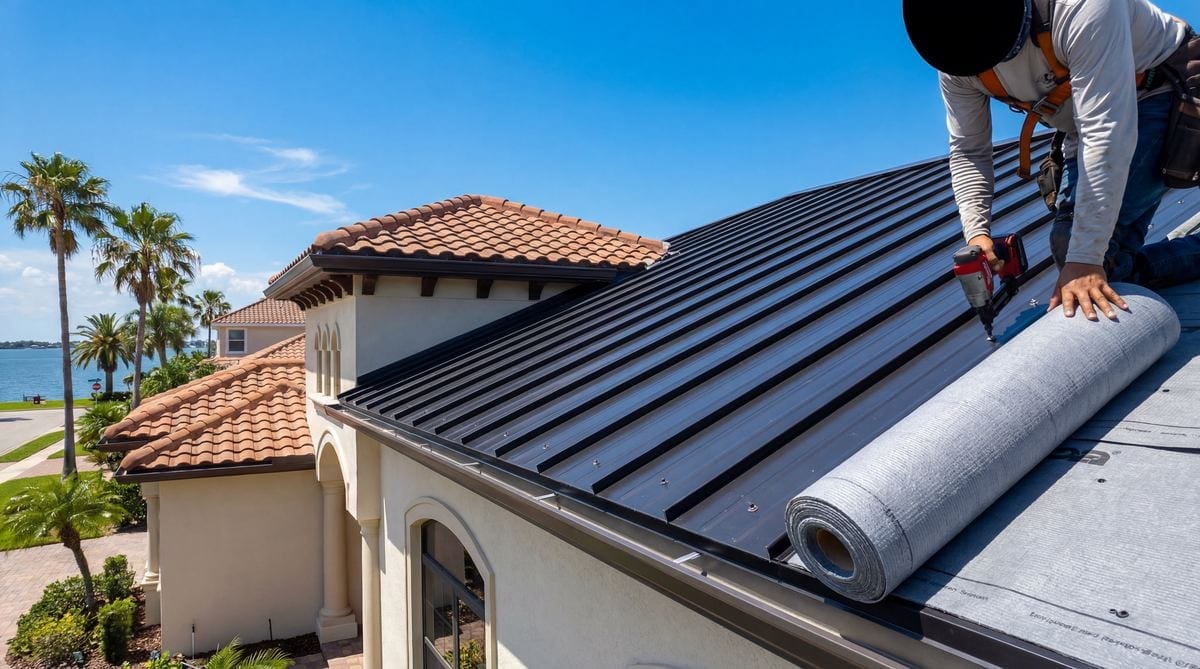
Standing seam metal (160-180+ MPH): Easily exceeds coastal code requirements. Best hurricane performance of any residential material. Our metal roof installation crews fasten standing seam with concealed clips rated well past coastal minimums. $10-$16 per sq ft installed.
Concrete tile with modern fastening (150+ MPH): Foam-set plus mechanical screw fastening delivers code-compliant coastal ratings. Older mortar-bed tile installations typically do not meet current standards and require re-fastening during repair or replacement. $10-$16 per sq ft installed.
Clay tile with modern fastening (150+ MPH): Premium option with 75-100+ year service life. Same fastening considerations as concrete tile. $12-$22 per sq ft installed.
Real-World Performance After Tampa Bay Hurricanes
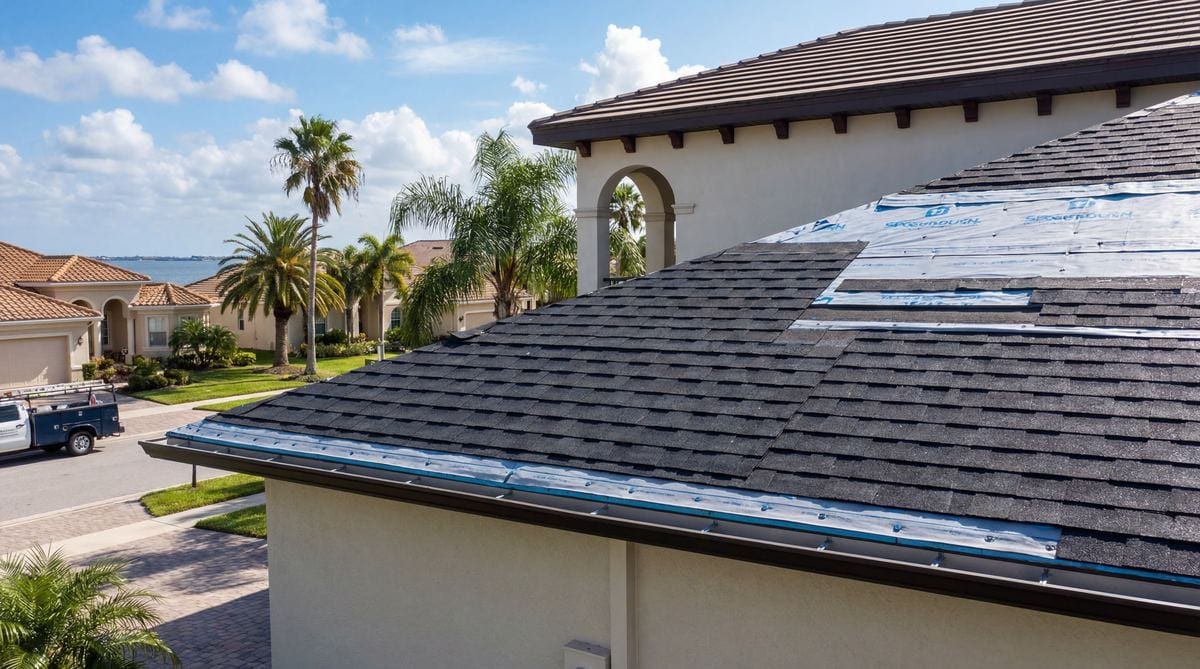
Our post-storm inspection data from Hurricanes Idalia (2023), Helene (2024), and Milton (2024) shows consistent patterns:
Standing seam metal roofs with modern concealed-clip fastening showed minimal damage across all three events. Direct-Gulf exposure on Clearwater Beach, Indian Rocks, and Anna Maria Island standing seam installations produced near-zero claim activity.
Properly-fastened tile roofs with foam-set plus mechanical screw installation performed well. Tile with older mortar-bed fastening (still present on many 1960s-1980s Tampa Bay tile roofs) showed significant tile lifting and required post-storm re-fastening work.
Impact-rated Class 4 shingle showed excellent field performance. Granule loss and isolated shingle damage occurred but full-field failures were rare even in direct-hit neighborhoods.
Standard architectural shingle (130 MPH-rated) performed adequately in inland Tampa Bay but showed significant damage on coastal homes during direct-strike events. The 130 MPH rating is adequate for inland code compliance but marginal for direct coastal exposure.
Older 3-tab shingle (pre-2002 installation, typically 80-110 MPH ratings) failed at high rates across all three storm events. Many of these roofs were past end-of-life anyway, and hurricane-damage claims became the mechanism for long-overdue replacement.
Is your Tampa Bay roof hurricane-rated for your address?
Our free inspection documents your current assembly rating and recommends upgrades for code compliance and insurance premium reductions.
Verifying Your Current Roof’s Rating
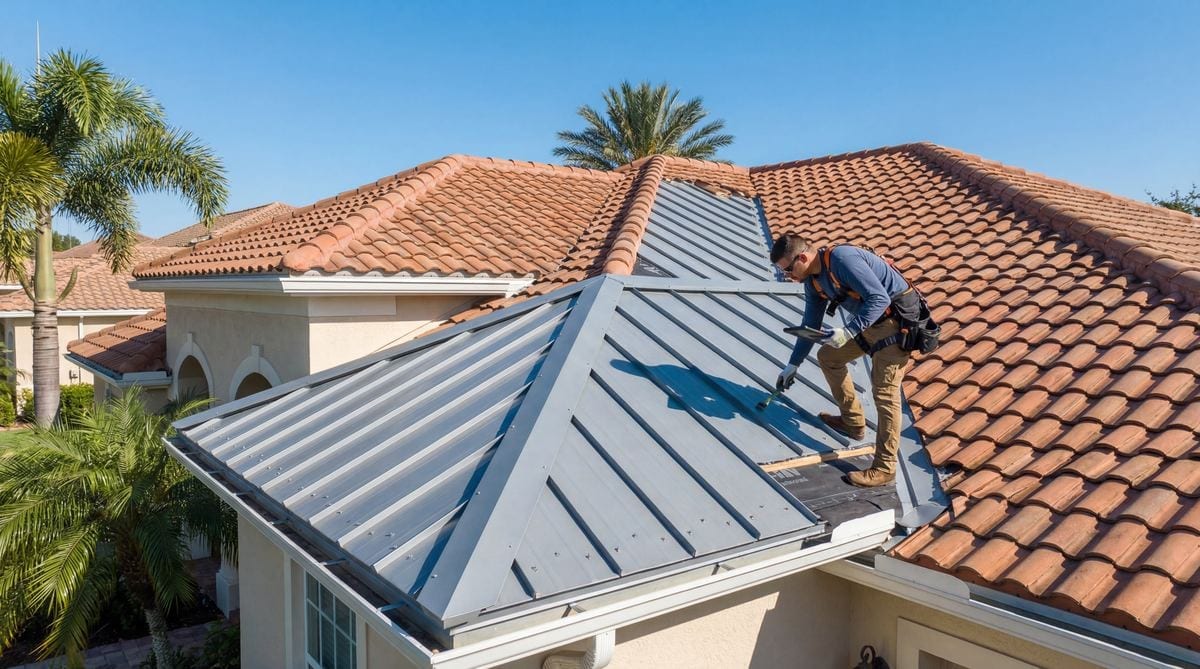
Tampa Bay homeowners unsure of their current roof’s rating should schedule a free wind mitigation inspection. The inspection produces a formal report documenting:
- Current roof age and material
- Assembly rating (primary material, fastening, underlayment, flashings)
- Roof-to-wall connection type (important for structural rating)
- Secondary water barrier presence
- Opening protection status (shutters, impact-rated windows)
The resulting report provides both code-compliance verification and insurance documentation for wind-mitigation premium reductions. Most Tampa Bay homeowners with pre-2002 roofs or mid-2000s production-grade installations discover their current assembly rating is below what current code requires and below what insurance carriers reward with maximum premium reductions.
Insurance Premium Implications
Florida wind-mitigation premium reductions are tied directly to documented roof ratings. Typical Tampa Bay savings on a $3,000 annual homeowner policy where roughly half is windstorm coverage:
- Roof covering upgrade (130 MPH to 150+ MPH): $200-$500 annual savings
- Roof deck attachment credit: $100-$300 annual savings
- Secondary water resistance credit: $100-$400 annual savings
- Roof-to-wall connection credit: $50-$300 annual savings
- Opening protection credit (shutters or impact windows): $150-$500 annual savings
Combined credits on a fully-upgraded Tampa Bay home typically total $600-$2,000 in annual premium reduction versus an unupgraded equivalent. Over 20-30 years, those savings are substantial.
Upgrade Priority for Tampa Bay Homeowners
If you are planning a roof replacement and budget allows, the upgrade priority in hurricane-rated assembly components:
- Synthetic underlayment (upgrade from felt). Minimal cost upgrade, major durability improvement.
- Enhanced fastener schedule (more nails per shingle, closer spacing). Modest cost, significant performance improvement.
- Impact-rated roof covering (Class 4 shingle or standing seam metal). Meaningful upfront cost, substantial insurance and performance benefits.
- Ridge cap hand-nailing (instead of stapling). Small install cost difference, significant wind-uplift improvement.
- Roof-to-wall connector upgrades (hurricane clips) if applicable to your home. Specific-scope additional cost.
Our Tampa Bay roof replacement quotes default to modern synthetic underlayment and enhanced fastener schedules as standard. Material and connector upgrades are presented as options with specific cost-benefit analysis for your situation.
Ready to verify your Tampa Bay roof’s hurricane rating or plan a rated upgrade? Schedule a free inspection for an assembly-rating assessment, or start with our roof cost calculator for upgrade pricing.
Want a real estimate on your Tampa Bay roof?
Enter your address and we'll pull satellite measurements instantly.
The Integrity Roofing Team · Florida Roofing Experts. Licensed & Insured
The Integrity Roofing of Florida team installs and repairs tile, metal, and shingle roofs across Tampa Bay. With decades of combined field experience, we've helped more than a thousand homeowners navigate hurricane-damage claims, material choices, and the gap between what's marketed and what actually holds up in Florida conditions. Every post is written by working Florida roofers. Not content writers.
Ready to talk to a real human?
No phone tree, no pressure. Owner-level attention on every call.